
How a Small Bhubaneswar Store Beat Big Brands in 2026 Using AI‑First Marketing
The problem: good products, zero visibility

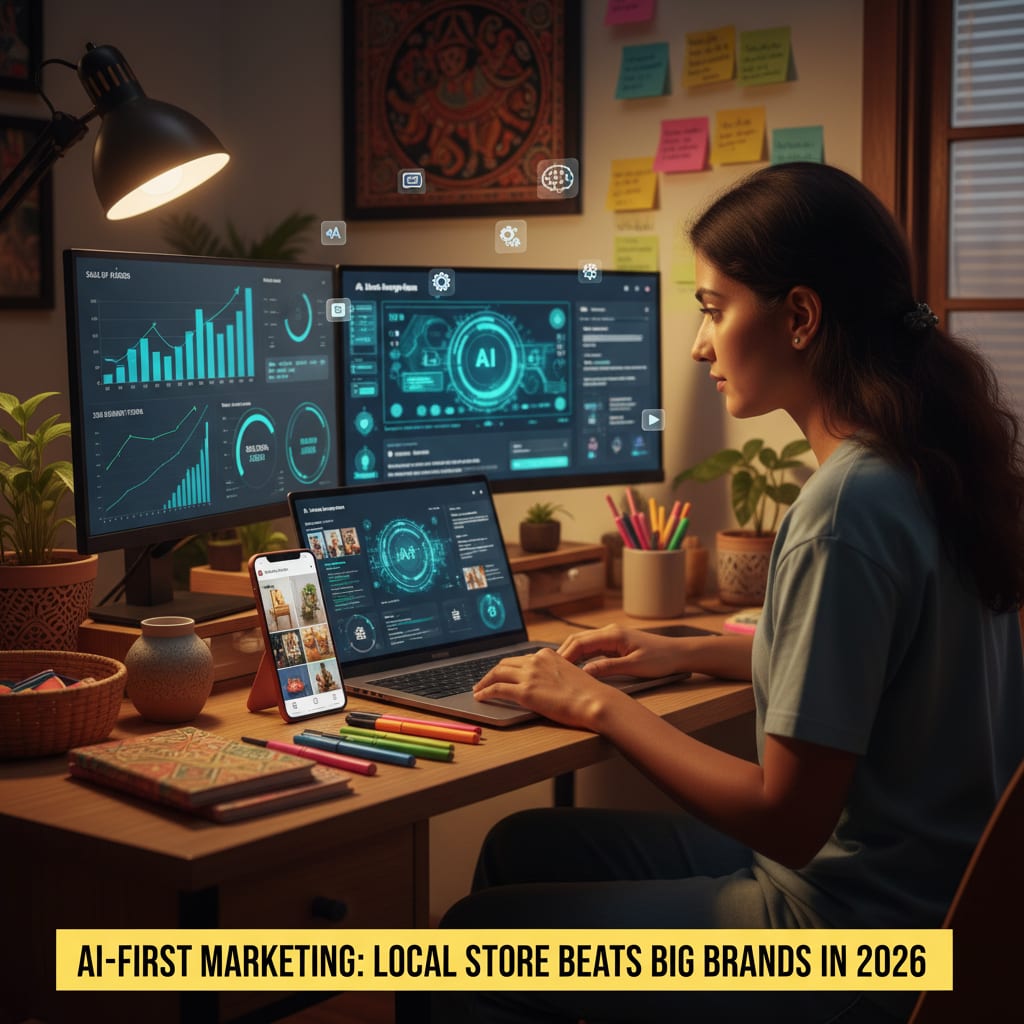
In 2026, Indian small businesses are under pressure: customers discover brands through Instagram Reels, YouTube Shorts, and Google “near me” searches, not just by walking past a shop board anymore.
At the same time, AI tools have made it possible for even a 3‑person e‑commerce team to run campaigns, design creatives, and analyse data like a professional agency.
For a small online store in Bhubaneswar like elench.store, this shift is both a threat and an opportunity.
If you stay offline mentally, you lose visibility in 12–24 months; if you become AI‑first, you can suddenly look and act like a much bigger brand.
Meet “Madhur Cart” – a realistic story
Imagine a fictional brand, Madhur Cart, a small Bhubaneswar‑based e‑commerce store selling home décor, stationery, and affordable gifts targeted at Gen Z and young professionals.
In early 2025, they had decent products but weak digital presence: a slow website, irregular Instagram posts, no blog, and almost zero email marketing.
By mid‑2026, Madhur Cart is a local online favourite:
Their Reels regularly cross 20–50K views.
Their blog ranks for long‑tail searches like “budget desk décor for small Indian apartments” and “aesthetic gifts under ₹499 Bhubaneswar".
They run WhatsApp broadcast lists and automated emails that bring repeat orders every week.
What changed? They adopted an AI‑first marketing workflow.
Step 1: Using AI for market and audience insight
The founder started with one simple question: “Who exactly are our best customers?”
Instead of guessing, they used AI tools like ChatGPT‑style assistants to generate and refine customer personas based on inputs: city (Bhubaneswar), age, income, favourite platforms, and typical pain points.
AI helped them see:
Their core audience spends time on Instagram Reels and YouTube Shorts, not long YouTube videos.
People care about “aesthetic room setup", “study table vibes", and “gift ideas under a specific budget".
Most customers discover new products via short videos, friend recommendations, and local “near me” searches.
This insight shaped every piece of content that followed.
Step 2: AI‑powered content ideas and SEO
Next, Madhur Cart used AI to generate content ideas and SEO topics.
With simple prompts, they got lists of blog titles, reel concepts, and FAQ topics that matched what Indian buyers were already searching and watching in 2026.
Examples of AI‑generated topics:
“5 desk décor setups under ₹999 for small Indian rooms”
“How to create a cozy study corner in a rented apartment in Bhubaneswar”
“Best budget gifts for college friends under ₹499”
Using AI SEO tools and keyword recommendations, they shifted from generic blogs to hyper‑local, problem‑solving content that aligned with 2026 digital marketing trends (long‑tail keywords, local SEO, and value‑driven topics).
Step 3: AI writing + human editing
Instead of writing everything manually, Madhur Cart created a hybrid workflow: AI‑draft, human‑edit.
They used AI copy tools to generate first drafts for:
Blog posts explaining how to choose décor, gifts, and accessories.
Product descriptions optimised for benefits, not just features.
Instagram captions and hooks tailored for Reels and carousels.
This matches a broader 2026 trend: small businesses are using AI to produce content faster, then adding human insight and local flavour to keep it authentic.
The founder edited each AI draft by:
Adding local references (Bhubaneswar landmarks, college life, hostel rooms).
Using Hinglish phrases and emojis to match how their audience actually speaks.
Including genuine product stories like “designed by local artists” or “printed in Odisha".
Result: Content got produced in hours, not weeks, but still felt personal.
Step 4: Short‑form video domination with AI help
In 2026, short‑form video is the main discovery engine for small brands.
Madhur Cart treated Reels and Shorts as their primary marketing stage, using AI at three points: ideas, scripting, and analytics.
Ideas: AI tools suggested trending formats (before‑and‑after desk makeover, “under ₹499 challenge", and “study space glow‑up”) based on global and Indian trends.
Micro‑scripts: They asked AI to write 20–40 second reels scripts, including hooks like “If your desk looks like this, watch till the end” and CTAs like “Follow for more budget décor ideas.”
Analytics prompts: After posting, they pasted performance data (views, saves, comments) into an AI assistant and asked, “What kind of content is performing best and why?” This helped them iterate quickly.
The combination of AI‑generated ideas + consistent posting aligned perfectly with the 2026 trend of short‑form video dominance for small businesses.
Step 5: AI‑powered personalization and automation
Once content started working, Madhur Cart focused on automation and personalisation, another key 2026 trend.
They implemented:
Email sequences created from AI‑drafted content: welcome series, abandoned cart reminders, and “new arrivals” campaigns.
WhatsApp chatbot flows that answer FAQs such as delivery time, payment methods, and return policies using ManyChat‑style tools adapted for Indian channels.
Personalised recommendations: “If a customer bought desk décor, suggest matching stationery or wall art” using simple rule‑based logic enhanced by AI suggestions.
AI removed manual busywork, while human team members focused on quality checks and creative decisions.
For a small store, this essentially acted like hiring a virtual marketing assistant, but at a fraction of the cost.
Step 6: Local SEO and voice search prep
In 2026, local SEO and voice search matter a lot for Indian small businesses.
Madhur Cart used AI tools to:
Optimise their product pages and blogs around "Bhubaneswar", "Odisha", and “near me” phrases.
Generate FAQ content that matches the way people actually speak into their phones and smart assistants.
For example, AI suggested phrasing like the following:
“Best affordable desk décor in Bhubaneswar”
“Where to buy aesthetic gifts online in Odisha”
This matched broader trends where search engines prioritise hyper‑local results and natural language queries.
Step 7: Turning AI data into smarter decisions
AI tools do more than write content; they help small businesses make CFO‑level decisions with better data.
Madhur Cart used simple dashboards and AI‑assisted reports to:
Identify which categories (gifts vs décor vs stationery) had the highest repeat purchases.
Understand which price range converted best for students versus working professionals.
Decide when to run discounts and what bundles to offer, based on predicted demand.
This reflects a 2026 startup trend: AI bringing structured, data‑driven decision‑making into very small businesses, not just big companies.
Why this niche wins in 2026
The niche you’re targeting—AI‑first marketing for small e‑commerce brands in Tier‑2 Indian cities—is powerful for three reasons:
It aligns directly with visible 2026 trends: AI‑powered personalised marketing, short‑form video dominance, and local SEO.
It speaks to a huge audience: millions of small Indian businesses who feel “late” to digital but now have access to affordable AI tools for marketing, content, and automation.
It offers practical hope: showing that a small store from Bhubaneswar can realistically compete on content, visibility, and customer experience if it adopts AI‑first workflows.
This combination makes your article both emotionally engaging (a relatable story) and strategically useful (clear steps other brands can copy).
If you want, I can now turn this into a more “story‑heavy” narrative version (less like a guide, more like a short business story) that you can pass through Quillbot Pro for a unique blog.
About the Creator
write with shan
🌍 Discovering the world through words.
👻 Horror & Mystery Stories
🔬 Science & History Articles
📈 Trading Knowledge
🎬 Movie Reviews & Analysis
New content every week.
Enjoyed the story? Support the Creator.
Subscribe for free to receive all their stories in your feed.
Comments
There are no comments for this story
Be the first to respond and start the conversation.