
From Which River
Rambling musings on the peopley-ness of people.


This isn't a post about Israel or Palestine or even politics.
This is a post about people.
Specifically, about how even people clever enough to go to university can still be stupid in specific ways. They can have access to all the information, and still be willfully ignorant. They can be wilfully ignorant and still advertise their own view as the right one, or even the only moral one.
Disclaimer
I don't post about Israel/Palestine as a general rule, because I know I don't know enough about the subject to have an opinion, much less express it. But people - specifically the psychology of people, collectively - is endlessly fascinating to me, and I'd like to examine this shift in viewpoints.
(I don't know that much about psychology either, but I can mull on it out loud. I recommend not doing that in respect of Israel/Palestine. There is no room to be wrong in that conversation. Which is a shame, but again - that's people for you.)
Person vs People
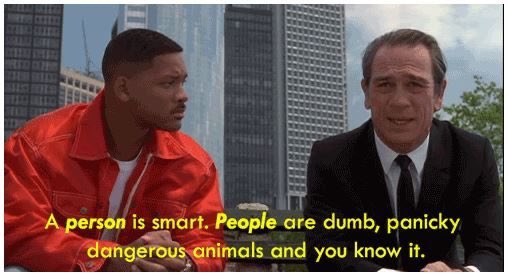
"A person is smart. People are dumb panicky animals."
Is this ever more starkly true than in groups of clever people? University students are a prime example. Individually they have got plenty of brains. But put them together - get some of the Brownian motion of the mob going... The whole is less than the sum of the parts.
This isn't just students. It's people. It's me. It's you. I doubt anyone is immune. What would we be without passion? (I know, I know - rare.)
University-goers are an easy example (target?) This is where the phenomenon is very clear: that (widening?) chasm between book-smarts and wisdom. The cleverer you are, the more obvious it is to others when you stumble intellectually, and the more tempted others are to laugh at you.
Sometimes, people don't form their views based on information. They look around themselves for clues, they let their identity form a sort of mould, and pour the issue into it. I am a progressive socialist/leftwing feminist/liberal/whatever, and people with that label think this.
More: people who don't think this are bad people. People who don't think this must all be Trump-loving/gun-waving/bigoted/basically Hitler.
It happens in reverse as well. I'm self-made, I believe in hard work and pulling yourself up by your bootstraps. Therefore any bleeding heart liberal who doesn't agree must be a lazy free-loading nancy.
Tell me you haven't seen this homogenisation of political groups, and I'll call you a liar.
There seems to be a swathe of young adults in higher education who are especially susceptible to this. Why is that? They're obviously bright, so why are they getting caught out in spite of their intelligence?
Age
Is it just that most of them are under 25, and their brains are still developing? It could be a factor, but I know plenty of mature people who do it, so there has to be more to it.
Disillusionment
Is it a spicy thirst for revolution? Show me a twenty-something uni student who isn't invested in whatever the latest social justice thing is, and I'll show you a unicorn. This can be a powerhouse for change. That can be positive... or not.
Legacy
Is it a selfish, deep-rooted wish (that we all share at some level) to leave a mark on the world? Our mark. Dressed up, maybe, as a desire to make it a better place.
Rebellion
We saw this with Brexit; old vs young. An elder could say, "the sky is up" and there will be some angry or idealistic greenhorn who contradicts them, almost out of habit. If they perceive you as being old fashioned, right wing, <insert descriptor>, then it follows, logically, that anything you say must be ignorant, racist, out-dated. The oppositional reflex also works in older people: a young person can say "rain makes stuff wet", and there will be a grumpy codger somewhere who wants to contradict or qualify it like a jerk of his arthritic knee. Teenagers think they know everything, they don't know jack-shit about the real world, just you wait. Right?
The Nature of Education
Is this naivete more pronounced in student populations, and if so, is that because they're going to lectures day after day, and reinforcing, over and over, that being told something, or reading something, is the same as learning about it? Being stuck in that mindset of believing what they're told, accepting things at face value. Is this going to be shed with maturity, and practise at researching, cross-referencing, seeking nuance?
What makes clever people stupid? Is it youth? Naivete? Idealism? A side effect of traditional education? Tribalism? All of the above?
A change of heart
We can laugh at their silliness in naively accepting an idea and getting carried away with a slogan (and they're likely to laugh at MAGA-hat-wearing people for doing the same thing, so it's probably fair) but can we take a sec to appreciate: these people demonstrate an ability and willingness to change their mind in response to facts. I admire that a lot. It takes a lot of courage, strength, intelligence, and humility.
Now, let's be clear - it'd be good to gather all the facts before forming a solid opinion on something. Whether you do or not, being able to say, "OK, I was wrong" and changing your viewpoint accordingly is a stamp of tremendous character in my book. (And I do actually have a book, now, so there is that.)
There have been several studies that show people don't care about facts that much. Facts don't change opinions.
Maybe if someone has taken a position based on information, you show them it was wrong and show them new information... then maybe they will more likely to change their mind. But if they formed their opinion based on how they felt... if it was forged in the storm of fiery righteousness... What are facts to that?
This little survey seems to show people do change their mind when exposed to new information. Is that specific to this educated demographic who are naturally inclined to value facts?
Worth noting: how did these conversations happen? One on one, or in groups? 1:1 is a wildly different dynamic to a group setting, and social media is different again.
In my experience, hardly anybody changes their mind quickly when presented with new information. It's a slow process, like osmosis. Reading between the lines, they didn't do a volte-face, they just became less supportive of an idea. That tracks for me.
Information is valuable, but it isn't how most of us normally decide things. We choose what feels right and safe, we hold close the opinion that feels kind or righteous or progressive... and then use facts that fit to justify our stance.
In the end, it doesn't matter if you're left or right, student or pensioner... we're all just people.
Most of the great triumphs and tragedies of history are caused not by people being fundamentally good or fundamentally evil, but by people being fundamentally people.
-Sir Terry Pratchett
About the Creator
L.C. Schäfer
Book babies on Kindle Unlimited:
Summer Leaves (grab it while it's gorgeous)
Never so naked as I am on a page
Subscribe for n00dz
I'm not a writer! I've just had too much coffee!
Sometimes writes under S.E.Holz
Enjoyed the story? Support the Creator.
Subscribe for free to receive all their stories in your feed. You could also become a paid subscriber, letting them know you appreciate their work.
Comments
There are no comments for this story
Be the first to respond and start the conversation.