
Collecting Stories Without Realising it
A Writer’s Journal — Entry Two

Muddy kisses on the window. Plants beside the glass. Another call of ‘Mam’. Another question.
These are among the ordinary details that found their way into Mam, Mam, Mam. Small things belonging to our summer days at home, familiar enough that I could have lived alongside them without recognising how much they had to do with writing.
What stayed with me was how quickly it all moved: the questions, the playfulness, the love. All at her default pace. The muddy marks made me stop long enough to notice how much the day held.
She had left something for me to find. In her own playful way, she had included me without saying a word—another invitation to put the everyday jobs down and join her for a little longer.
There was affection on that glass. Humour. The evidence of a child making herself known in the home we share. And somewhere among the repeated calls and interrupted tasks, there was a poem.
Those calls can feel like a lot. On a tiring day, bedtime can become the thing I am working towards. I wanted to share the poem so someone else might recognise their own everyday in it, and the little invitations that can be easy to miss while we are busy getting through it.
For this poem, inspiration was already there in the life we were living.
I am beginning to wonder how much of my writing has been waiting in places like that.
Before I knew it was a story
It has been around two months since I published the opening entry in this journal, What Happened After I Was Ready.
I had hoped to return to this journal sooner. Other pieces found their way onto the page, and life kept happening around them.
This entry waited—but the subject kept growing while I was away from it.
The longer I left it, the easier it became to feel that returning required something more impressive than simply opening the page again. Yet the experiences I might write about were still arriving. The pause had given me more to recognise when I returned.
In the first journal, I wrote:
Ordinary routines carried on being ours until a line appeared inside one of them and asked to be remembered.
LJ — What Happened After I Was Ready.
At the time, I was trying to explain how writing had stayed with me through the interruptions. The ambition had been there for years, even when other work and life occupied the space around it. Now writing has a working place in my days. I am learning to return to it when something else needs me.
I find myself thinking about what happened before that line appeared. The days I had lived, the things I had noticed, the photographs I had taken without any plan for the words that might eventually accompany them.
I once worried that I would not have enough to write about. I imagined I might need a more interesting life, a greater ability to dream one up, or a more orderly day in which I could sit down and recognise an idea on command.
Instead, much of what I have written has come from motherhood, home, love, faith and memories I was already carrying. It has also come from looking beyond our front door, wondering about the world we share and the one my daughter is growing up in.
I was living among those things long before I began calling them material.
I can see now that some of the collecting had begun before I knew there was anything to collect.
Things kept without knowing why
Some photographs have been waiting in my phone for years.
When I took them, I was preserving something I wanted to see again: a moment with my family, a piece of a view I could not take home, something unexpected that had made me smile. I did not know that one might eventually become part of a poem’s story, or that its feeling would become clearer after I found words for it.
Looking back through them now can feel like meeting an earlier version of myself. She had noticed something. She had stopped long enough to keep it. She could not have told me everything it would mean later.
There is something lovely about those versions of me meeting. I can return to what she kept with experiences and words she did not have yet, and discover how much more there is to see.
I do not always have to understand why something matters when I decide to keep it. Sometimes I only discover how much it holds later.
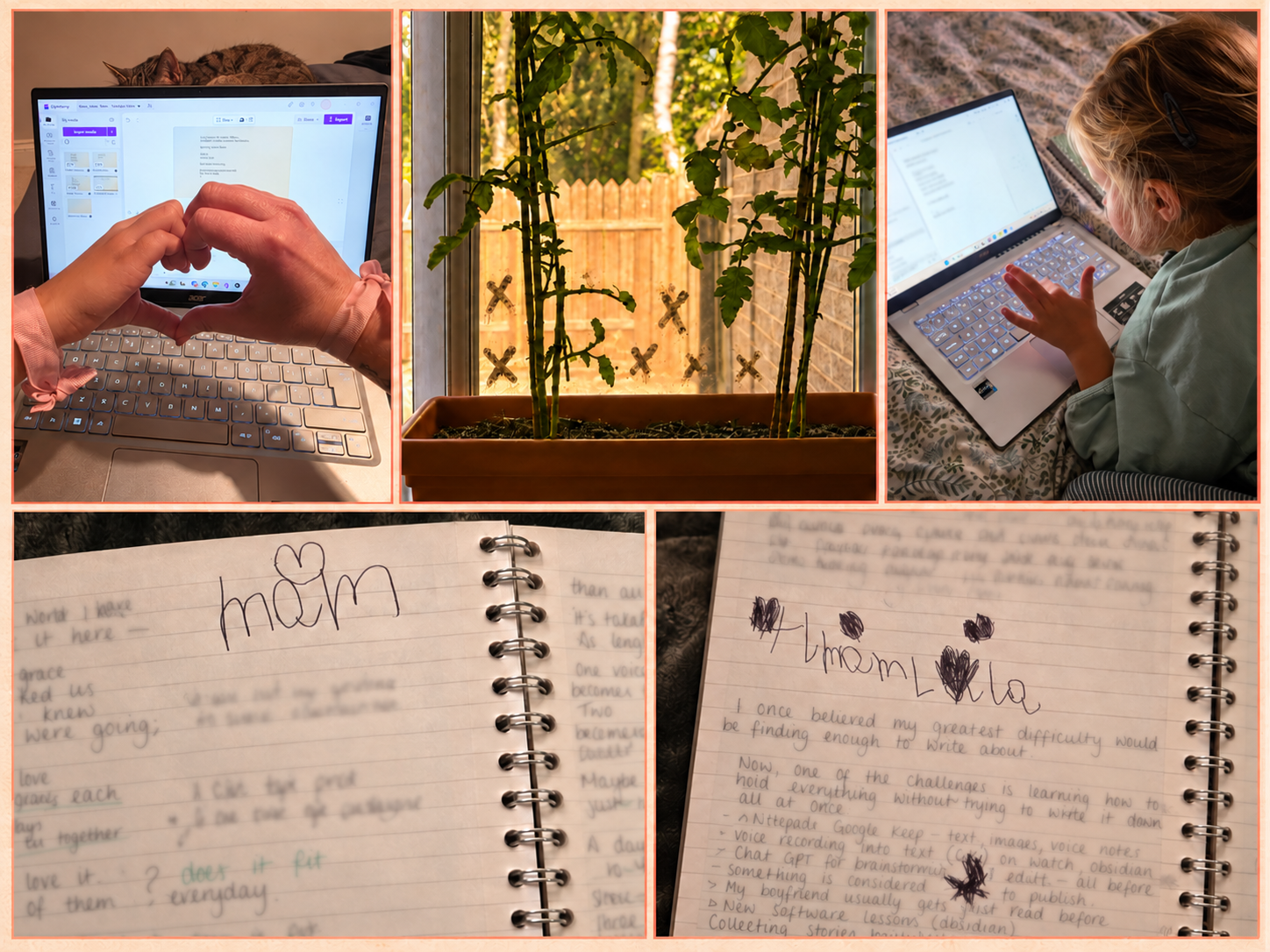
For this entry, I chose photographs that bring several parts of our writing life together. The muddy kisses behind the plants hold the moment that helped Mam, Mam, Mam find its words. My daughter at the laptop offers a glimpse of the curiosity she brings to my work; the heart held in front of the screen is another way she makes herself part of it. Across the two notebook pages, her handwriting and little drawings sit among my drafts. Together, these images show how closely the writing and our life share their space, with her affection, questions and contributions finding their way in alongside my words.
The same can be true of words. A phrase from a conversation. Something my daughter asks. A thought that seems too small to deserve a page of its own, but keeps returning anyway.
Sometimes I know almost immediately where it belongs. Sometimes I keep it for the simple reason that I do not want to lose it. Then another thought arrives beside it. A memory gains a deeper meaning. A photograph begins to look like part of something I have been trying to say.
That is one of the quiet pleasures of returning to writing. I am finding connections between things I kept separately, without knowing they might ever need one another.
The inspiration is sometimes in the meeting, as much as in either thing alone.
The inconvenient timing of ideas
Of course, recognising inspiration does not mean it becomes considerate.
The joy and wonder of it usually earn forgiveness for its lack of timing etiquette.
It still arrives while I am doing the dishes. It still waits until I am somewhere between being awake and asleep to offer a line I do not trust my half-asleep memory to retain. It still has very little interest in which draft I intended to work on today.
While I was writing the first journal, a poem that had arrived the night before returned more fully when I stepped away to do a simple chore. I had meant to give the journal my attention. Instead, both pieces moved forward.
Luckily, I find that more encouraging than inconvenient. There is pleasure in having words to work with, and in discovering that others are already waiting for their turn—even if they seem a little impatient about it.
I would still appreciate a device that could save an incoming idea while I finish the one in front of me. If someone invents it, I would like royalties.
Until then, I have to find somewhere for the thought myself.
Before I can reach for a pen, I sometimes begin working out where it belongs. I can hold its feeling and the shape of what I want to say, but not always the exact line. By the time I write it down, the meaning may still be there while the words that first carried it have slipped away. Frustratingly, they often sound just right when they first arrive.
That is why there are notes in so many places.
There are notebooks, some now colour coded, and Post-its that occasionally need replacing thanks to the bairn’s mutual fondness for them. A bumblebee pad sits beside my bed with its own dedicated pen. My phone and smartwatch are usually close enough, but there are still moments when I prefer to be old-fashioned.
There are photographs, hurried captures in Google Keep and voice recordings made before an idea has quite worked out what it is. And now there are Seedlings in Obsidian, giving those fragments somewhere I can find them again.
Someone close to me suggested that my ‘too many’ houseplants thrive because I have the instinct to nurture them. I rather like the thought that the words have become another set of seedlings to tend. They need somewhere to begin, and a little attention while I discover what they might grow into.
There will be another journal for the practical lessons: catching ideas, finding them again and choosing which one to develop when several seem equally convinced that the answer is them.
Here, what interests me is the small act of keeping something before I know what I can make of it. Writing down a line gives me permission to return to the dishes, the conversation or the draft already open. I can welcome the idea without asking it to become a finished piece immediately.
It has somewhere to wait.
And I have a little less to hold in my head.
Living with writing
The more I write, the more readily I seem to recognise something that might become a piece. It often happens while I am already listening, laughing or joining in. A phrase stays with me. A gesture holds a little more than I first understood.
My partner, an arborist, can see a tree that needs attention where I might only notice bare branches. I wonder whether returning to writing is developing something similar in me: an awareness of what a familiar moment might hold.
That recognition happens within the experience itself. I am there with my daughter, or listening to someone I love, when something catches my attention. I can keep that little spark and return to it later.
Living and writing are becoming more closely connected for me. The ordinary day gives me something to write about; writing helps me understand what I recognised in it.
There are choices to make when I return to those moments on the page. A memory can belong to me without every part of it being mine to publish.
I write from what I have lived, felt and learned, hoping that something I share might reach someone who recognises a little of their own experience. Finding the right shape can mean leaving details out, changing the way I tell something or allowing time before I share it. Some moments can remain ours.
Nor does every fragment need to become a finished piece simply because I have saved it. An idea might eventually join another. It might change so much that I barely recognise the original note. It might sit quietly for years, or remain a sentence I am glad I wrote down.
There is already satisfaction in the work I have finished and shared. I want the growing collection beside it to remain full of possibilities, with room for me to discover which ones I can develop.
I am willing to make space for writing in a busy life. I also want to give the things that inspire me enough freedom to surprise me. Sometimes a photograph is a photograph, a conversation is a conversation, and a lovely moment has done everything it needed to do by being lived.
I think the writing benefits from that freedom too. It leaves room for the pieces that continue asking for my attention.
What asked to be remembered
When I began thinking about this entry, I thought I would be writing about where ideas come from.
Now I wonder whether I am also writing about trust.
Trusting that something small can matter. Trusting myself to keep a fragment without an explanation attached. Trusting that an idea can wait while I tend to the life that gave it to me.
My faith is teaching me to trust more of what I cannot yet see: why a moment stays with me, or what it may become when I am ready to return to it. I am learning to extend some of that trust to the timing of the work too, as a piece finds its shape and becomes ready to share.
And, after a longer gap than I intended, I am trusting that I can still return to the page.
Inspiration has not always felt like a sudden arrival. Sometimes it has been a gradual recognition: a photograph seen again, a familiar memory understood differently, an ordinary detail that stays in my thoughts until I finally give it words.
I am beginning to understand how much the name Between Moments holds of the way I write. There are moments I return to long afterwards, and thoughts arriving in the small spaces between one task and the next. More and more, I am learning to recognise what is there.
There is so much I have already lived that I have not yet understood how to write about, and so much still happening around me. I cannot know which of it will become a piece I finish.
For now, I can keep what catches my attention, let some of it wait and make room to be surprised by what grows.
The muddy kisses were already on the glass. The love, the interruptions and the ordinary day were already there too.
The writing began when I recognised how much those ordinary moments held.
Be among the first to hear when I publish a new Writer's Journal entry.
SubscribeAbout the Creator
Enjoyed the story? Support the Creator.
Subscribe for free to receive all their stories in your feed. You could also become a paid subscriber, letting them know you appreciate their work.
Comments
There are no comments for this story
Be the first to respond and start the conversation.