
The Lazarus Taxa
Behaviour Mirrors Awareness
Dear Powers that Be,
Please accept this humble apology on behalf of humanity, for those who do not appreciate our divine origins. We are generally being incapable of accepting the complexity. We take things for granted, such as the power of Nature, the seasons, health and the simple act of just breathing. Exhale. Inhale. Breath.
Many people say we should have a relationship based on openness, but we are limited to what we can comprehend. Humans mirror the stage of their awareness, of the source of your power, in their behaviour. Many people act like slime, or slugs, are bird-brained, or reflect the survival traits of reptilian ancestors, still found in our brain stem. Many unwittingly find the connection with a small brained simple being, the coelacanth.
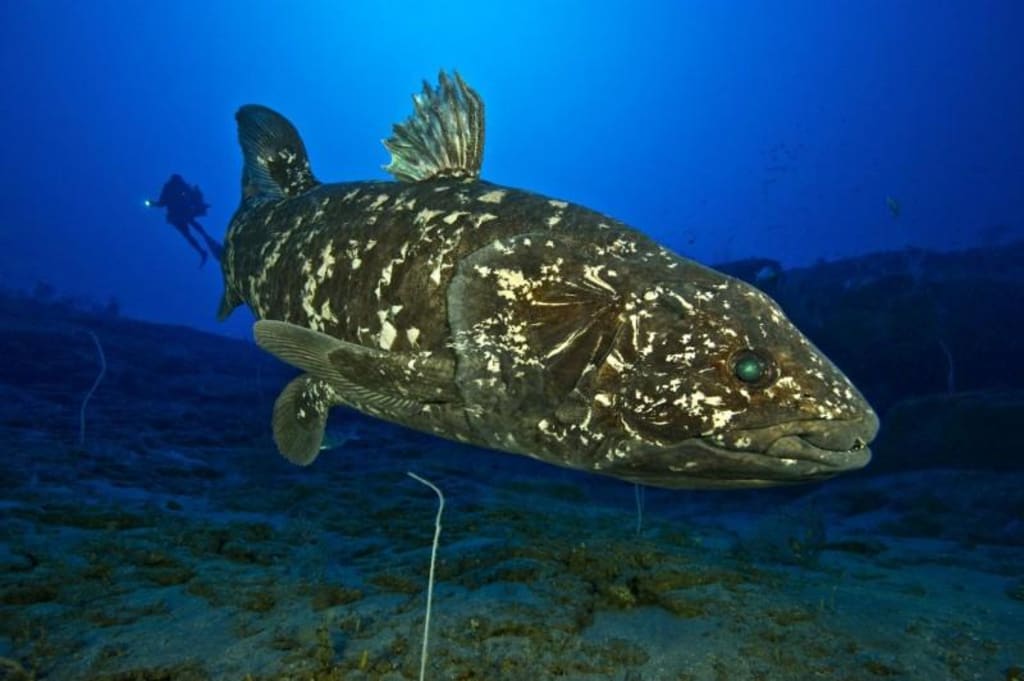
The coelacanth is a deep-sea fish, considered the direct descendant of lobe-finned fishes, from which land-dwelling animals- called tetrapod evolved. This closely related cousin to humans, and other backboned animals, is a living fossil that forms an evolutionary bridge. We are related to this Lazarus taxa, that resurrects traits, back from the dead.
Like our pre-reptilian coelacanth ancestors, we generally swim through life, passively drifting as an opportunistic feeder, head down, going backwards or belly up, to taking advantage of up- or down-welling current and drift. We can adapt and camouflage, and hide in a cave, curled up in a ball thanks to a hollow, fluid-filled backbone. Humanity often acts like a spineless craven coward, afraid to stand up for what they believe. They need the support of a group.
Humans, as do Coelacanths, locate cohorts, mates and prey by an evolutionary development of the rostral organs held in our snout. With a simple whiff of the right scent, extrasensory perception is triggered. The gel within liquifies, and we start to leak from orifices as low-frequency electrochemical signals spark and let us "see" a future in the dark unknown.
Then, like our coelacanth ancestor, our brain case becomes unhinged and swings upwards, greatly enlarging the gape of the mouth and increasing the bite force. It also reveals our small brain, cushioned in fat.
Our heart also holds similarities the coelacanth's, whose chambers are arranged in a straight tube. We take what nourishes the needs of our heart and eliminates undigested fibre.
When pressures are great, humans often sink into less-inhabited depths. We travel in the deep cold depth of thought. Coelocanths and humans share a highly developed pineal eye or third eye, that holds remnants of far more ancient Trilobite ancestors. Like the coelacanth we can develop "surfer's eye" that causes discomfort, redness, and vision issues.
To deal with harsh conditions, we revert to Coelocanth historical behaviour. The coelacanth once had gills, then had lungs then later developed gills with small, hard, flexible plates scattered around their vestigial lungs that regulated lung volume. The lung later turned onto a fatty vestigial organ.
Humans work to slow down our metabolism, and enter into hibernation, by controlling breathing. Breathing mechanics involve the movement of the diaphragm downward at inhalation, to increase the space in the chest cavity as muscles between ribs, and lungs expand. Chest breathing results in shallow breathing used during stress, anxiety, high-intensity exercise, or poor posture.
As humans searched for enlightenment, overthinking eventually arrived at Yogic no thought. It involves using abdominal breathing, or Adham Pranayama. Breathing in slowly through your nose brings air in as the thoracic diaphragm moves down and the abdominal muscles moves out. At exhalation, the chest remains still. This breathing increases relaxation and oxygenation of the blood, vitality, mental clarity, and spiritual awareness. This breathing seeks to bridge the body and soul, connect and regulate the life force energy called prana, in individual consciousness with the universal divine consciousness.
Reversed abdominal breathing, is opposite to Yogic breathing. Taoist Breathing, also called embryonic breathing or kidney breathing, in inhalation, has the stomach muscles tighten and the abdomen moves in as the perineum, called the Huiyin cavity raises. This causes the diaphragm to move downward to bring in the air. Upon exhalation, the abdomen and perineum relax causing the diaphragm to rise and breath to push out. Reverse breathing lets Qi accumulate and manifest, so synergy and muscle activation increase. Longer and fewer breaths leads to Longevity. In Five Gates Breathing, Qi goes beyond the locations of your Yin and Yang energy centre along the centre energy line of the body. In Xisui Jing the Qi moves inward into the bones.
Both forms of abdominal breathing attempt to connect what is within to the divine source. However, some humans remain bird-brained, others revert to chest breathing and have chest beating gorilla actions to signal their size and strength. Others act as cold-blooded reptiles. Often those who unknowingly tap into their coelacanth nature develop invisible hard scales, woven tight as armor, that are rough to the touch. They secrete mucus, which combined with the excessive oil makes them slimy and give them a distinctly unpleasant flavor, making what they say and do difficult to digest, and cause diarrhea.
Dear Divine powers, Forgive our inclination to tap only into a source that has survived longer than dinosaurs. We humbly apologize for what we are not, but respect those similarities to the fleshy sarcopterygians’ lungfish, that have offered us a means to avoid extinction. Please accept this apology for not being able fathom our divine origins that stem from beyond the stars, and reverting to the behaviour of a slimy, fat-headed, small brained, strange beast that is a nocturnal lurker. I hope this fish story explains that we are trying our best.
About the Creator
Katherine D. Graham
My stories usually present facts, supported by science as we know it, that are often spoken of in myths. Both can help survival in an ever-changing world.
Enjoyed the story? Support the Creator.
Subscribe for free to receive all their stories in your feed. You could also become a paid subscriber, letting them know you appreciate their work.
Comments
There are no comments for this story
Be the first to respond and start the conversation.