
The Deadbug as an Existential Life Lesson
Learning from the things we look down on


Yesterday, I fell down a YouTube rabbit hole, or, given the algorithm’s increasingly aggressive personalization, more a precisely engineered trench, and found myself watching a fitness instructor demonstrate the “deadbug exercise”.
For the uninitiated, this involves lying flat on your back, lifting your limbs into the air as if you are an overturned table, then waving your arms and legs in the air as if you’re trying to signal a rescue helicopter while simultaneously being very concerned with your core engagement.
As I lay there trembling on my yoga mat staring blankly at the ceiling and praying for a swift end to my third set, a stray thought drifted into my aching skull.
Dead bug.
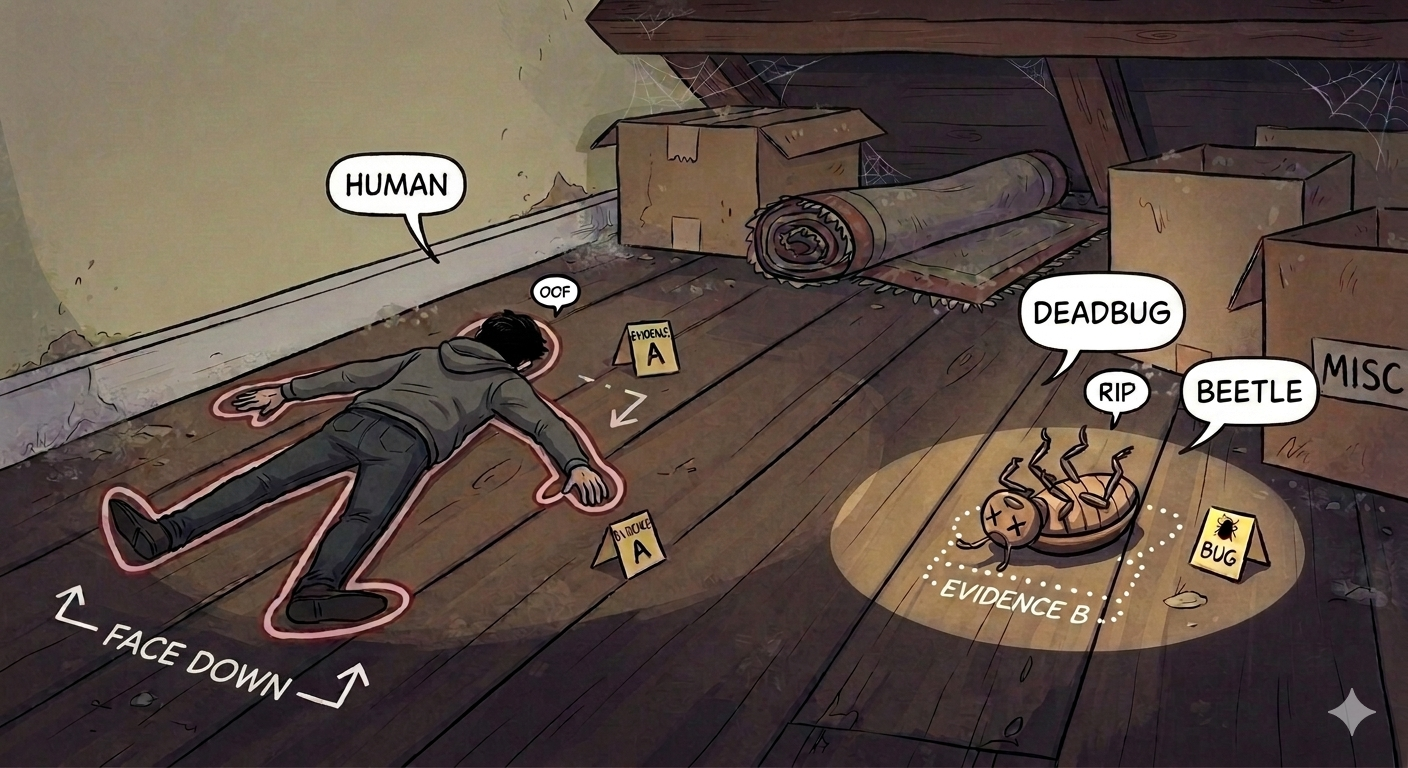
This is exactly the position all the bugs I’ve ever found on my windowsill have died in. Why is that?
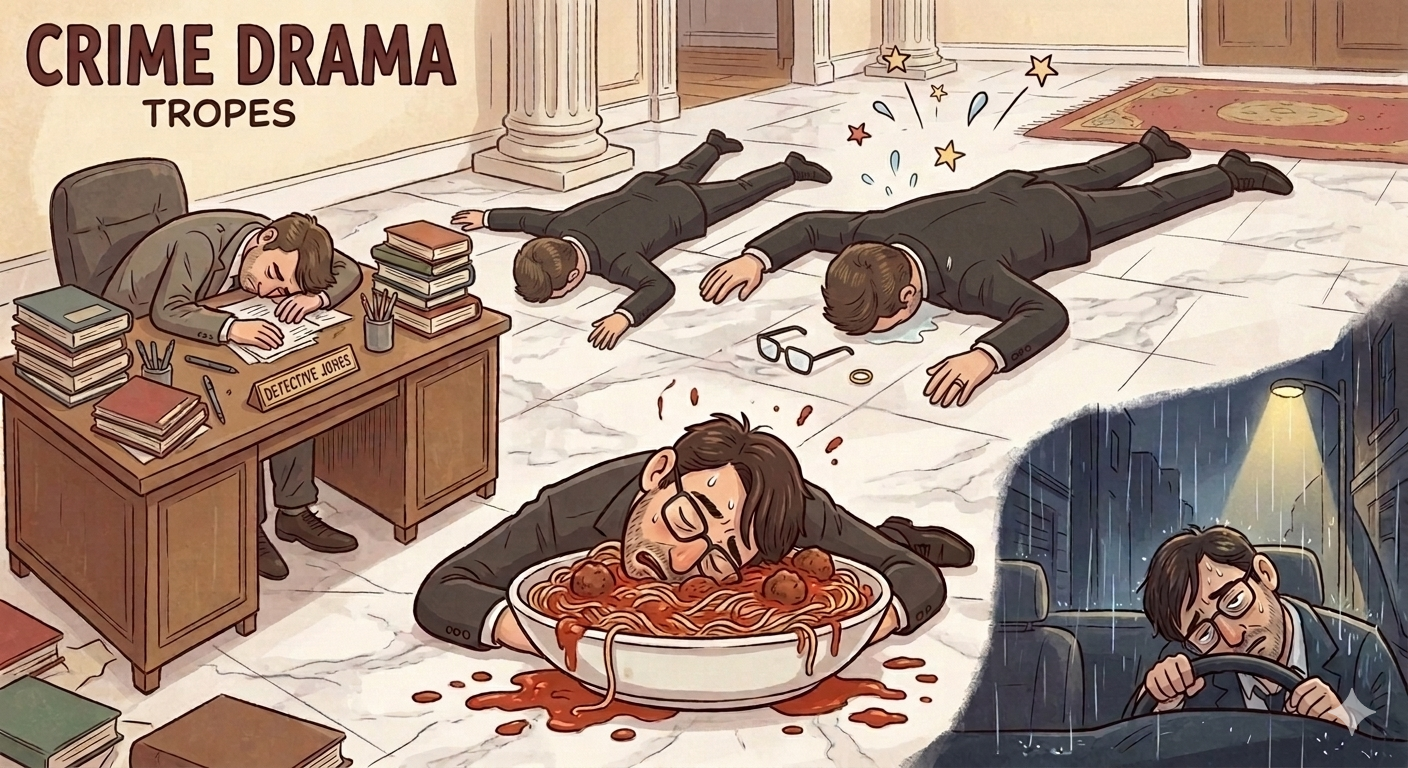
When a human dies on a prestige crime drama, they always go out face down. Slumped over desks. Sprawled across marble foyers. Collapsed dramatically into plates of spaghetti. Limp on a steering wheel in a rain-soaked alley.
Gravity and cinematography have conspired to teach us that death is an earthward-facing affair. The face-down position says: This is serious. This is permanent.
But insects? Insects are the ultimate drama queens. They don’t just expire; they roll over, throw their legs into the air, and meet death facing up at the heavens. Insects demand an open-casket view of the cosmos.
Their compound eyes stare straight into the infinite, as if to say: “You know what? I’ve spent my entire three-week life scurrying under refrigerators and fleeing from rolled-up newspapers. If I’m going out, I’m going to see what all the fuss is about with that ‘ceiling’ thing.”
It is, if you think about it — and I have, extensively, instead of doing my taxes — the most dramatic gesture available to a creature with no access to Shakespearean dialogue or slow-motion flashbacks.
Trust the Science
There are tedious, technically correct reasons an insect may attempt the backstroke in their final moments. A bug’s exoskeleton is, ergonomically speaking, basically a heavy kayak they carry on their back, which might tend to flip over in its final throes of despair.
But here’s where I part ways with the entomological establishment. I refuse to believe that every single bug — every ant that marched one time too many, every fly that found the invisible boundary of a clean windowpane, every roach that survived nuclear winter only to meet a can of bug spray — winds up on its back purely by accident. Statistically, some of them must be making a choice.
Consider the alternatives. A bug dies on its side, and it just looks like it’s napping. A bug dies face-down, and it looks like it’s searching for food. But a bug dies on its back, legs gently cycling in the air, and suddenly it’s a performance. It’s a statement.
The contrast with human death in pop culture could not be more stark. In crime shows, the face-down death is all about mystery. The victim is denying us their final expression, their eyes, their story. Detectives have to turn them over, which is always shot with ominous strings and a slow pan across the room to a knocked-over chair that definitely means something.
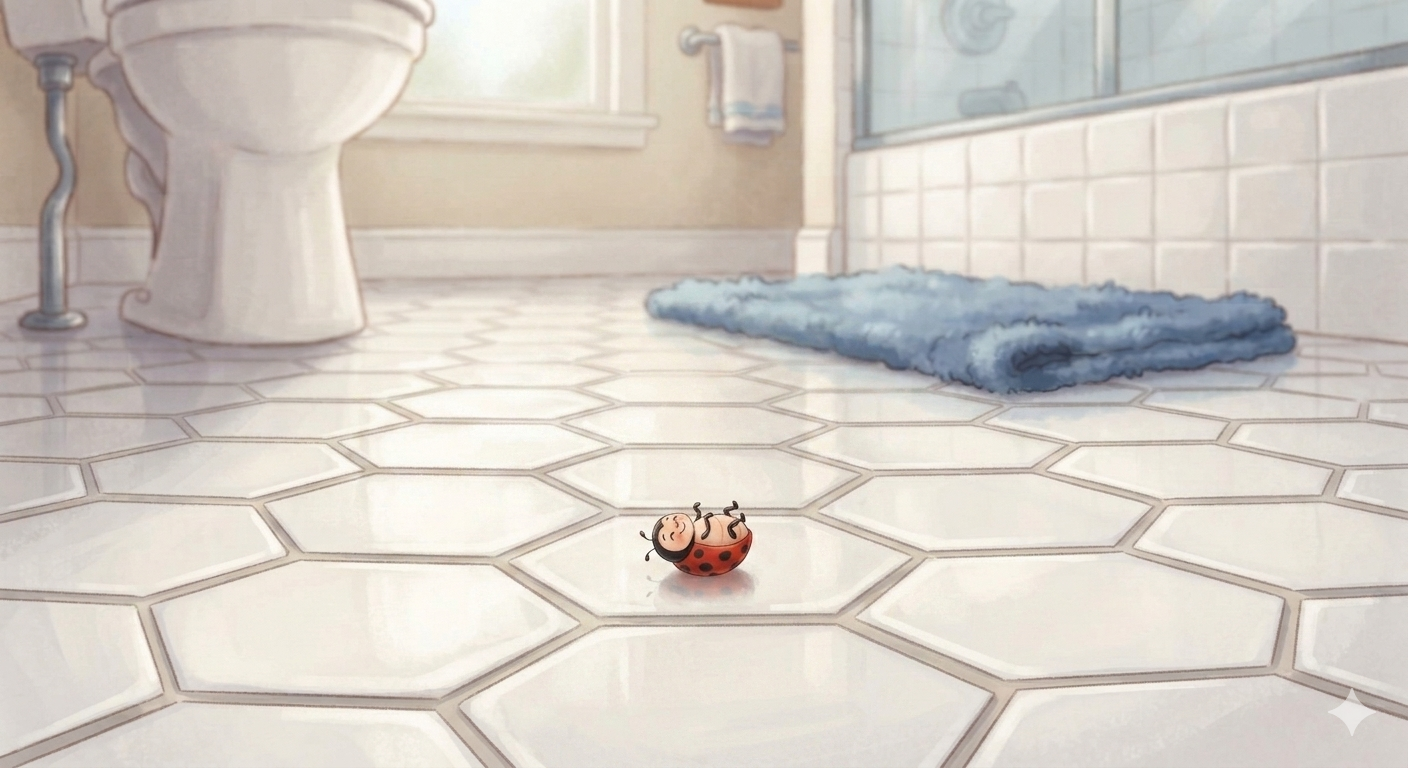
I once found a beetle in my bathroom in the “deadbug” pose. A magnificent, iridescent thing, about the size of a thumbnail and twice as shiny. It lay there on the tile, six legs arranged in what I can only describe as a posture of profound resignation. As I stood over it for a solid minute, holding my toothbrush, I felt a strange kinship. Because let’s be honest: haven’t we all, at 2 a.m., found ourselves drunk, flat on our backs, limbs in the air, staring at the ceiling and wondering where exactly our lives took a wrong turn? The beetle and I were the same in that moment, except I had dental hygiene to attend to and it had achieved a state of permanent transcendence.
This is the part where I should probably mention that I gave the beetle a small funeral. Nothing elaborate — I’m not a lunatic — but I did slide it onto a piece of junk mail and deposit it in the flower bed with more ceremony than the situation warranted. My neighbor saw me do this. We have not spoken since. I choose to believe this is because she was moved by my compassion, and not because she watched a grown man in boxer shorts perform last rites over an insect.
Let’s not forget the deadbug exercise itself, that YouTube fitness trend that started this whole article. There is something almost insulting about it, if you’re a bug. Humans have taken the most vulnerable, final moment of an insect’s existence and turned it into a core-strengthening routine.
Humans, as a species, see a tragedy and we think: How can I monetize this? How can I make this improve my obliques? A bug dies in quiet desperation, and somewhere a Peloton instructor is already planning a “Deadbug Burn” class set to remixed music about being forever young.
Perhaps I’m too cynical. Perhaps the deadbug exercise is actually a tribute. A strange, sweaty, Lululemon-clad tribute to the billions of bugs who have gone before us, flipping onto their backs with the grace of manic gymnasts.
Every time some fitness enthusiast lies on a yoga mat and waves their limbs in the air, they are channeling the spirit of that beetle in my bathroom. They are saying: “Today, I too shall stare at the ceiling and contemplate the void”.
Last Words
As I rolled off my yoga mat, drenched in sweat and nursing a deeply sore core, I looked down at my own outstretched limbs.
Perhaps the bugs have the right idea. If you’re going to go out, you might as well point your toes to the sky, throw your hands up, and make the universe look you in the eyes. It certainly beats slumping into the spaghetti.
About the Creator
Scott Christenson🌴
Born and raised in Milwaukee WI, living in Hong Kong. Hoping to share some of my experiences w short story & non-fiction writing.
Enjoyed the story? Support the Creator.
Subscribe for free to receive all their stories in your feed. You could also become a paid subscriber, letting them know you appreciate their work.
Comments
There are no comments for this story
Be the first to respond and start the conversation.