
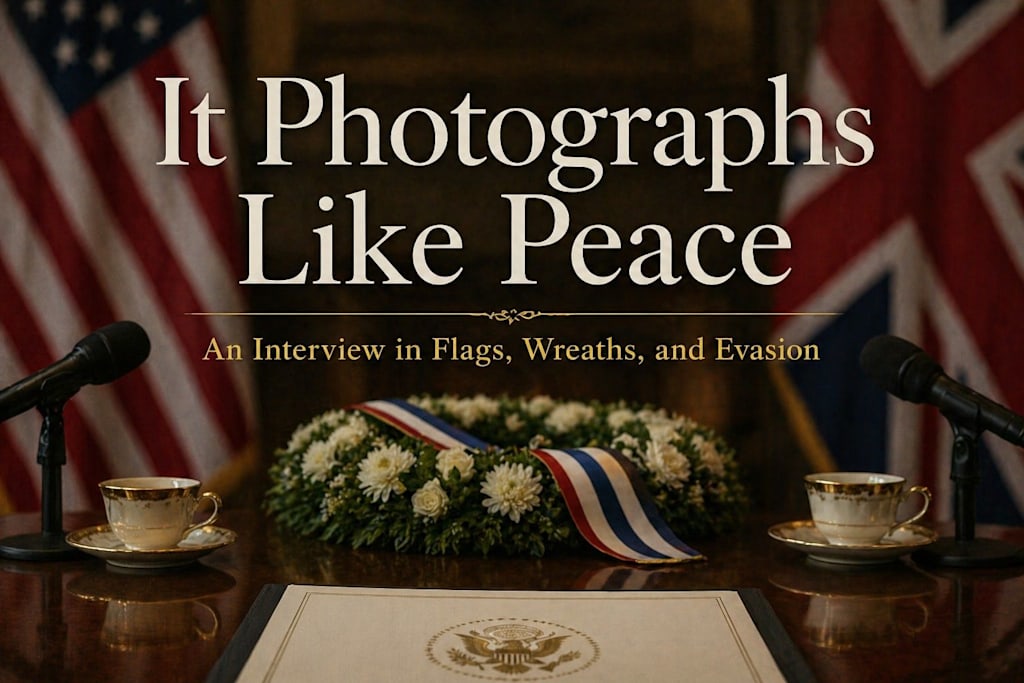
It Photographs Like Peace
An Interview in Flags, Wreaths, and Evasion
“Mr. President, did King Charles come here to discuss the war?”
“He came because he respects me tremendously.”
“That isn’t what I asked.”
“It’s what everybody saw.”
“What did he ask you about?”
“He asked about history. Great history. Tremendous history. Two hundred and fifty years. Nobody does years like we do.”
“The visit marked the anniversary of American independence from Britain.”
“And they came back. Very smart. They missed us.”
“Did the King raise concerns about the war?”
“He raised a glass. Beautiful glass. Crystal. Maybe British, maybe ours. Hard to say, but beautiful.”
“At the state dinner?”
“Fantastic dinner. People are still talking about the dinner.”
“Were they talking about the war?”
“They were talking about the Dover sole.”
“The war did not come up?”
“Everything comes up when you serve good fish.”
“Did King Charles mention NATO?”
“He mentioned many letters. NATO has letters. USA has letters. UK has letters. I know letters.”
“He publicly emphasized alliances.”
“Because I have the best alliances.”
“He appeared to warn against abandoning allies.”
“He was complimenting me.”
“That is not how many observers interpreted it.”
“Observers are people who didn’t get invited to dinner.”
“Did he challenge you?”
“He charmed me. Kings are very good at charm. I’m good at everything else.”
“The King addressed Congress.”
“Beautiful room. I’ve spoken there. Better, probably, but he did fine.”
“He spoke about democracy.”
“I invented a lot of democracy.”
“Democracy predates you.”
“Not the popular kind.”
“He spoke about checks on power.”
“Checks are fine. I prefer wire transfers.”
“Did that sound like a rebuke?”
“It sounded British.”
“What does that mean?”
“It means polite enough to ignore.”
“He also joked that without Britain, Americans might be speaking French.”
“Very funny. I laughed. Nobody laughs at France like I do.”
“Did you understand the joke?”
“I understood that he likes me.”
“That was not the joke.”
“That’s always the joke.”
“Mr. President, the King visited the 9/11 Memorial.”
“Very moving. Tremendous pools. Very reflective.”
“He met victims’ families and first responders.”
“First responders love me.”
“This is not about you.”
“Everything is about response. I respond first.”
“Did the visit remind you of shared sacrifice?”
“It reminded me we have great ceremonies.”
“What do ceremonies do during wartime?”
“They show strength.”
“Do they hide weakness?”
“They hide nothing. The cameras were excellent.”
“The King also went to Arlington.”
“Beautiful cemetery. Very respectful. Nobody respects cemeteries more than me.”
“Do the dead matter to policy?”
“The dead are very important voters in some places.”
“That was a joke?”
“That was a fact, depending who counts.”
“Did standing there change your view of the war?”
“I stood very well.”
“That is not a view.”
“It was a very presidential standing.”
“Did the King ask for restraint?”
“He asked for tea.”
“In the Oval Office?”
“Private tea. Very elegant. Very British. Small cups. Not my favourite cups.”
“What was discussed over tea?”
“Tea things.”
“Such as?”
“Steam. Porcelain. Maybe war. But very elegant war.”
“Elegant war?”
“Diplomatic war. The best kind. Nobody gets dirty except the people far away.”
“Did he tell you civilians are dying?”
“He may have mentioned people.”
“Which people?”
“People generally. The King is very general. That’s why he’s King.”
“Did you give him assurances?”
“I gave him a tour.”
“Of what?”
“History. Pictures. Flags. Me.”
“Did he give you advice?”
“He gave me a look.”
“What kind of look?”
“Very royal. Hard to invoice.”
“Was it disapproval?”
“It was admiration with wrinkles.”
“Did Queen Camilla say anything?”
“She said many gracious things.”
“About the war?”
“About the flowers.”
“The flowers were at the memorial.”
“Exactly. Very diplomatic flowers.”
“Do flowers answer for bombs?”
“They soften the photographs.”
“Should photographs be softened?”
“You never want hard photographs during peace.”
“We are not at peace.”
“We hosted a state dinner.”
“A state dinner is not peace.”
“It had candles.”
“Candles are not peace.”
“They’re close.”
“Did the King come to repair relations?”
“Our relations are perfect.”
“The alliance is strained.”
“Strained means strong. Muscles strain.”
“The Prime Minister has been criticized by you.”
“He should be grateful. I made him famous here.”
“Did Charles defend him?”
“Kings don’t defend prime ministers. They float above them. Very smart system.”
“He defended the alliance.”
“Because the alliance is me.”
“The alliance is older than you.”
“Everything old eventually becomes mine.”
“Did you discuss Iran?”
“We discussed global stability.”
“That means Iran?”
“That means whatever sounds best in the transcript.”
“Did you discuss Ukraine?”
“We discussed courage.”
“That means Ukraine?”
“That means very nice words everybody can applaud.”
“Did you discuss Gaza?”
“We discussed suffering.”
“That means Gaza?”
“That means dessert was served quietly.”
“Mr. President, are you using the monarchy as cover?”
“I don’t need cover. I have motorcades.”
“Is this pageantry distracting from war?”
“Pageantry is what civilization does when it wants better lighting.”
“So yes?”
“So beautiful horses.”
“There were military honours.”
“Fantastic military. Very precise. Very strong. They love kings and presidents. Mostly presidents.”
“Military ceremony during war can look unsettling.”
“It looks powerful.”
“To whom?”
“To television.”
“Do you think the King was uncomfortable?”
“He looked comfortable. He has been standing in ceremonies his whole life.”
“Did he look troubled?”
“British people look troubled when the soup is cold.”
“Was the soup cold?”
“The soup was tremendous.”
“Mr. President, did he ask you to stop anything?”
“He asked me to continue the friendship.”
“Did he ask you to stop bombing?”
“He asked for continued dialogue.”
“That is not the same thing.”
“It is if you say it slowly.”
“Did he ask for de-escalation?”
“He said many dignified words. De-escalation might have been one of them.”
“And your answer?”
“We are always de-escalating upward.”
“Upward?”
“Strongly upward. Very safe direction.”
“That is escalation.”
“Only if you’re negative.”
“Did the King object?”
“He nodded.”
“In agreement?”
“In monarchy.”
“What does that mean?”
“It means nobody knows until the historians get involved.”
“Will historians say this visit mattered?”
“They’ll say it was historic.”
“That doesn’t mean it mattered.”
“Historic is better than mattering. Mattering is messy.”
“What did you want from the visit?”
“Pictures.”
“What did he want?”
“Continuity.”
“What did the public get?”
“Flags.”
“What did the dead get?”
“Wreaths.”
“What did the war get?”
“A day off from headlines.”
“Did it take one?”
“No.”
“Then what was achieved?”
“The special relationship.”
“What is special about it?”
“It survives everything.”
“Even denial?”
“Especially denial.”
“Mr. President, did King Charles leave reassured?”
“He left on schedule.”
“That isn’t the same thing.”
“It is for kings.”
“Did he leave disappointed?”
“He waved.”
“People wave goodbye when they’re disappointed.”
“They also wave when they’ve had a wonderful time.”
“Which was it?”
“Very royal.”
“Do you understand what he was trying to tell you?”
“He told me America and Britain share history.”
“And?”
“Shared values.”
“And?”
“Shared sacrifice.”
“And?”
“Shared lunch, almost.”
“Almost?”
“Very busy schedule.”
“So even the lunch was postponed?”
“Temporarily.”
“Until when?”
“Soon.”
“Is that your answer to the war too?”
“Soon is a very powerful word.”
“For peace?”
“For headlines.”
“Mr. President, final question. Are we closer to peace after this visit?”
“We are closer to Britain.”
“That is geography.”
“It’s diplomacy.”
“It’s not peace.”
“It photographs like peace.”
About the Creator
Enjoyed the story? Support the Creator.
Subscribe for free to receive all their stories in your feed.
Comments
There are no comments for this story
Be the first to respond and start the conversation.