
Animals Vote With Their Feet (and Sneezes Too)
The Greeks didn't invent Democracy; they just had better publicists
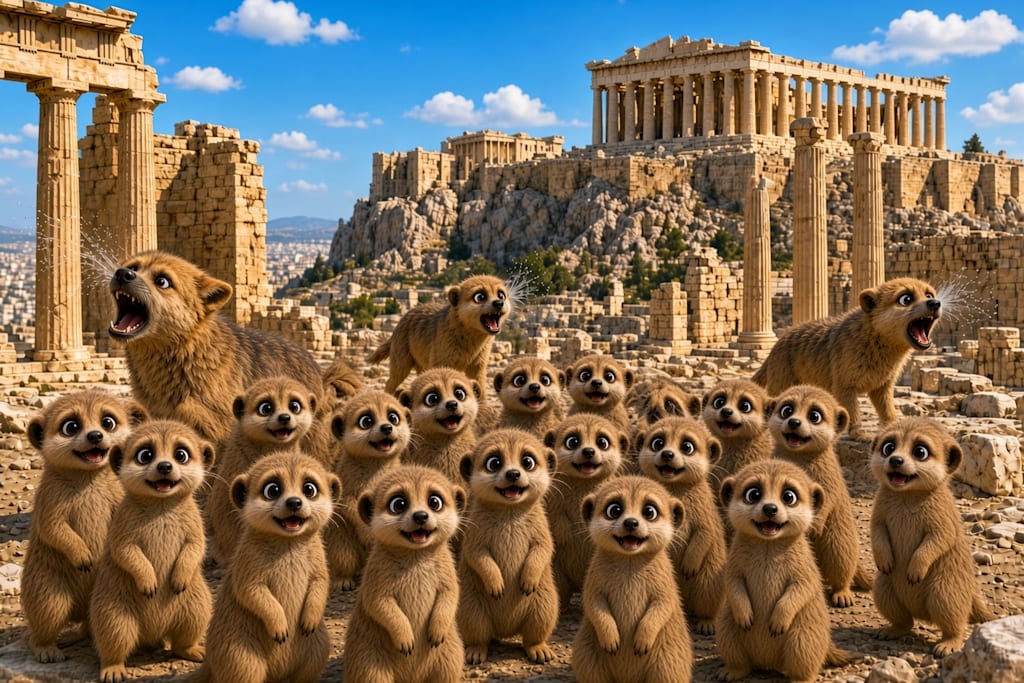
Last week, I happened upon one of those relentlessly high-minded articles that insists we owe a profound debt of gratitude to the ancient Athenians for “inventing” democracy.
You know the sort of article — inevitably illustrated with a sketch of the Acropolis, as if the concept of collective decision-making is inextricably linked to columns of white marble. Washington D.C. was clearly built on the same delusional architectural premise, under the impression that if you build enough fake Greek temples, fairness will spontaneously break out inside them.
As I read on, I found myself thinking… really?
Are we seriously expected to believe that humanity spent millennia wandering the earth in a state of absolute, bewildered autocracy until a few old men in tunics (Europeans, of course) came along and said, “Look, why don’t we see what the majority thinks?”
It is a uniquely arrogant, academic form of nonsense to suggest that voting didn’t exist until someone wrote a thesis about it 3,000 years ago. Every family of three siblings trying to decide on a joint birthday present for their parents has engaged in democracy. Every group of friends arguing outside a cinema has held a vote.
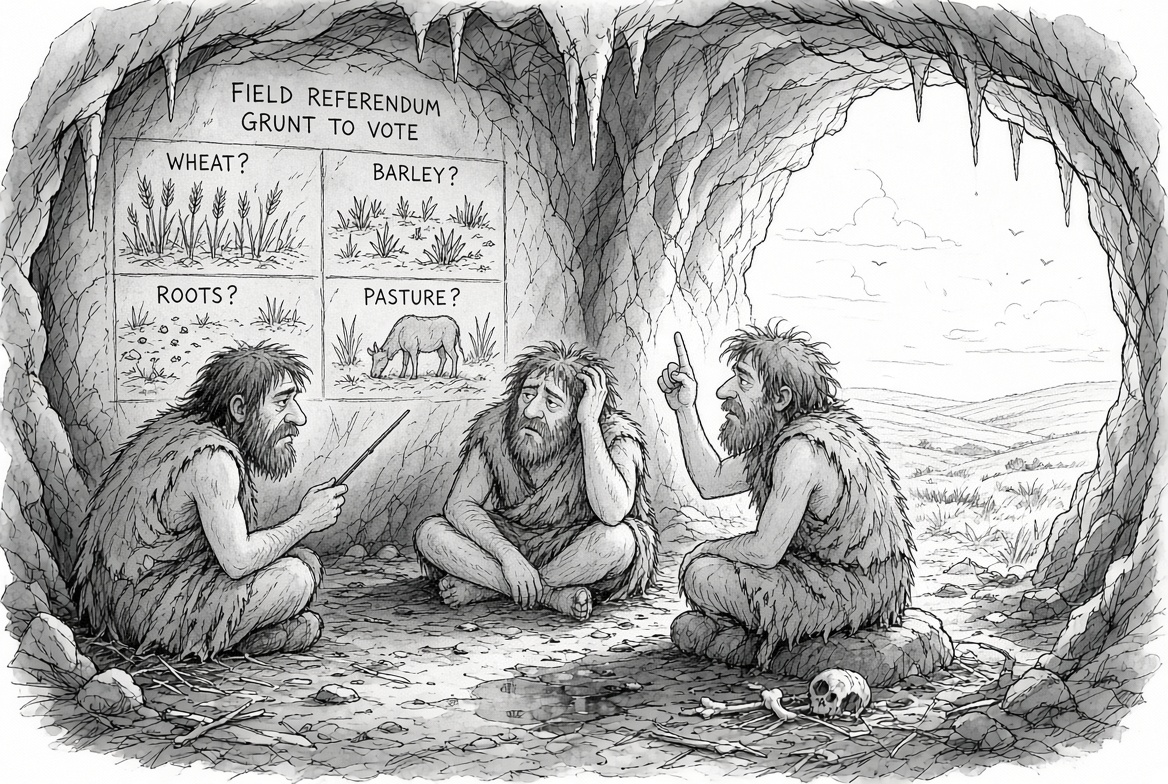
I am absolutely certain that every trio of cavemen, upon waking up in a damp cave, held a brief, grunting referendum on which particular field they should trudge toward to look for rabbits.
The concept is so blindingly obvious, so fundamentally baked into the logistics of existing in a group, that I began to wonder if even the animal kingdom has sorted it out.
And it turns out, after a brisk and deeply satisfying dive into Google, that they absolutely have. Honestly, they do it with a lot less administrative fuss than we do:
African Wild Dogs: Voting by Sneezing
African wild dogs live in highly structured packs, but their decisions to hunt are entirely democratic. Before setting off, the pack engages in high-energy “greeting rallies”. To cast a “yes” vote for a hunt, a dog will emit an audible, rapid nasal exhalation — a sneeze.
The Quorum System: Scientists from the University of New South Wales discovered that if a certain threshold (quorum) of sneezes is reached, the pack immediately leaves to hunt.
• Weighted Votes: Votes are not entirely equal. If the dominant pair starts the rally, the pack only needs about three sneezes to leave. However, if a lower-ranking dog initiates the rally, the group requires at least 10 sneezes to guarantee a consensus.
Read the deep-dive These Dogs Vote by Sneezing to learn how researchers discovered their quorum system.
Olive Baboons: Voting with Their Feet
Baboons live in strictly stratified, aggressive societies dominated by alpha males. However, a groundbreaking study published by the Max Planck Institute revealed that travel decisions are purely egalitarian.
Initiation: Any baboon, regardless of sex or rank, can act as an “initiator” by walking away from the group in a purposeful direction.
Splitting the Vote: If two different baboons walk in different directions, the troop splits into subgroups behind them. If the angle between the two directions is small (under 90 degrees), the baboons compromise and walk down the middle. If the angle is wide, they wait to see which subgroup attracts the numerical majority, and the entire troop then follows the winning crowd. Dominant males are frequently outvoted and forced to follow the group’s choice.
A leading research institution has an article Baboons Follow the Majority which outlines how travel paths are democratically compromised.
African Buffalo: Voting by Body Language
African buffalo travel in massive herds and must decide which way to migrate across plains. To determine the direction, they use a silent, visual voting method.
The Staring Vote: Adult females in the herd will stand up, look intently in a specific direction, and then sit back down.
Data Aggregation: The herd assesses the directional orientation of all the sitting females. Whichever compass direction receives the most “stares” is the direction the herd travels once they stand up to move.
The New York Times has an article: Contrary to Orwell, Democracy Rules on the Big Animal Farm
Meerkats: Voice Voting
While much smaller than buffalo, these social mammals live in highly cooperative “mobs” of up to 30 individuals. When deciding when to leave a foraging patch to avoid predators, they rely on vocal consensus.
Moving Calls: One meerkat will give a specific “moving call” to signal it is time to switch locations.
The Three-Vote Rule: Biologists at the University of Zurich found that the group will only speed up and move if at least three different individuals join in and echo the call within a short window, preventing a single anxious meerkat from prematurely disrupting the group.
Their full research paper: Researches in Moving calls: a vocal mechanism underlying quorum decisions in cohesive groups
Why Voting is Just Grunting at a Rabbit Hole with Extra Paperwork
We delude ourselves that we are basking in the neon glow of an advanced age of governance (at least before Donald Trump and Nigel Farage), just because we’ve wrapped the ancient necessity of group logistics in layers of soul-crushing bureaucracy and colorful plastic buttons.
If a herd of buffalo can successfully aggregate complex compass data using nothing but a collective, passive-aggressive stare, and a pack of wild dogs can manage an equitable resource-distribution strategy through the medium of a well-timed sneeze, then our elaborate political systems aren’t a monument to human genius. They are simply a loud, expensive way of doing what the meerkats figured out millions of years ago — and the meerkats don’t have to listen to all campaign speeches beforehand.
About the Creator
Scott Christenson🌴
Born and raised in Milwaukee WI, living in Hong Kong. Hoping to share some of my experiences w short story & non-fiction writing.
Enjoyed the story? Support the Creator.
Subscribe for free to receive all their stories in your feed. You could also become a paid subscriber, letting them know you appreciate their work.
Comments
There are no comments for this story
Be the first to respond and start the conversation.