
Your Eyes Can't Fake a Smile
Here's a small warning before you read on: once you know this, you can't un-know it. The next time you're at the grocery store, a bubble tea shop, or a job interview and someone smiles at you, it will pop into your head on its own.

Here’s a small warning before you read on: once you know this, you can’t un-know it. The next time you’re at the grocery store, a bubble tea shop, or a job interview and someone smiles at you, it will pop into your head on its own.
It’s called the Duchenne smile. Don’t let the name put you off. The story behind it isn’t dry at all. It’s actually kind of funny.
The bet
A few years ago, I sat in on interviews with our company’s HR manager. We’d been at it all afternoon and I was fried. She was sorting résumés and venting:
“That last guy smiled the whole time, looked totally cheerful. But I could tell right away he was terrified. That smile was completely fake.”
I didn’t buy it. “He looked sincere to me. His mouth was turned way up.”
So she made me a bet. For the next candidate, she wouldn’t need to hear a word. Just by watching his smile, she’d know whether it was real.
The next applicant walked in, nodded politely, and gave us a textbook smile with the corners of his mouth lifted high. She nudged my arm and whispered: “Fake.”
Five minutes in, she asked him about a project that had failed. His brow tightened slightly, and in that instant the smile didn’t fade. It dropped, all at once. And the whole time, the muscles around his eyes had never moved.
Afterward I pulled her aside. How did you know?
Photo created by Author
The doctor with the electrodes
That’s when she told me about Guillaume-Benjamin Duchenne, a French neurologist who, in the mid-1800s, became obsessed with the muscles of the human face.
His method looks wild today. He put electrodes on people’s faces, zapped individual muscles, and watched which expressions appeared. Then he did something almost nobody was doing yet: he photographed the results, because he believed only a camera could capture an expression faithfully. He published the images in 1862 in Mécanisme de la physionomie humaine.
What he found is simple. A smile uses two separate groups of muscles.
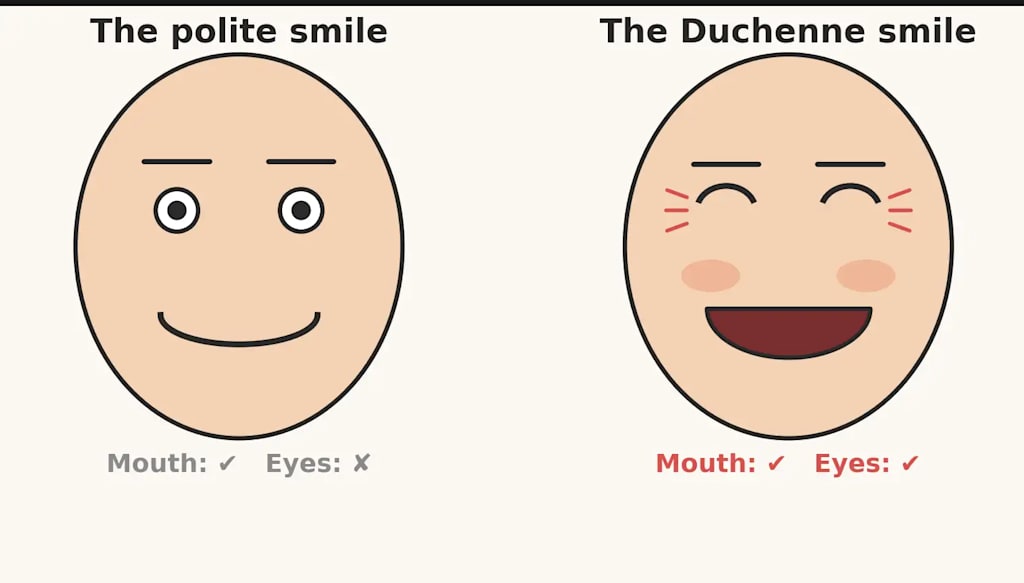
The mouth muscles (mainly the zygomatic major) pull the corners of your lips up. You can move these any time you like. This is the smile you put on for interviews, photos, and customer service.
The eye muscle (the orbicularis oculi) rings your eye. For most people, it doesn’t respond well to a conscious command. It tightens mostly when you actually feel joy, lifting the cheeks and crinkling the skin at the corners of your eyes into crow’s-feet.
Duchenne put it more poetically: this eye muscle obeys only “the sweet emotions of the soul.”
So a genuine smile moves two places: the mouth goes up and the eyes crinkle. A polite smile moves only the mouth, and the eyes stay calm and flat.
Fake smiles move the mouth. Real smiles reach the eyes.
My first reaction was: Isn’t that common knowledge? She shook her head. The basics, sure. But there are a few details that are stranger than most people realize.
Strange detail #1: You can’t easily fake it on purpose
Try it right now. Look at your screen and give the most radiant smile you can. Pull up your mouth and try to squeeze your eyes into happy crescents.
For most people, the eyes won’t cooperate. Push harder and you end up with something closer to a grimace than a grin.
That’s because the eye muscle is closely tied to the brain’s emotional systems, not just to conscious will. It’s why a photographer can yell “Smile with your eyes!” and get a row of smiles that stop at the cheekbones. You can control your mouth. Your eyes are harder to boss around.
(Some people can do it. Research shows a minority can produce a convincing Duchenne smile on cue, which is why good actors are good. But most of us can’t.)
Strange detail #2: Fake smiles fall off a cliff
A real smile rises and fades smoothly. The feeling builds, the smile blooms, the feeling passes, and the smile gently settles.
A fake smile works like a light switch. On command, the corners of the mouth snap up. But as soon as your attention goes elsewhere and you forget to hold it, they snap right back down.
That’s exactly what my HR manager watches for. Candidates hold a polite smile until a hard question comes along. Their focus shifts to building an answer, they stop maintaining the expression, and the smile falls off a cliff. It lasts a split second, but once you know to look, it’s hard to miss.
Strange detail #3: A fake smile can fool your brain (a little)
This is the funniest part. Psychologists who built on Duchenne’s work proposed the facial feedback hypothesis: holding a smile, even a fake one, sends signals from your face to your brain that can nudge your mood up a bit.
The evidence has been debated. Some famous studies failed to replicate, but a large international study in 2022 found a small but real effect. So yes, faking a smile can lift your mood slightly. It just can’t fake the eyes.

Then I couldn’t stop seeing it
After that, I could not help testing it on everyone.
In the cafeteria, the server gave me the standard service smile: lips up, eyes flat. Non-Duchenne. Confirmed.
A coworker heard a good joke and laughed so hard his eyes turned into slits. Duchenne. Definitely.
At a company meeting, the boss finished speaking and the whole room smiled and clapped in unison, with only their mouths moving. A room full of mass-produced smiles.
At dinner with friends, we lined up for a photo and yelled “Cheese!” Everyone’s mouth went up and almost nobody’s eyes changed. I explained the whole thing on the spot, and the entire table started trying to force their eyes to crinkle. The faces they made were so ridiculous that we all ended up laughing, and those were real Duchenne smiles.
My favorite was at a bubble tea shop. The young woman behind the counter recommended a new drink with a perfect customer-service smile. I said, half joking, “That’s your work smile. Your eyes aren’t in on it.”
She paused, then burst out laughing, and her eyes crinkled right away. She told me she smiles for work all day, so often that she’d stopped being able to tell her real smile from her work face.
About the Creator
Lucy Guo
Born and raised in Shanghai, used to live in Helsinki, Syracuse, Chicago; now living in Fairfax, VA. Researcher at the intersection of artificial intelligence and education. Loves writing AI reflection stories and travel blogs.
Enjoyed the story? Support the Creator.
Subscribe for free to receive all their stories in your feed.
Comments
There are no comments for this story
Be the first to respond and start the conversation.