
Why Liquid Biopsy Is Transforming the Future of Cancer Diagnosis and Personalized Medicine
Non-Invasive Testing, Precision Oncology, and Advances in Genomic Technology Are Driving Rapid Growth in the Global Liquid Biopsy Market

Cancer remains one of the world's most significant health challenges, affecting millions of people each year and placing enormous pressure on healthcare systems worldwide. While advances in treatment have improved survival rates for many patients, early diagnosis continues to be one of the most critical factors influencing treatment success and long-term outcomes.
Traditionally, cancer diagnosis and monitoring have relied heavily on tissue biopsies, procedures that often require invasive surgery, specialized facilities, and significant recovery time. Although highly effective, tissue biopsies can be uncomfortable for patients and may not always provide a complete picture of how a tumor evolves over time.
Today, a groundbreaking innovation known as liquid biopsy is changing that reality. By enabling clinicians to detect and analyze cancer-related biomarkers through simple blood samples and other body fluids, liquid biopsy is providing a less invasive, more convenient, and increasingly accurate alternative for cancer diagnosis and monitoring.
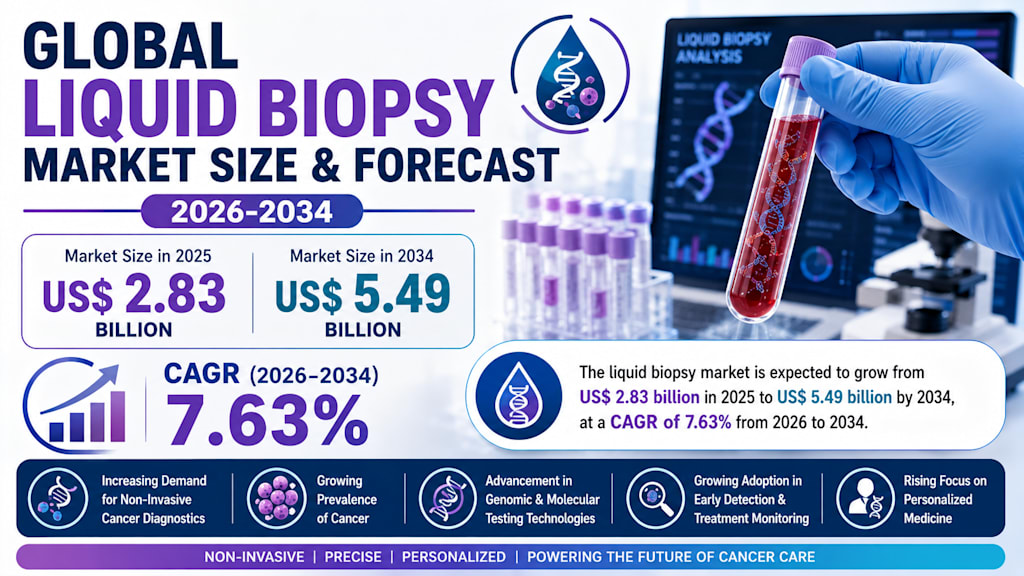
According to Renub Research, the Global Liquid Biopsy Market is expected to grow from US$ 2.83 billion in 2025 to US$ 5.49 billion by 2034, expanding at a compound annual growth rate (CAGR) of 7.63% between 2026 and 2034. This growth reflects rising demand for non-invasive cancer diagnostics, advancements in genomic technologies, and the increasing adoption of personalized medicine across healthcare systems worldwide.
What Is Liquid Biopsy?
Liquid biopsy is an advanced diagnostic approach that enables healthcare professionals to detect and analyze cancer-related biomarkers circulating within body fluids, particularly blood.
Unlike traditional tissue biopsies, which require the surgical removal of tumor samples, liquid biopsy relies on analyzing biological materials such as circulating tumor DNA (ctDNA), circulating tumor cells (CTCs), exosomes, and other nucleic acids released by tumors into the bloodstream.
Because the procedure only requires a blood sample or other body fluid, it is significantly less invasive and can be repeated multiple times throughout a patient's treatment journey. This allows physicians to monitor disease progression, evaluate treatment effectiveness, and detect potential recurrence without subjecting patients to repeated surgical procedures.
The technology has become increasingly valuable within oncology, where continuous monitoring and timely intervention can dramatically improve patient outcomes.
The Growing Global Cancer Burden Is Driving Demand
One of the most important factors fueling growth within the liquid biopsy market is the increasing prevalence of cancer worldwide.
Cancer remains one of the leading causes of death globally, creating an urgent need for diagnostic solutions that can identify disease earlier and improve treatment outcomes. Traditional diagnostic approaches often detect cancer only after symptoms appear or when tumors have already progressed to more advanced stages.
Liquid biopsy offers the potential to identify cancer-related genetic changes and biomarkers at much earlier stages, allowing healthcare providers to intervene sooner and potentially improve survival rates.
The scale of the challenge is substantial. According to projections highlighted in the report, the United States alone is expected to record approximately 2,041,910 new cancer cases and 618,120 cancer-related deaths in 2025. Common cancers include breast cancer, prostate cancer, lung cancer, colorectal cancer, melanoma, bladder cancer, kidney cancer, pancreatic cancer, leukemia, thyroid cancer, and liver cancer.
As cancer incidence continues to rise globally, healthcare providers are increasingly seeking innovative diagnostic tools capable of supporting earlier detection and more effective disease management.
Early Detection Is Changing Cancer Care
Early diagnosis has long been recognized as one of the most effective ways to improve cancer treatment outcomes.
When cancer is detected at an earlier stage, patients often have access to a wider range of treatment options and generally experience better survival rates. However, achieving early detection has historically been challenging for many cancer types.
Liquid biopsy offers a unique advantage by identifying molecular changes associated with cancer before clinical symptoms become apparent. The ability to monitor circulating biomarkers enables healthcare providers to detect disease progression and recurrence more rapidly than many traditional diagnostic methods.
This capability is particularly valuable because cancer is often dynamic, with tumors evolving over time and developing resistance to certain treatments. Continuous monitoring through liquid biopsy provides clinicians with real-time information that can support more informed treatment decisions.
As awareness of these benefits grows among both healthcare professionals and patients, adoption of liquid biopsy technologies is accelerating worldwide.
Advances in Genomic Technology Are Expanding Possibilities
Technological innovation is playing a central role in the evolution of liquid biopsy.
Recent advances in next-generation sequencing (NGS), digital polymerase chain reaction (PCR), bioinformatics, and molecular diagnostics have dramatically improved the accuracy and sensitivity of liquid biopsy testing.
Modern genomic technologies can detect low-frequency genetic mutations and identify complex tumor characteristics that were previously difficult to analyze through non-invasive methods. These capabilities enable more precise cancer profiling and support increasingly personalized treatment approaches.
Research and development investments by biotechnology companies continue to expand the range of cancers that can be detected and monitored using liquid biopsy technologies.
In April 2025, Labcorp expanded its precision oncology portfolio by introducing two new diagnostic solutions. One of these, Labcorp Plasma Detect, was developed to help assess post-surgery relapse risk in patients with stage III colon cancer. The company also introduced PGDx elio plasma focus Dx, the first FDA-approved prepared liquid biopsy test for solid cancers designed to support targeted therapy decisions.
Such innovations demonstrate how rapidly the field is advancing and highlight the growing clinical value of liquid biopsy technologies.
Precision Medicine Is Creating New Opportunities
The rise of personalized and precision medicine is another major factor contributing to market growth.
Traditional cancer treatments often rely on generalized treatment protocols that may not account for the unique genetic characteristics of individual tumors. Precision medicine seeks to change this approach by tailoring treatments to each patient's specific molecular profile.
Liquid biopsy plays a crucial role in this process by identifying genetic mutations, biomarkers, and molecular alterations that influence treatment selection. These insights help oncologists determine which therapies are most likely to benefit individual patients while avoiding treatments that may be less effective.
The technology also enables clinicians to monitor how tumors respond to therapy over time. If resistance begins to develop, liquid biopsy can identify molecular changes that may indicate the need for alternative treatment strategies.
Pharmaceutical companies increasingly use liquid biopsy during clinical trials and drug development programs because it helps identify suitable patient populations and supports more targeted therapeutic research.
In April 2025, Guardant Health announced a strategic partnership with Bayshore HealthCare in Canada to expand access to precision oncology solutions. The collaboration aims to make advanced liquid biopsy technologies available throughout Bayshore's nationwide healthcare network, supporting patients across the cancer care continuum.
Kits and Reagents Remain Essential Market Components
Kits and reagents represent one of the most important product segments within the liquid biopsy industry.
These products contain the materials necessary for collecting, preparing, isolating, and analyzing cancer-related biomarkers from patient samples. They enable researchers, diagnostic laboratories, and healthcare providers to conduct liquid biopsy testing with greater efficiency and consistency.
As liquid biopsy adoption continues to expand across clinical and research settings, demand for standardized, high-quality testing kits is increasing accordingly.
Diagnostic laboratories and research institutions rely heavily on these solutions to maintain accuracy, improve workflow efficiency, and support large-scale testing operations. The growing use of liquid biopsy in oncology research is further strengthening demand within this segment.
Circulating Tumor Cells Offer Valuable Insights
Among the many biomarkers analyzed through liquid biopsy, circulating tumor cells represent a particularly important area of research and clinical application.
Circulating tumor cells are cancer cells that detach from primary tumors and enter the bloodstream. By studying these cells, researchers gain valuable information about tumor biology, disease progression, and metastatic behavior.
Although circulating tumor cells are relatively rare and difficult to isolate, advances in detection technologies are making analysis increasingly practical and clinically useful.
Researchers continue exploring how circulating tumor cell analysis can support treatment selection, monitor therapeutic response, and improve understanding of cancer metastasis. As technologies improve, this segment is expected to play a growing role within the broader liquid biopsy market.
Diagnostic Laboratories Are Driving Adoption
Diagnostic laboratories represent one of the most important end-user segments within the liquid biopsy market.
Specialized laboratories conduct testing that supports cancer diagnosis, disease monitoring, treatment planning, and recurrence detection. To meet growing demand, many laboratories are investing heavily in advanced sequencing technologies, automation systems, and bioinformatics platforms.
Centralized laboratory models provide economies of scale and help improve access to sophisticated testing capabilities. Partnerships between hospitals, cancer centers, and diagnostic laboratories are also expanding the availability of liquid biopsy services.
As healthcare providers increasingly integrate precision oncology into routine practice, diagnostic laboratories will continue serving as key drivers of market growth.
Challenges Continue to Affect Market Expansion
Despite significant growth potential, the liquid biopsy market faces several important challenges.
One of the primary obstacles is cost. Advanced sequencing technologies, specialized laboratory equipment, and highly trained personnel contribute to relatively high testing expenses. These costs can limit accessibility, particularly in developing countries and resource-constrained healthcare systems.
Limited reimbursement coverage in some regions also affects adoption rates, as patients and healthcare providers may face financial barriers when considering advanced diagnostic testing.
Another challenge involves regulatory approval and clinical validation. Regulatory authorities require extensive evidence demonstrating the accuracy, reliability, and clinical usefulness of liquid biopsy technologies before approving widespread clinical use.
Conducting large-scale clinical trials and generating the necessary validation data requires significant time and financial investment. These requirements can slow commercialization efforts and increase development costs for manufacturers.
Regional Markets Continue to Expand
The United States remains the largest and most advanced liquid biopsy market globally. Strong healthcare infrastructure, high cancer incidence rates, extensive research activity, and widespread adoption of precision medicine continue to support market leadership. The presence of major biotechnology companies and diagnostic laboratories further strengthens the country's position.
Germany represents one of Europe's leading markets, benefiting from advanced healthcare systems, strong reimbursement frameworks, and significant investment in cancer research. The country's emphasis on personalized medicine and early diagnosis supports continued adoption of liquid biopsy technologies.
India is emerging as an important growth market due to rising cancer prevalence, increasing healthcare awareness, and expanding access to diagnostic services. Strategic partnerships and local technological development are helping make liquid biopsy solutions more accessible across the country.
Saudi Arabia is also investing in healthcare modernization and advanced cancer care programs. Government initiatives aimed at improving diagnostic capabilities and treatment outcomes are creating favorable conditions for future market growth.
Looking Ahead
The future of the liquid biopsy market appears highly promising. Growing demand for non-invasive diagnostics, increasing cancer prevalence, rapid advances in genomic technologies, and expanding adoption of precision medicine are creating strong momentum across the industry.
Healthcare providers are increasingly recognizing the value of liquid biopsy in supporting early detection, treatment monitoring, and personalized care. At the same time, biotechnology companies continue developing more sophisticated testing platforms capable of analyzing multiple cancer types with greater accuracy.
Leading organizations including Roche, Bio-Rad Laboratories, Thermo Fisher Scientific, Johnson & Johnson, Guardant Health, Illumina, Labcorp, QIAGEN, and Exact Sciences continue investing heavily in innovation, reflecting confidence in the market's long-term potential.
Final Thoughts
Liquid biopsy represents one of the most exciting advancements in modern cancer diagnostics. By offering a less invasive, highly informative, and increasingly accurate alternative to traditional tissue biopsies, this technology is transforming how cancer is detected, monitored, and treated.
With the market projected to approach US$ 5.5 billion by 2034, liquid biopsy is poised to become an increasingly important component of precision oncology and personalized medicine. Continued technological innovation, broader clinical adoption, and expanding access to advanced diagnostic solutions will further strengthen its role in improving patient outcomes around the world.
As healthcare continues moving toward more personalized and proactive approaches, liquid biopsy stands out as a powerful tool capable of reshaping the future of cancer care.
About the Creator
Enjoyed the story? Support the Creator.
Subscribe for free to receive all their stories in your feed.
Comments
There are no comments for this story
Be the first to respond and start the conversation.