
When the Theatre of Work Goes Dark
The Ghost in the Cubicle: When the Theatre of Work Goes Dark

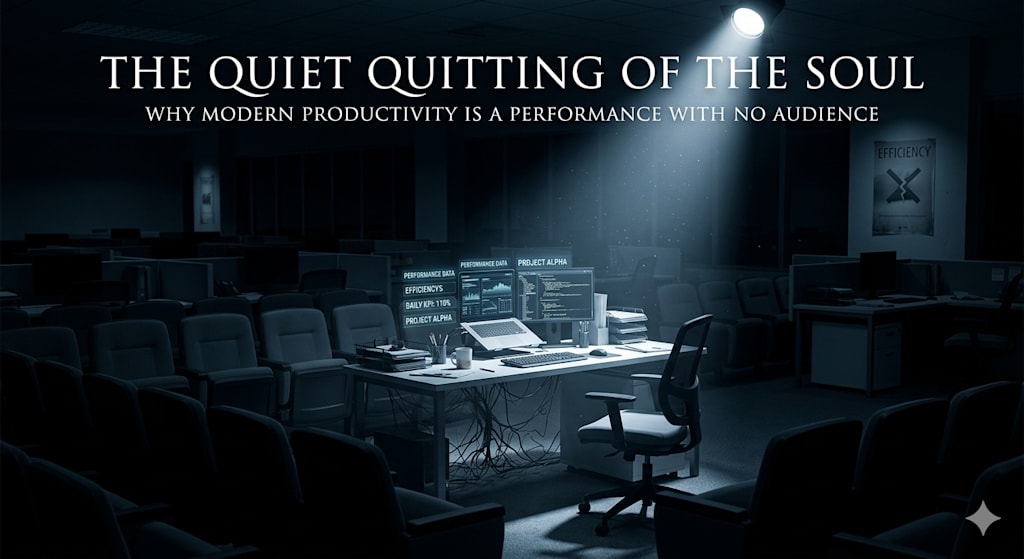
The Ghost in the Cubicle: When the Theatre of Work Goes Dark
I remember sitting in a glass-walled conference room three years ago, watching a senior vice president describe a new "synergy initiative" with the fervor of a man witnessing a religious miracle. He spoke of optimization, of pivoting toward a more "fluid ecosystem of deliverables," and as he spoke, I looked around the room. Every head was nodding. Every hand was scribbling notes. But when I looked into the eyes of my colleagues, I didn't see inspiration. I saw a profound, echoing absence. It was the look of someone who had left the building hours ago, leaving behind a perfectly programmed biological shell to handle the remaining meetings.
This wasn’t just burnout. It was the first time I truly recognized the "Quiet Quitting of the Soul." We talk about quiet quitting as a labor trend—a transactional boundary set by a weary generation—but that framing is too shallow. It treats the phenomenon as a simple dispute over hours and wages. In reality, we are witnessing a mass exodus from the very idea that modern work can provide a sense of self. We have reached the end of the era of the "Vocation," and we have entered the era of the "Performance." And the most exhausting part of any performance is realizing that the theatre is empty.
For decades, the narrative of the professional world was built on the theology of the meritocracy. If you poured your identity into your output, the world would reflect your value back to you. Your work was your contribution to the grand architecture of society. But as the digital age matured, the "output" became increasingly abstract. We stopped making things and started managing perceptions of things. We shifted from being builders to being curators of "impact." In this transition, the audience for our labor shifted too. It was no longer the community, the family, or even the self. The audience became the Algorithm—a cold, unblinking eye that demands constant movement but offers no recognition.
We find ourselves trapped in a strange, fluorescent purgatory where the metrics of success have become detached from the reality of human fulfillment. I see it in the way we "optimize" our LinkedIn profiles with the same care a medieval painter might have given a cathedral fresco. We are building monuments to a version of ourselves that doesn't actually exist, for people we don't actually know, in hopes of achieving a status that won't actually satisfy us. This is the performance with no audience. We are shouting into a void, and when the void doesn't shout back, something inside us simply clicks off.
The pivot point in this cultural shift isn't found in a spreadsheet; it’s found in the collapse of the "Social Contract of Meaning." Historically, humans could endure immense physical hardship if the work felt tethered to a tangible reality. A farmer might be exhausted, but the grain in the silo is an indisputable fact. A carpenter’s back might ache, but the chair exists. Modern productivity, however, is largely a series of linguistic maneuvers. We write emails about meetings that result in memos regarding the strategy of future emails. When the "product" of your life is a series of digital ghosts, the soul begins to feel like a ghost too.
I suspect that the "quiet" in quiet quitting isn't an act of defiance, but an act of mourning. It is the sound of people realizing that the "Grind" was a promise that failed to deliver. We were told that if we gave our lives to the machine, the machine would give us an identity. Instead, it gave us a burnout-induced haze and a collection of corporate platitudes. The soul quits because it refuses to be a secondary character in its own life. It retreats into the shadows of the psyche, waiting for something real to happen.
There is a common critique that this trend is merely a symptom of a pampered, "soft" generation. But that view misses the philosophical depth of the crisis. It takes a tremendous amount of internal strength to continue performing a role that you know is meaningless. The "High Achiever" who suddenly stops answering emails after 5:00 PM isn't being lazy; they are engaging in a desperate act of self-preservation. They are reclaiming the territory of their own attention. They are deciding that if the audience doesn't exist, they might as well stop the show and go home to themselves.
We have spent the last twenty years turning our lives into content. We have commodified our hobbies, our relationships, and our very thoughts, all in the service of a "Personal Brand" that is supposed to lead to professional security. But a brand is not a soul. A brand is a mask, and wearing a mask for sixteen hours a day is a form of spiritual suffocation. The quiet quitting we see today is the sound of millions of people taking those masks off at the same time. It is a collective sigh of relief that is being mistaken for a lack of ambition.
But if we stop performing, what are we left with? This is the question that haunts the modern professional. If I am not my title, my "key results," or my "professional network," then who am I? This vacuum is terrifying. It is the reason why many people continue the performance long after they’ve realized it’s a sham. The stage, however empty, provides a structure. Without the script of productivity, we are forced to confront the raw, unedited reality of our own existence—a reality that we have been taught to avoid at all costs.
Yet, perhaps this is exactly where the healing begins. The "Quiet Quitting of the Soul" might be the necessary precursor to a "Loud Reawakening of the Human." By acknowledging that the current theatre of work is a performance with no audience, we are freed from the obligation to be performers. We can begin to look for work that doesn't require us to leave our souls at the door. We can seek out "small" things—tangible, local, and human—that offer a different kind of audience: the person sitting across from us, the child in our lap, or the quiet reflection in the mirror that finally recognizes itself again.
The lights in the office towers may stay on all night, but the actors are leaving the stage. We are moving toward a world where the measure of a life is no longer how well we performed for the machine, but how much of ourselves we managed to keep out of its gears. As we step out of the fluorescent glare and into the actual night, we might find that the most important audience was the one we ignored for far too long: the quiet, steady pulse of our own humanity, waiting for us to come home.
Is it possible that the great resignation isn't about leaving jobs, but about returning to the parts of ourselves we thought we had to kill to survive? And if we finally stop performing for a void that will never love us back, what might we finally have the energy to build for each other?
About the Creator
Mo. Khalid
🎁 FREE PREMIUM GUIDE: Transform Your Life with Small Daily Habits! 🌟Are you tired of feeling sluggish, stressed, or unfocused?
https://1024terabox.com/s/1iUyn4d0wNGRjF5iLqb2DFg
Enjoyed the story? Support the Creator.
Subscribe for free to receive all their stories in your feed.
Comments
There are no comments for this story
Be the first to respond and start the conversation.