
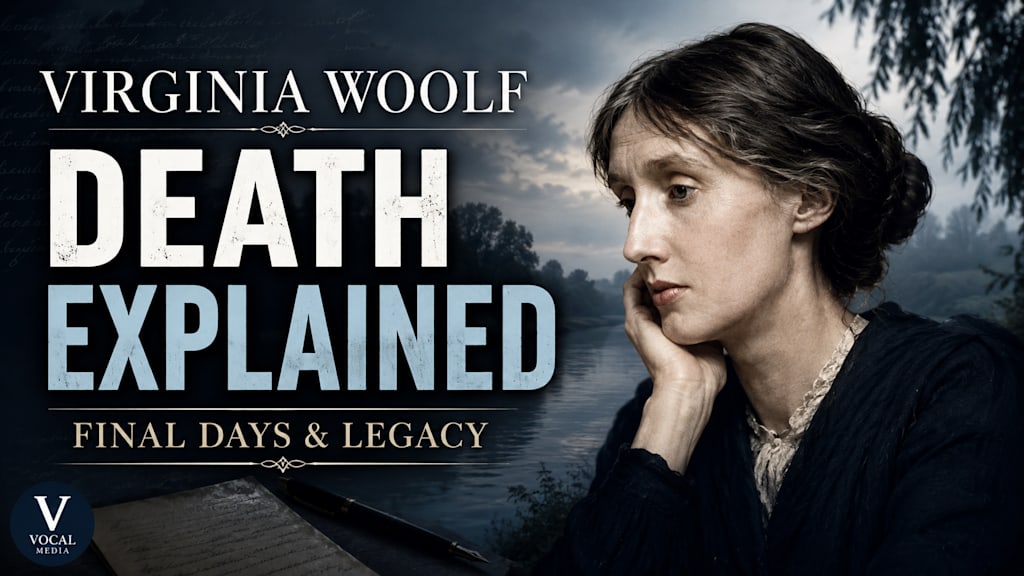
Virginia Woolf Death Explained: What Happened in Her Final Days and the Legacy She Left Behind
The tragic final chapter of one of the 20th century’s most influential writers — and why Virginia Woolf should be remembered for far more than the way she died.

Content note: This article discusses suicide and mental health.
Virginia Woolf remains one of the most important names in English literature. Even decades after her death, readers continue searching for how Virginia Woolf died, what happened during her final days, and why her life ended so tragically.
Her death is certainly a significant part of her biography, but focusing only on that moment risks overlooking an extraordinary literary career that transformed modern fiction.
Who Was Virginia Woolf?
Born Adeline Virginia Stephen on January 25, 1882, Virginia Woolf became a novelist, essayist, critic and publisher who helped shape literary modernism.
Her best-known works include Mrs Dalloway, To the Lighthouse, Orlando, The Waves and the influential essay A Room of One’s Own.
Rather than always telling stories in a straightforward chronological way, Woolf explored thoughts, memories and emotions inside her characters' minds. Her experimental approach to narrative helped change what readers expected a novel to be.
Together with her husband Leonard Woolf, she also established the Hogarth Press, which became an important part of Britain's literary world.
Virginia Woolf’s Struggles Behind Her Literary Success
Behind Woolf's remarkable career were periods of severe psychological distress.
Historical accounts describe repeated episodes of depression during her life. Yet reducing Virginia Woolf entirely to illness would give an incomplete picture of her story.
She continued writing, publishing and experimenting with literature despite difficult periods in her personal life.
The British Library has specifically noted how discussions of Woolf have sometimes placed so much emphasis on her depression and suicide that her achievements as a novelist, feminist thinker and intellectual have been overshadowed.
The Difficult Final Years of Virginia Woolf
The beginning of the Second World War created an increasingly dark environment around Woolf.
Britain was experiencing bombing, uncertainty and enormous social disruption. Woolf and Leonard's London home was damaged during the Blitz, adding another source of instability to an already difficult period.
At the same time, Woolf continued working on what would become her final novel, Between the Acts.
Documents preserved by the British Library include correspondence from Virginia and Leonard Woolf dating from March 1941, providing historical evidence from the period immediately surrounding her final days.
How Did Virginia Woolf Die?
On March 28, 1941, Virginia Woolf left her home in Sussex.
She died by suicide in the River Ouse near her home.
She was 59 years old.
Official historical records preserved by the UK's National Archives confirm March 28, 1941 as her date of death.
Before her death, Woolf wrote letters to people closest to her, including her husband Leonard and her sister Vanessa Bell. Those original letters are now part of the British Library's manuscript collection.
They have become some of the most discussed documents connected with Woolf's life, but they should be understood within the much larger story of a woman who spent decades producing groundbreaking literature.
The Story Should Not End With Her Death
It is easy for famous historical figures to become permanently associated with the circumstances of their deaths.
Virginia Woolf deserves something different.
Her books continue to be studied in schools and universities around the world because of the way she explored identity, memory, gender, relationships, time and the private lives of ordinary people.
A Room of One’s Own, published in 1929, became particularly influential in discussions about women, independence and creative freedom.
Mrs Dalloway examined a single day while moving deeply through the memories and internal experiences of its characters.
To the Lighthouse experimented with time, family relationships and loss.
And Orlando challenged traditional ideas about identity and gender decades before such discussions became common in mainstream culture.
Why Virginia Woolf Still Matters
More than eight decades after her death, people continue reading Virginia Woolf because her writing feels remarkably intimate.
She understood that enormous emotional experiences can exist beneath seemingly ordinary moments.
A conversation, a memory, a walk through London or a family gathering could become the foundation for an exploration of an entire inner world.
That may be Virginia Woolf's greatest legacy.
Her death on March 28, 1941 was a tragic conclusion to her life, but it was not the defining achievement of that life.
The more meaningful story is what came before it: a writer who challenged literary conventions, expanded the possibilities of the modern novel and left behind books that continue to influence readers and writers generations later.
About the Creator
parwinder singh
🎬 Movie & Entertainment Writer sharing reviews, ending explanations, story breakdowns, plot twists and hidden details from Bollywood, Hollywood, South Indian cinema, Korean dramas and OTT releases.
Enjoyed the story? Support the Creator.
Subscribe for free to receive all their stories in your feed.
Comments
There are no comments for this story
Be the first to respond and start the conversation.