
The Stranger Who Promised to Reveal Every Secret: A Digital Nightmare Behind the Screen
He claimed he could unlock any phone, recover every deleted message, and expose the truth hidden behind a password. But the people who trusted him soon discovered that the greatest danger was not the technology—it was the person behind it.

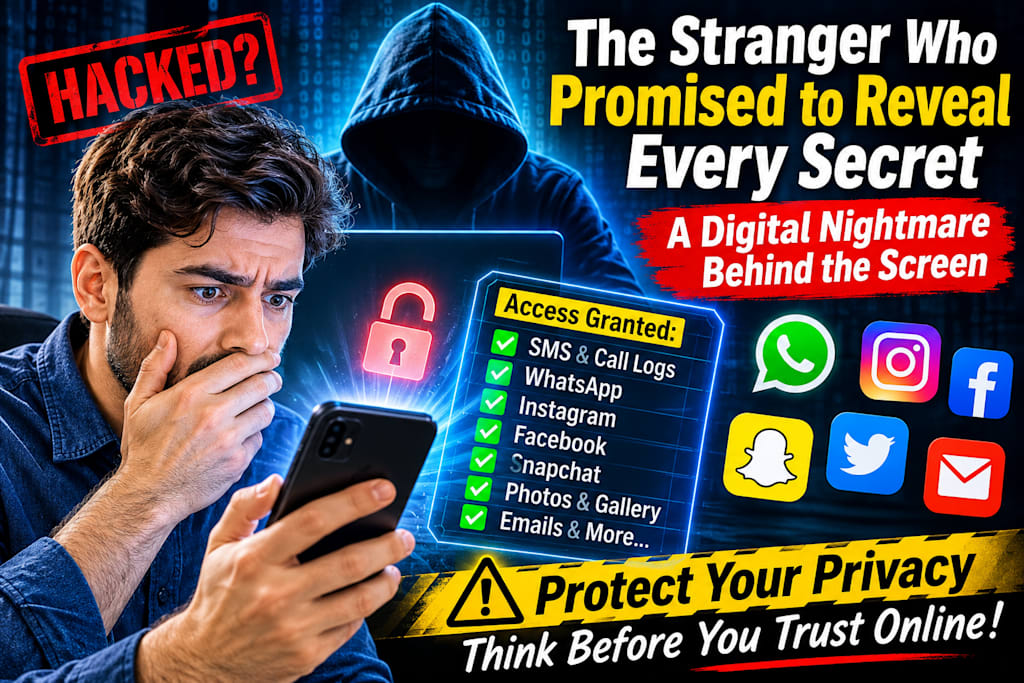
At 2:17 a.m., Daniel received a message that would change the way he looked at the internet forever.
The sender had no profile picture, no personal information, and no visible history. His message was short:
“I can show you everything someone is hiding on their phone. Deleted messages, private conversations, photographs, and social media accounts. Nothing stays secret.”
Daniel read it twice.
At first, he laughed. The internet was full of people making extraordinary promises. But something about the message caught his attention.
For months, he had suspected that his closest friend was hiding something from him. He had no evidence, only unanswered questions and uncomfortable silence.
The stranger seemed to offer exactly what Daniel wanted.
And that was where the trouble began.
The Business of Selling Secrets
The following morning, Daniel searched online for similar services.
He found dozens of advertisements promising access to private phones without physical contact. Some claimed they could recover deleted WhatsApp messages. Others promised access to photographs, call records, social media accounts, and private conversations.
Their language was remarkably similar.
Complete access.
No installation required.
100% confidential.
Guaranteed results.
The advertisements were designed to sound professional. Some included testimonials, impressive photographs, and contact information.
But Daniel noticed something strange: none of the advertisers provided reliable evidence that their services actually worked.
He began wondering whether the people behind these advertisements were real hackers or simply criminals searching for vulnerable customers.
He decided to investigate further.
A Dangerous Conversation
Daniel contacted one of the advertisers using a separate email account.
The response arrived quickly.
The person introduced himself as a cybersecurity expert and claimed to have years of experience accessing smartphones remotely. He promised that no one would discover the activity.
Daniel asked how the service worked.
The stranger avoided giving a clear explanation.
Instead, he asked Daniel for personal information, payment, and details about the person whose phone he wanted to access.
Then came another request: an additional payment for a special security procedure.
Daniel became uncomfortable.
When he asked for verifiable professional credentials, the stranger changed his tone.
He insisted that Daniel should trust him. He even claimed that several satisfied customers had used his services successfully.
But there was no independent proof.
The more Daniel questioned him, the more aggressive the conversation became.
Something was wrong.
When Curiosity Becomes a Trap
That evening, Daniel received another message.
This time, the stranger warned him that delaying the process could make the service more expensive.
He also sent a photograph supposedly showing private information recovered from another customer's phone.
Daniel could not verify whether the photograph was genuine, stolen, or completely fabricated.
For the first time, he understood how easily someone could manipulate another person's curiosity.
People often search for secret information because they are worried, jealous, suspicious, or desperate for answers.
Scammers understand those emotions.
They do not necessarily need sophisticated technology to exploit someone. Sometimes, they only need to understand what that person fears losing.
A promise to reveal someone's secrets can become a powerful weapon.
The Real Target Was Daniel
Two days later, Daniel received an unexpected notification from his email provider.
Someone had attempted to access his account from an unfamiliar location.
He immediately changed his password and reviewed his security settings.
Then he remembered the information he had shared during his conversation with the supposed hacker.
He had not provided his main password, but he had shared more personal details than he should have.
The stranger might have been collecting information rather than offering a genuine service.
Daniel reported the suspicious account and stopped communicating with it.
He also warned his friends not to trust advertisements promising unrestricted access to private phones.
His investigation had revealed something important: the person promising to expose someone else's secrets might actually be trying to steal yours.
The Hidden Cost of Digital Surveillance
The experience forced Daniel to think about something he had previously ignored.
A smartphone is not simply a device for making calls or sending messages.
It contains photographs, conversations, financial information, personal documents, family memories, and sometimes years of private history.
When someone gains unauthorized access to that information, the consequences can extend far beyond embarrassment.
Private photographs can be misused. Personal conversations can be manipulated. Financial accounts can be targeted. Relationships can be damaged by information taken out of context.
And the victims may never know exactly how their privacy was compromised.
That is why digital security is not just a technical issue. It is also about trust, dignity, and personal safety.
No relationship should depend on secretly invading another person's private accounts. Concerns deserve honest conversations, not illegal surveillance.
The Lesson Daniel Never Forgot
Several weeks later, Daniel received another advertisement from a different account.
It made almost identical promises.
This time, he did not feel curious.
He recognized the language immediately and reported the advertisement.
He had learned that extraordinary claims require extraordinary evidence. A professional-looking profile, a collection of testimonials, or a confident message does not prove that someone is trustworthy.
Real cybersecurity professionals protect systems, investigate threats lawfully, and help people secure their information. They do not need to promise illegal access to someone's private life to demonstrate their expertise.
Daniel eventually understood that he had almost allowed his fears to make a decision for him.
He had searched for another person's secrets and nearly exposed his own.
The internet can connect people across continents, create opportunities, and make information available within seconds. But it can also give dishonest individuals a place to hide behind false identities and attractive promises.
Sometimes, the most dangerous person online is not the one who claims to be a genius hacker.
It is the stranger who knows exactly what you want to hear.
A final question for readers: If someone promised you access to every secret on another person's phone, would you trust them—or would you recognize that the person making the promise might be trying to steal your secrets instead?
About the Creator
Behind the Curtain
"Exploring the untold stories and hidden truths. From royal rumors to cultural deep dives, Behind the Curtain brings you bold, insightful narratives that spark curiosity and conversation."
Enjoyed the story? Support the Creator.
Subscribe for free to receive all their stories in your feed.
Comments
There are no comments for this story
Be the first to respond and start the conversation.