
The Six-Layer Training of Thinking: How to Get Sharper Without Overthinking Everything
A practical loop for pulling structure out of experience, testing your reasoning, and knowing when to stop.
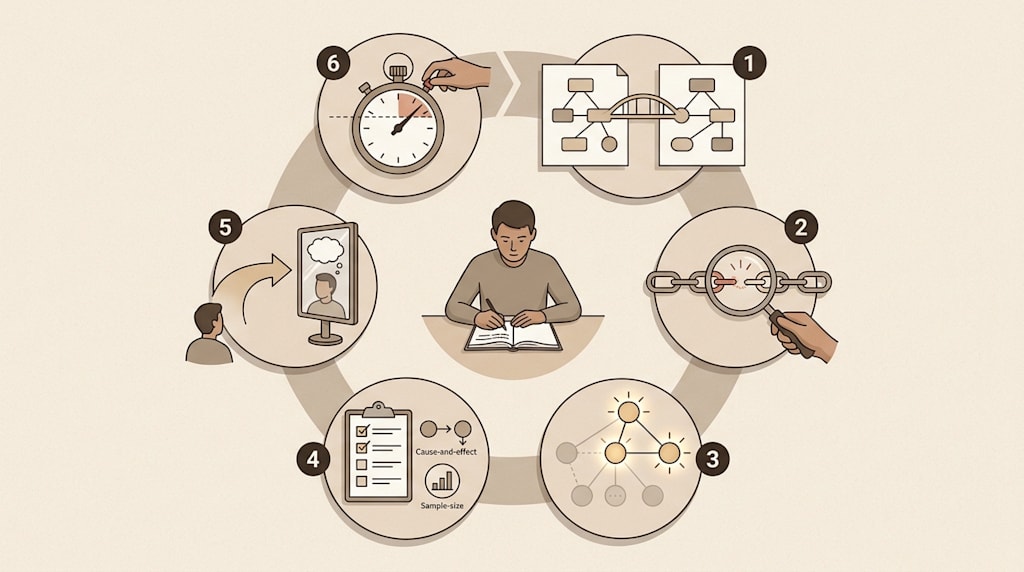
A useful model of thinking is a control loop: extract structure, interrogate mechanism, find the main contradiction, test reasoning, reflect and calibrate, decide when to stop. That loop matters because information changes faster than judgment. Someone who can pull a shared structure out of two different events, ask what makes a mechanism work, and correct a bad assumption will usually beat someone who only collects more facts.
1. Accumulate knowledge by extracting shared structure
Knowledge becomes useful when it stops being a pile of facts and becomes a set of structures you can carry into new problems.
Psychologists have studied this through analogical transfer. In a typical design, participants read two stories that share a similar solution structure. When they compare the stories and try to abstract the common principle, they are more likely to apply that principle to a new problem that looks unrelated on the surface. The more accurately they state the shared principle, the better their transfer tends to be.
Here is one example. The Moon’s gravity produces periodic motion in Earth’s oceans, which we see as tides. A star in a binary system is also affected by its companion’s gravity. The tidal interaction can influence the orbit and the star’s internal fluid motion. The surface phenomena differ: ocean water versus stellar fluid. The underlying structure is similar. Gravity produces tidal deformation, the fluid responds to external gravitational perturbation, and dissipation redistributes energy and angular momentum between spin and orbit.
That structure travels farther than the fact “the Moon causes tides.” If you understand gravitational perturbation, fluid response, and dissipative redistribution, you can carry that structure into binary-star evolution, planetary interiors, or other rotating fluid bodies.
After mapping an analogy, write down its boundary conditions: where does the shared structure stop holding? If you cannot name a failure condition, the analogy is decoration until you can.
2. Ask why until the mechanism shows
Take a stock market rally. A headline says “stocks rose on good news.” Ask a second question: which factors produced the rise, and which of them were necessary conditions? Was the good news a cause, a trigger, or a label attached after the move? Did money flow in because prices rose, or did prices rise because money flowed in? If you changed one condition, would the result still hold?
This habit exposes the illusion of explanatory depth. People often overestimate how well they understand how things work. They feel confident about zippers or bicycles until asked to explain the mechanism from beginning to end. Familiarity with a word or an image is not the same as understanding the causal chain.
A practical test: without notes, explain the phenomenon in plain language. Draw the causal chain. Name the weakest link. Give one counterexample or one condition under which the explanation fails. If you stall, mark the stall. That is the part you do not yet understand. Writing or speaking the explanation is part of the test. It is not a performance after the test.
3. Find the main contradiction, build a model, skip the rest for now
Real problems have many variables. A company’s growth slows. You can list the macroeconomy, industry cycle, competition, product iteration, organization efficiency, channel shifts, user reviews, exchange rates, and a dozen more. A person who tries to include everything will produce a description that is long, cautious, and useless for a decision.
A better move is to identify which factors decide the main result. This is close to modeling in science. A good model does not chase perfect accuracy. It keeps the mechanisms that determine the system’s main behavior.
Write a sentence for each candidate factor: “If this factor changes, the main result changes; if that factor changes, the result barely moves.” Rank the factors by their effect on the decision you need to make. Keep two or three. Put the rest in a parking lot. The goal is to decide which detail deserves attention first. Ignoring detail comes later, after the model works.
4. Keep training reasoning
Reasoning can be improved with practice, including short training in explicit rules. The rules are simple. Using them under pressure is not.
If two events occur together, ask whether there is a common cause, reverse causality, or selection bias. If you hear several success stories, ask where the failures went. If you form a judgment from personal experience, ask how representative that experience is. If you feel strongly about a conclusion, ask what evidence would change your mind.
These questions put a brake on personal experience and emotion. They also slow the pull of prior views. They do not make judgment cold. They make judgment checkable. A person who can say “I saw this happen once” and then ask “What would I need to see to believe it happens generally?” is already ahead of someone who treats one vivid case as a law.
5. Reflect on the thinking process
Metacognition means knowing how your own understanding is built and where it breaks.
When you fail to understand a concept from a book, do not stop at “I don’t get it.” Ask: Is my prior knowledge insufficient? Is the logical chain too long for me to hold? Is the source’s explanation unclear or incomplete? When an outcome contradicts your judgment, do not rush to defend yourself. Check the assumptions you started with.
Treat “I was wrong” as an analysis event. Ask where the error came from: missing information, a jumped inference, a wrong model, or an execution problem. Each error type has a different fix. “I’ll be more careful next time” fixes none of them.
Reflection also needs external feedback. On your own, you can make a flawed logic sound more complete. Ask someone who knows more. Check real data. Listen to a serious opponent. The goal is to put your reasoning into a system that can correct it. Opinion collection is a side effect.
6. Know when to stop
Thinking well includes knowing when not to keep thinking.
Some questions deserve hours or months. Some need only a rough judgment with reduced precision. Time and attention are limited. If you demand full depth on every question, you will miss the questions that deserve depth.
Use a simple rule: decision cost × error cost × reversibility.
For a reversible, low-cost decision, decide quickly. If it is wrong, change it. For an irreversible, high-cost decision, slow down. Define the evidence that would change your mind. Check one reliable data source and one serious critic. Then decide when your threshold is met.
Do not spend thirty minutes choosing lunch and then choose a career move by mood. Depth belongs where error is expensive and hard to undo.
Closing rule
Before you deepen a question, write down four things: the decision, the cost of being wrong, whether the decision is reversible, and the evidence threshold that would make you stop. If the decision is cheap and reversible, set a short timer and decide. If it is expensive and irreversible, check one data source and one opposing view, then decide. Stop when the threshold is met.
About the Creator
Jin
Writer of reamstories
https://reamstories.com/jin
Enjoyed the story? Support the Creator.
Subscribe for free to receive all their stories in your feed. You could also become a paid subscriber, letting them know you appreciate their work.
Comments
There are no comments for this story
Be the first to respond and start the conversation.