
The Screw Elon Musk Kept in His Pocket for 8 Years
A biography that refuses to explain him—only shows what his hands did while the world talked.
In the cockpit of Joshua Haldeman's small plane, the compass on the instrument panel had already drifted twelve degrees. He folded a corner of his chart, slid it into the leather pouch beside his leg, and turned to his wife Winnifred. "Enough fuel to make Recife." Five children squeezed into the rear cabin; the youngest clutched a mimeographed copy of Technocracy Study Course, its cover curled at the edges. The cabin smelled of aviation gasoline and vomit. Winnifred said nothing. She handed a damp cloth to the back, wiping a child's mouth.
Years later, the wreckage of that plane would rust to a skeleton in a South African hangar, and in that mimeographed pamphlet, the phrase "abolish money, rule by engineers" would be crossed out by Winnifred with a fountain pen. Beside it she wrote a line: "Joshua, they dissolved the council."
Kimbal Musk dug up this story when Elon was fourteen. Elon pulled the annotated pamphlet from the bottom shelf of his mother Maye's bookcase, turned three pages, closed it, put it back. Then he shoved his own copy of The Hitchhiker's Guide to the Galaxy into his school bag. The zipper didn't close all the way; a strip of the spine poked out.
He didn't yet know what "leaving" meant, but his body already knew. Every time his father Errol walked into the room, his shoulder blades tightened automatically, like a cat encountering cold water. At the dinner table, he would push peas one by one to the left side of his plate, then back to the right, until Errol called him "stupid, just like your mother's side of the family."
Jacaranda trees lined the streets of Pretoria's wealthy suburbs, and fallen petals lay purple on the ground. But what Elon remembered most clearly wasn't the color of the flowers—it was the viscosity of blood.
He was fifteen that year. He went with Kimbal to an anti-apartheid concert. As the crowd pushed out at the end, he stepped into a pool of deep-red liquid. His sole made a soft splat, like crushing an overripe mango. He looked down and saw a body beside him, a knife handle sticking out of the chest, the blade entirely buried. Kimbal tugged his sleeve. He didn't move. He stared at the shoe for four seconds. Then he lifted his foot, walked to a dry patch of dirt by the roadside, and scraped the sole five times until it stopped making noise.
Three months later, a group of schoolmates pushed him from the top of a concrete stairwell. The fall lasted longer than he expected. When the back of his head hit the edge of a step, he heard his own teeth clack together. Then came fists and feet. He covered the back of his head with both arms and curled into a fetal position. He smelled shoe polish on his attackers' shoes. Before he lost consciousness, he heard one of them laugh and say, "This half-breed is fucking weird."
Errol stood in the hospital corridor for ten minutes. He did not enter the room. A nurse handed him a visitor's log to sign. He signed, placed the pen on the counter, and said, "Let him learn his lesson."
After he was discharged, Elon pinned a map of the United States on his bedroom wall and circled Silicon Valley in red. The red pen ran out of ink. He sharpened the tip of a pencil, continued drawing the circle until the paper roughened and nearly tore.
The day Zip2 sold in 1999, Elon saw the number 22,000,000 on the balance alert on his phone screen. He turned the screen toward Kimbal. Kimbal was eating a burger; a piece of lettuce fell onto his plate. He said, "So you can pay your rent now." Elon took the phone back. He didn't smile. That night he started writing the business plan for the next company. He typed until four in the morning; pizza crumbs accumulated between the keyboard keys.
That company was called X.com. A year later, it merged with Confinity and became PayPal.
September 2000. Elon was on his honeymoon in Australia. The room phone rang. He picked up and heard Peter Thiel's voice. Thiel said, "The board voted. You're out." Elon switched the receiver to his other ear. His right hand found his wedding ring on the table—he had taken it off before his shower. He pinched it between thumb and forefinger, rotated it half a turn, set it down. He took a sheet of hotel notepaper and wrote a line of code logic, then crossed it out, wrote another, crossed that out. Justine asked from the bathroom who was on the phone. He answered, "Work stuff."
After hanging up, he walked onto the balcony and stood there for six minutes. A seagull perched on the railing, tilting its head at him. He crumpled the scribbled notepaper into a ball and tossed it at the bin. The ball bounced off the rim and landed on the floor. He didn't pick it up.
Kwajalein Atoll.
The wreckage of the third failed launch still smoked on the beach. Elon crouched beside the stump of the launch mount, turning a warped, burnt bolt over and over in his right hand. The bolt came from the second-stage engine, which had stuck for 0.3 seconds. He flipped it, dug a fingernail into the carbon black caked in the threads, scraped until the grooves showed clean metal. His fingertips grew slick with dark grease. No one dared approach. Kimbal stood fifty meters away, shifting a water bottle from his left hand to his right. In the end, he did not walk over.
His phone buzzed. A South African number lit up the screen. Elon answered. He said nothing.
Errol's voice carried the hum of a swimming pool filter. "I saw the news. Your rocket blew up again. I always told you you're not cut out for hardware. At least your brother knows how to sell a company. You can't even learn that."
Elon closed the bolt inside his left fist; the charred threads bit into his palm. He switched the phone to his other ear, his vocal cords scraped raw. "You called just to say that?"
"You're weeks from bankruptcy. Nobody wants your electric car company. You can come back to South Africa. I need someone to manage the mine."
Elon stood. His kneecap gave a small click. He tossed the bolt into a nearby iron bucket full of debris. Clang. A few seabirds startled up. He said into the phone, "I'll put the next rocket on the pad. If you call again, I'll give this number to a scam syndicate." He hung up. He shoved the phone into his pocket. The fingers of his right hand trembled slightly. He gripped the seam of his trousers until the knuckles steadied.
That night he didn't go back to the temporary quarters. He walked into the engineers' trailer, pulled up every channel of telemetry data, and began replaying frame by frame from the first anomaly. As he watched, he gnawed a stale crust of pizza. On the third bite he realized a tiny flake of rocket paint was stuck to it. He spat the paint chip into a napkin and continued to the next frame.
That same week, Tesla had only enough cash left for one more payroll. Elon sat on a folding chair in the Fremont factory. Three term sheets lay in front of him. Each demanded he surrender control. He picked up the first, read one page, set it down. He picked up the second, set it down. Halfway through the third, he removed his glasses, wiped the lenses with the hem of his shirt—three wipes—put them back on, and signed the last page. The tail of the final letter "k" in his signature dragged long and tore through the paper.
Winter 2017. At the end of the Fremont assembly line, a gray sleeping bag was stuffed under a plastic shelving unit. Next to it sat six empty Red Bull cans, arranged mouth-down in a row. A seventh stood upright, still unfinished.
Elon lay on the sleeping bag, his phone screen illuminating his face. He had just posted a tweet: "Tesla will go bankrupt? Possibly." After pressing send, he laid the phone screen-down on his chest and closed his eyes. The LED panels in the ceiling emitted a steady hum. A screw rolled off the conveyor belt and bounced, tink-tink-tink, coming to a stop beside his hand.
He picked up the screw, wiped the machine oil off it with his fingers, and held it up to the light to check its threading—no wear. He put the screw into his pocket, stood, and walked to the quality-control station. The QC engineer was asleep at the desk, a defect report open in front of him. A gap error was circled in red: 0.7 mm.
Elon didn't wake him. He pulled the red pen from the engineer's hand, drew a downward arrow beside the 0.7 mm figure, and wrote: Must ≤ 0.5. He capped the pen, placed it back beside the engineer's fingers, and turned to walk back to the assembly line.
At the same time, Martin Eberhard's legal letter arrived at the Palo Alto office. The envelope was opened and laid flat on the desk. Elon glanced at the opening paragraph, then turned the page over and began sketching a battery layout for Model 3 on the back. As he drew the third row of cells, the pen leaked, leaving a small blot of blue-black ink on the webbing between his thumb and forefinger. He finished the sketch before going to wash his hands.
Late one night in 2022, Elon sat in a conference room at Starbase, Texas. In front of him was a whiteboard. It had no formulas, only a column of names—someone else had written them during an earlier strategy meeting. His eyes fixed on the top name: Bill Gates.
His phone screen lit up with an alert: the Gates Foundation had increased its short position against Tesla to five hundred million dollars. Elon lifted the phone to his mouth and dictated: "He thinks shorting Tesla will solve climate change faster? He won't even disclose his own fund's carbon footprint." After the message went out, he placed the phone on the whiteboard ledge, stood, walked to the window, and wiped a streak across the glass with his index finger. The light from the launch tower outside shone through the clean track.
The next morning, his assistant placed three newspapers on his desk. The New York Times headline read about injury rates at the Tesla factory. The Washington Post headline was about conflicts of interest in his government contracts. The Wall Street Journal mentioned the shareholder lawsuit over the SolarCity acquisition. Elon picked up the New York Times, tore off the front page, folded it into a paper airplane, and launched it diagonally across the office. The plane hit the wall and dropped into a potted pothos.
He then opened his laptop and began drafting the offer to acquire Twitter.
That same year, his email exchange with Jeff Bezos leaked. A message from Bezos read: "Rules should apply equally to all participants." Elon's reply was a single line: "Fly your rocket first, then talk to me about rules." Time of reply: 2:47 a.m. After sending, he closed the email client and clicked on a replay of Blue Origin's latest launch. When the booster recovery failed, he picked up his coffee mug, took a sip of water, and set it back on its coaster. A ring of moisture spread at the coaster's edge.
February 2025. Kimbal forwarded a link to his private messages: a petition on Canada's parliamentary website demanding the revocation of Elon's Canadian citizenship. The signature count was climbing by the tens of thousands every second. Elon tapped the link, scrolled quickly, and saw the highest concentration of signatures came from Ontario. He placed the phone on the table, picked up a Sharpie, and wrote on the back of a discarded circuit board: Next step, they'll revoke air. He bit the cap off the marker, held it between his teeth, tasting the acrid plastic.
Three days later, at a dinner at Mar-a-Lago, Trump said in front of a full table: "I might have to let DOGE go back and eat you." Elon was cutting a piece of steak; the blade scraped the porcelain with a faint shriek. He set the knife on the right side of his plate, switched his fork from left hand to right, speared a piece of meat, chewed for fifteen seconds, swallowed, then said, "I'm the one who named DOGE." Trump's laughter came across the table, sounding like an outdoor AC unit kicking on. The rest of the table silently dipped bread into their soup.
Two months later, in the same dining room, the two men sat at the same table again, signing a new cooperation agreement. The pen was different; the paper was from the same batch of official stationery. Elon signed, capped the pen, and slid it back toward Trump. Trump didn't take it; he let an aide collect it. As Elon walked out, he pulled a DOGE commemorative coin from his pocket, flipped it with his thumb, caught it, and returned it to his pocket.
In New York, Elizabeth Warren's voice filled the televised congressional hearing. The feed cut to Elon in the witness seat. In front of him sat a glass of water and a stack of documents he had brought himself. Warren said, "It would take an average American family more than eleven million years, without spending a single cent, to earn Mr. Musk's current wealth." Elon unscrewed the water bottle cap, took a sip, screwed it back on—three clockwise turns—and spoke into the microphone: "Senator, several clauses in your tax plan would directly crush Tesla's suppliers. Do you want me to read them out?" He pulled a spreadsheet from his stack, traced his finger down a column of figures, and stopped at the third row, waiting for an answer.
After the hearing ended, CNN commentators used words like "anti-human," "monopolist," and "mental state." As the broadcast aired, Elon was on the roof of a Starlink ground station, adjusting an antenna. He tightened a bolt with a wrench—two and a half clockwise turns until the bolt bit down. He took out his phone, opened X, and typed a line: "The media uses 'mental issues' as a disclaimer. I'm used to it." His thumb hovered over the send button, paused for a second, then pressed. He muted the phone and kept tightening the next bolt.
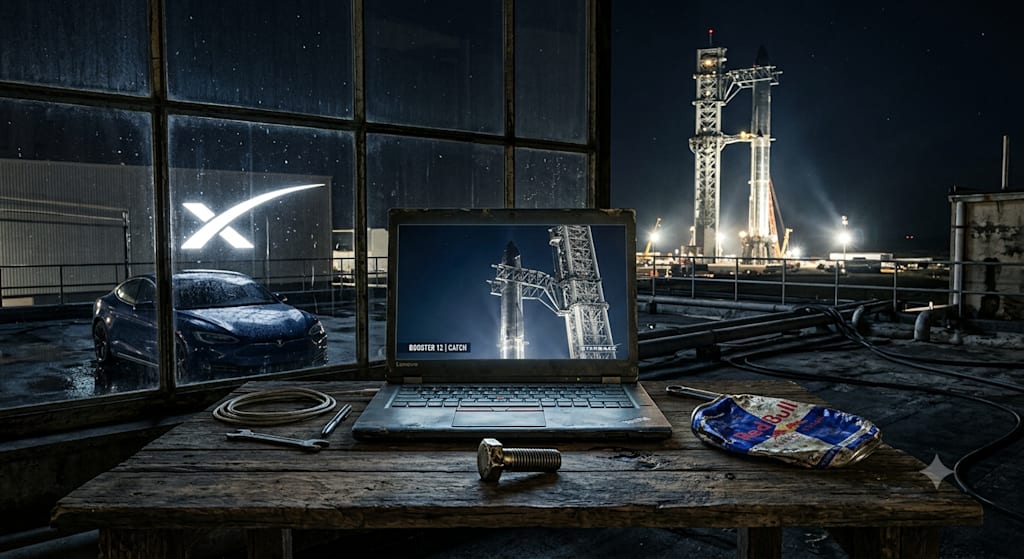
Three a.m. on an ordinary Wednesday in 2025. The roof of the Austin Tesla Gigafactory. Elon sat on an aluminum folding chair, a temporary small desk made of bolted planks in front of him. On it lay an open MacBook, the screen playing the fourth test flight replay of SpaceX's Starship—the moment the booster was caught by the tower's mechanical arms. He had replayed that moment sixteen times.
The Red Bull can was empty. He turned it upside down, waited five seconds. One last drop landed on his thumb. He crushed the can flat, put it in his pocket. Reaching into his trouser pocket, his fingers brushed against a screw—the same one he had picked up off the factory floor in 2017. The screw had been in his pocket all those years; the oil on its surface had long dried, leaving only a faint scent of rust.
He took the screw out and set it on the small table, its hex head aligned with the center of the Starship replay. Then he stood. The folding chair slid back a few centimeters, scraping against the concrete floor.
He walked into the stairwell and descended, his heels echoing hollowly against the steel steps. Forty-three steps. He had counted.
On the ground floor, he pushed open the security door and walked to the Model S in the parking lot. The window glass reflected the glow of the X logo overhead. That X logo was new, installed three months ago. The old blue bird emblem had been removed and placed on the third shelf of the warehouse rack, with a label showing a date: October 27, 2022.
He pulled open the car door and got in. The system automatically resumed playing an old song. He tapped the steering wheel twice with his knuckle, then gripped it, shifted into gear. The headlights painted two white arcs across the concrete floor as he drove out.
Behind him, the automatic parking lot door lowered slowly. When the rubber seal met the ground, it produced a muffled, heavy thud.
About the Creator
Jin
Writer of reamstories
https://reamstories.com/jin
Enjoyed the story? Support the Creator.
Subscribe for free to receive all their stories in your feed. You could also become a paid subscriber, letting them know you appreciate their work.
Comments
There are no comments for this story
Be the first to respond and start the conversation.