
The Invention Born from Traffic Chaos: How the Parking Meter Saved Downtown Businesses
Today, whenever we see a parking meter or open a mobile app to pay for a parking spot in a crowded city center, most of us feel a slight wave of annoyance. We view parking fees as an unwelcome municipal tax, a modern hassle designed to drain our wallets.
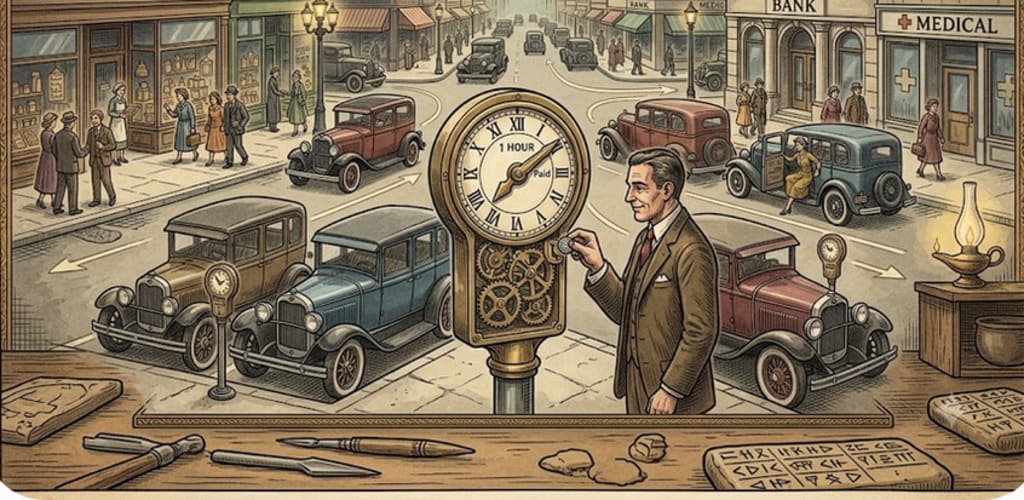
However, back in 1935, when the very first mechanical parking meters appeared on the streets of America, the public reaction was the exact opposite. The groundbreaking invention was enthusiastically welcomed by local retailers, business owners, and even drivers themselves. For them, this strange little mechanical box represented the only functional, logical solution to a devastating economic and traffic collapse that was paralyzing the hearts of growing American cities.
The massive, unprecedented boom in automobile ownership during the 1920s and 1930s presented urban planners with a sudden crisis they had never anticipated—a chronic, suffocating shortage of parking capacity. Up until that point, downtown city streets had absolutely no time limits or financial restrictions regarding parking. Cars were a new luxury, and the rules of the road were still being written. Consequently, office workers, bank clerks, and store employees would arrive early in the morning, park their vehicles directly at the curbs of the main business avenues, and leave them sitting there until they clocked out in the evening.
This stagnant behavior completely paralyzed the local downtown economy. Potential customers who actually wanted to drive into the city center to shop, deposit money at the bank, or visit a doctor found absolutely nowhere legal to park. For ordinary drivers, this meant that the simple act of running an errand turned into a nightmare; crawling through traffic and circling the block for hours was incredibly stressful and exhausting. For store owners, it meant empty shops and a drastic, terrifying drop in daily revenues.
By 1933, the critical situation reached a breaking point in Oklahoma City. The streets were choked with cars, and businesses were desperate for a solution. Carl C. Magee, a sharp lawyer and local journalist who had been appointed chairman of the city’s traffic committee, realized a fundamental psychological truth: the only way to force drivers to move their vehicles and clear the spaces was to implement a strict time limit that could be easily and instantly monitored by law enforcement. Magee envisioned a mechanical device that would merge a simple countdown timer with a financial fee. Collaborating with engineers from the University of Oklahoma, he successfully developed a robust mechanical apparatus called the "Park-O-Meter." The world’s first 150 units of these mechanical parking meters were officially installed along the bustling curbs of Oklahoma City in July 1935.
The construction and operation of Magee’s invention were built on absolute mechanical simplicity. After pulling into a vacant spot, a driver was required to insert a single nickel coin (a five-cent piece) into the slot of the machine. This action instantly triggered a spring-loaded clockwork mechanism inside, which started a sixty-minute countdown, turning a prominent indicator window green. As soon as the permitted hour expired, the internal gears shifted, and a bright red flag with the word "Overtime" popped up in the display window. A passing police officer walking the beat could instantly spot the violation from yards away without needing to manually log times, check tires with chalk, or perform complex measurements. The officer could simply write out a ticket on the spot.
The introduction of these automated meters was an immediate, overwhelming logistical and economic triumph. The threat of a financial penalty forced drivers to shorten their stays to the absolute minimum required, which drastically increased the turnover rate of parking spaces. Instead of a single car clogging a spot for eight hours, up as many as eight different automobiles could utilize the exact same space throughout the business day. Retailers in the city center witnessed an immediate return of eager customers, and the revolutionary system began generating a massive, incredibly stable stream of revenue for the city treasury with virtually non-existent operating costs.
While those primitive mechanical boxes have long been replaced by digital touch-screen terminals, license-plate scanners, and slick mobile applications, the core economic principle remains entirely unchanged: public space in densely populated areas is a highly valuable, finite commodity. It can only be distributed fairly among citizens if its consumption is clearly regulated by time and money.
Sources:
Smithsonian National Museum of American History – Historical collections, technical blueprints, and archival records regarding the 1935 Park-O-Meter.
Oklahoma Historical Society – Studies on the urban development of Oklahoma City, Carl Magee’s traffic reforms, and the economic impacts of early parking regulations.
About the Creator
Enjoyed the story? Support the Creator.
Subscribe for free to receive all their stories in your feed.
Comments
There are no comments for this story
Be the first to respond and start the conversation.