
The Difference Between a Twin Flame and a Karmic Relationship (Most People Get This Wrong)
How to Tell Whether Your Intense Connection Is Helping You Grow or Keeping You Trapped in Painful Patterns


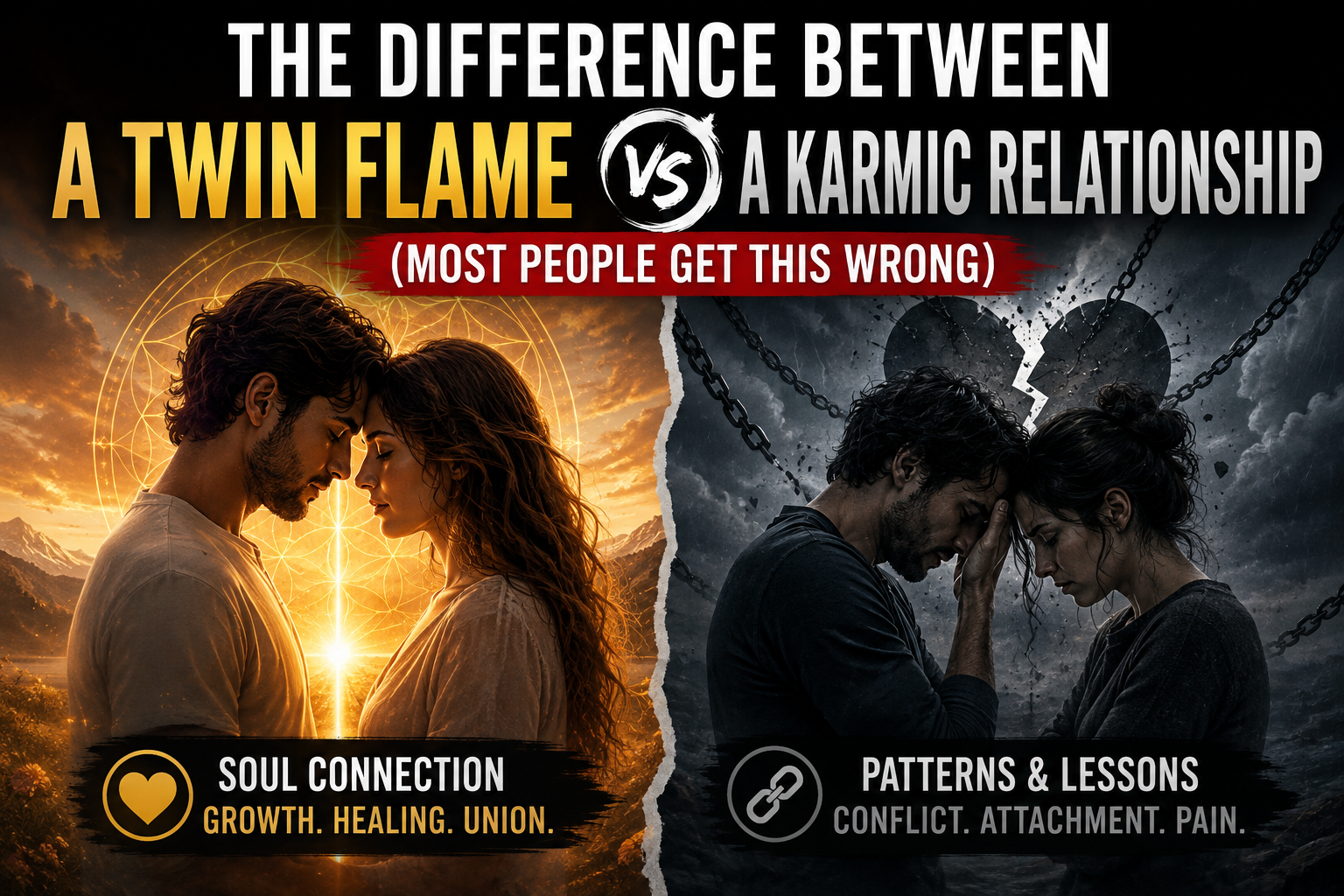
For almost a year, I called the wrong relationship by the wrong name, and that mistake cost me more than I like to admit. I told everyone—friends, family, and most convincingly of all, myself—that I had met my twin flame. I used the word with total confidence, as one does with a word misinterpreted and never questioned. It was only much later, after that relationship had run its course and I'd had the distance to actually study what I'd lived through, that I understood I hadn't been in a twin flame connection at all. I'd been in a karmic one. And the difference between those two things, I now believe, is one of the most misunderstood distinctions in all of spiritual relationship language.
I want to walk you through what I got wrong, because I think almost everyone misinterprets some version of it wrong the first time they encounter an intense, difficult connection and reach for the most dramatic label available to explain it. "Twin flame" has become a catch-all term for any relationship that feels overwhelming, and "karmic" has become an afterthought—a lesser category, almost an insult, as though it means "not exceptional enough." Neither of those things is true, and understanding the actual difference changed how I understood not just that relationship, but every connection I've had since.

The Mistake I Made First: Confusing Intensity With Category
When I met him, everything about the connection felt enormous. Instant recognition. Conversations that went on for hours without either of us noticing the time. A sense of familiarity so strong it felt less like meeting someone new and more like remembering someone I'd somehow forgotten. Naturally, when I went looking for language to explain what I was feeling, I found the term "twin flame," and it fit like a key sliding into a lock. Nothing else I'd read seemed to capture the scale of what I was experiencing.
What I didn't understand at the time is that intensity alone tells you almost nothing about which category a relationship belongs to. Karmic relationships can be every bit as overwhelming, as instantly familiar, and as magnetically intense as twin flame connections—sometimes more so, because karmic bonds are specifically designed, in the framework I've come to understand, to surface unresolved patterns as forcefully as possible. The size of the feeling was never the distinguishing factor. I just didn't know yet what it actually was.
What a Karmic Relationship Actually Is
A karmic relationship, as I understand it now, exists primarily to teach—to surface a specific wound, pattern, or unfinished lesson from your past, whether that past is understood as this lifetime or, in some frameworks, a previous one. The defining feature of a karmic connection isn't how it feels in the beginning. It's what it demands of you by the end and how it typically resolves.
Karmic relationships tend to follow a fairly recognizable arc: intense attraction, rapid escalation, a period of genuine difficulty where old wounds repeatedly trigger, and then, eventually, a resolution that usually involves the relationship ending once its lesson has been learned. This is one of the most important things I misunderstood at the time—karmic relationships are, in most cases, temporary. Their entire function is tied to the lesson, and once the lesson is absorbed, the relationship has typically served its purpose, and the two people move on, sometimes amicably, more often through a difficult, clarifying rupture.
It just ended naturally, like a lesson does. Looking back at my relationship through this lens, everything fits with uncomfortable precision. The connection surfaced my abandonment wounds relentlessly, over and over, through a push-pull dynamic that forced me to confront exactly the pattern I'd spent years avoiding. And when I finally learned what it was trying to teach me—that I was repeating a cycle of chasing emotionally unavailable partners in an attempt to earn a security I'd never fully felt as a child—the relationship ended. Not dramatically. This concept just ended naturally, like a lesson does once you've actually understood it.
What a Twin Flame Relationship Actually Is
A twin flame connection, by contrast, is generally understood within this framework as something closer to a mirror than a teacher—two halves of a single soul, or two souls of extraordinarily similar vibrational origin, whose purpose isn't primarily to teach a lesson and then part ways, but to grow together, even when that growth requires periods of painful separation along the way.
The twin flame dynamic does often include intense difficulty—the well-known "runner and chaser" stage, periods of separation, and cycles of coming together and pulling apart. But the underlying purpose is different from a karmic connection's. Where karmic relationships tend to resolve through ending, twin flame connections tend to resolve through reunion—not because reunion is guaranteed or easy, but because the entire trajectory of the connection is oriented toward eventual union rather than eventual separation. The difficulty in a twin flame dynamic isn't there to teach you to let go. It's there to strip away everything in both people that isn't capable of sustaining real intimacy so that what's left, eventually, can actually last.
This is the piece I misunderstood most profoundly in my own situation. I kept waiting for our difficulty to resolve into reunion, the way twin flame stories are supposed to resolve, and I couldn't understand why it never did—why every cycle of separation and return just led to another, more painful cycle, rather than an eventual settling into peace. The answer, I now believe, is simply that I was applying the wrong framework. I was waiting for a karmic relationship to behave like a twin flame connection, and it never would, because it was never built for that outcome.

The Signs I Should Have Been Reading Differently
Once I understood the actual distinction, I went back through the entire relationship and found sign after sign I'd either missed or misread at the time.
That growth was marked by individual misinterpretations. In my karmic relationship, almost all the growth was individual—I was the one doing the internal work, confronting my patterns, while he remained largely unchanged throughout, or at least unchanged in ways that mattered. I think this distinction is important, and getting it wrong is significant. patterns, while he remained largely unchanged throughout, or at least unchanged in ways that mattered. In genuine twin flame dynamics, both people typically engage in internal work simultaneously, even during periods of separation, as the connection itself seems to demand mutual evolution, based on everything I've studied and heard from others living through these experiences. I think this distinction is important, and getting it wrong is significant. survive.
The emotional aftermath. After my karmic relationship ended, the overwhelming feeling was clarity—a sense of having learned something important, even through pain, and having no real desire to return to the relationship itself once the lesson had landed. Twin flame separations, by contrast, tend to leave both people with a persistent, ongoing sense of unfinished business, an ache that doesn't resolve into closure the way karmic endings often do, because the connection was never oriented toward ending in the first place.
The pattern is being repeated. My karmic relationship recreated a specific, identifiable wound from my past with almost eerie precision—it wasn't a new problem; it was an old one wearing a new face. Twin flame connections, from what I understand, tend to surface challenges that feel less like a repetition of the past and more like an accelerated confrontation with each person's deepest, often unrelated fears—fear of merging, fear of loss of self, fear of being truly seen—regardless of whether those fears trace back to a specific prior wound.
The role of timing. Karmic relationships often arrive at a specific, almost surgical moment—precisely when you're ready to learn the lesson they're carrying, and rarely a moment before. Twin flame connections, in the accounts I've studied, seem less tied to a single teachable moment and more to a long, unfolding timeline that can span years or even decades, unfolding in stages rather than resolving around one central lesson.
Why Getting This Distinction Wrong Matters
Or is it asking us both for an ongoing, mutual evolution that doesn't seem oriented toward ending at all, however difficult the path might be?I don't think this distinction is just a matter of semantics, and I don't think getting it wrong is a harmless mistake. I spent months waiting for a resolution that was never coming, because I'd assigned my relationship to the wrong category entirely. If I had understood, even six months earlier, that what I was in was karmic rather than a twin flame connection, I believe I would have released it far sooner—not out of failure or defeat, but out of an accurate understanding of what it actually was and what it was actually for.
Misapplying the twin flame framework to a karmic relationship keeps people waiting for reunions that were never structurally coming, because the relationship in question was never built for permanence in the first place. And misapplying the karmic framework to an actual twin flame connection can cause people to give up on a bond too early, releasing something that was always meant to resolve through eventual reunion, simply because the difficulty of the early stages looked, on the surface, like a lesson rather than a process.
The stakes of getting this right aren't abstract. They determine how long you wait, what you release, and how you interpret the pain you're moving through—as something to learn from and let go of, or as something to weather together, on the way to something that eventually holds.
How I Tell the Difference Now
These days, when I meet someone with that overwhelming, unmistakable intensity, I don't reach immediately for a label anymore. I wait and watch—not for how strong the feeling is, but for what the connection seems to be asking of me. Is it asking me to confront a specific, identifiable pattern from my past, with an ending built into its structure once that pattern is resolved? is rarely clear you.Or is it asking both of us, together, for an ongoing, mutual evolution that seems oriented toward a long-term commitment, however difficult the path there might be?
That question, more than any single sign or synchronicity, has become my real measure. Intensity, I've learned, will lie to you if you let it. The shape of what a connection actually demands from you . Irarely will.
I don't regret the relationship I mislabeled. It taught me exactly what it was supposed to teach me, even if I spent most of it waiting for a different kind of ending than the one it was always going to have. But I do think, now, that understanding the real difference between these two kinds of connections is one of the most useful things anyone navigating an intense relationship can learn—because it's the difference between waiting for something that isn't coming, and finally, accurately, letting go of something that was only ever meant to teach you, not to stay.
About the Creator
Wilson Igbasi
Hi, I'm Wilson Igbasi — a passionate writer, researcher, and tech enthusiast. I love exploring topics at the intersection of technology, personal growth, and spirituality.
Enjoyed the story? Support the Creator.
Subscribe for free to receive all their stories in your feed.
Comments
There are no comments for this story
Be the first to respond and start the conversation.