Stream of Consciousness
I FOUND A FROG
Even though I’m now a grandparent, the memory still feels as fresh as yesterday. I can still see myself as that small, curious six-year-old coming home from school, tossing my backpack to the floor, and racing into my room — only to freeze in my tracks and shout:
By Junaid Shahid about a year ago in Humans
All My Exes Hate Me Part 5 - The One Who Changed Everything
Sometimes I wish I was “normal” so we could've worked out. Spoiler: We wouldn’t have. I would’ve felt so lonely. Not because he’s a bad person. Not because he didn’t love me. But because even though I was a mess, he wasn’t able to give me the type of love I crave. Instead of avoiding and shutting down my feelings, I need communication and to be heard. If not, I WILL go to the internet. Just kidding.
By Gail Fredricksabout a year ago in Humans
Dark Psychology and Manipulation: The Hidden Games of the Human Mind
Introduction: The Shadow Side of the Mind We like to think we are in control—of our choices, our opinions, our lives. But what if that’s not entirely true? Beneath the surface of everyday interactions lies a web of invisible threads—crafted by words, tones, and behaviors—that can subtly steer us in directions we never consciously chose. This is the world of dark psychology—the art and science of manipulation, persuasion, and emotional control. It’s not magic. It’s human behavior, weaponized.
By Emad Iqbalabout a year ago in Humans
Sleepwalkers Who Never Came Back: The Bizarre Cases That Still Haunt Us
Unsolved Stories of People Who Vanished While Sleepwalking Sleepwalking has always been a strange phenomenon. People move, talk, and sometimes even cook — all while being completely unconscious.
By Leya kirsan official about a year ago in Humans
Your Brain Can’t Feel Pain — So Why Do Headaches Hurt?
The Brain Doesn’t Feel Pain – But Why Do We? 🤯🧠 Have you ever bumped your head so hard that it made you dizzy? Or felt a throbbing headache that made you want to crawl into bed and hide from the world? Now, imagine this: The very thing that seems to hurt — your brain — actually can’t feel pain. Yes, you read that right. Your brain, the command center of your entire body, has no pain receptors. That shocking fact has left scientists, doctors, and curious minds wondering for decades: If the brain can’t feel pain, then where is all that pain coming from? Let’s dive deep into this strange reality — and explore how pain works, what it means for us, and why this fact may just change the way you think forever. 💡 --- Your Brain: A Numb Genius The brain is made up of billions of neurons, synapses, and networks that control every movement, thought, and feeling you experience. It interprets sounds, processes images, and remembers your first heartbreak. But strangely, it can’t sense pain itself. That’s because the brain has no nociceptors, the specialized nerves responsible for detecting pain. So even during brain surgery — when a doctor literally opens up your skull — a patient can be awake and not feel pain inside the brain. (Sounds like science fiction, right? But it’s 100% real.) --- So Why Do Headaches Hurt So Much? 😖 If the brain can’t feel pain, what about migraines and tension headaches? Those are caused not by the brain tissue, but by other structures surrounding it. Things like: Blood vessels Muscles of the scalp and neck The meninges (the protective layers around the brain) When these areas get irritated or inflamed, the brain receives signals that something’s wrong — and interprets it as pain. But again, the origin isn’t inside the brain itself. It’s like the brain is sitting in a control room, watching alarm lights go off — but not feeling the fire directly. 🔥 --- Pain Is a Perception, Not a Location Here’s something even more mind-bending: Pain doesn’t live in the body — it lives in the mind. For example, if you stub your toe, it feels like the pain is coming from your foot. But in reality, the nerves in your toe send signals to your brain, and the brain creates the feeling of pain. This is why people with amputated limbs can still feel pain in a limb that’s no longer there. It’s called phantom limb pain, and it’s more proof that pain is a brain-based experience. --- What About Emotional Pain? 💔 Now, let’s stretch our thinking even further. Emotional pain — like heartbreak, grief, or betrayal — also activates some of the same areas of the brain that physical pain does. That’s why being left out or losing a loved one can physically hurt. The brain doesn’t distinguish much between a broken bone and a broken heart — it reacts to both with signals of distress, discomfort, and sometimes even tears. --- Why This Matters Understanding that the brain doesn’t feel pain helps doctors treat patients better. It’s why open brain surgery can happen with a patient wide awake — the doctors use local anesthesia for the scalp and skull, and the brain itself stays silent. It also opens up powerful conversations about how we experience pain — physically, emotionally, and even socially. Pain isn’t just about injury — it’s about how the brain interprets signals from the body and the world. And once we realize this, we can begin to understand our own experiences more clearly. --- Final Thought: Your Brain Is a Mystery and a Miracle 🧠✨ The fact that the brain can’t feel pain — yet is the very place where all pain is processed — is one of the most fascinating truths of human biology. It’s both strange and beautiful. And it reminds us that we are walking, breathing mysteries — shaped by the organ that knows us better than we know ourselves. So next time you get a headache, just remember: Your brain is working hard — even though it has no idea what pain actually feels like. 😅💭 --- 💧 Stay curious. Stay kind. And hydrate your brain — even if it can't feel the refreshment. 😊
By Leya kirsan official about a year ago in Humans
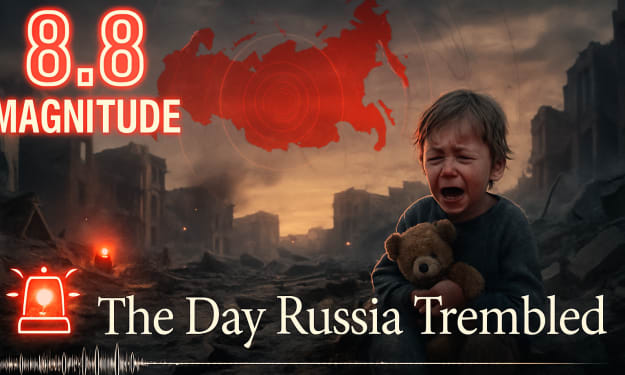
8.8 Magnitude: The Day Russia Trembled
I. The Morning That Started Like Any Other It was the kind of morning that gives no warning. Birds stirred in the Kamchatka trees. Fishermen readied their boats along the Pacific coast. Children tied shoelaces and packed lunches. In the eastern Russian town of Petropavlovsk-Kamchatsky, nestled on a peninsula surrounded by volcanoes, life was moving at its usual slow pace. Until it wasn't. At 6:42 AM local time on August 1st, 2025, the earth beneath the Kamchatka Peninsula began to shake. But this wasn’t a tremor. This was the kind of earthquake seismologists have nightmares about. 8.8 on the Richter scale. One of the most powerful quakes in Russian history. And perhaps one of the most catastrophic natural disasters of the decade. In less than a minute, over 11,000 lives were lost. Hundreds of thousands displaced. The land cracked open. Roads twisted into impossible shapes. Coastal towns were swallowed by water. Entire villages erased. II. A Fault Line Awakens Russia’s Far East sits on the edge of the Pacific Ring of Fire — a volatile zone where tectonic plates collide and pressure builds for decades before releasing in waves of raw destruction. This time, it was the Okhotsk Plate shifting beneath the Pacific Plate, just offshore from the Kamchatka Peninsula. Scientists later described it as a “mega-thrust event.” The sea floor lifted by 8 meters, displacing water and sending tsunamis hurtling toward the coast at terrifying speed. But no one had time to prepare. In the first 15 seconds, all phone towers in Kamchatka collapsed. In 20 seconds, power across the region vanished. By 30 seconds, buildings were falling. By 46 seconds, entire neighborhoods were reduced to dust. III. The Collapse In the city of Yelizovo, just 30 kilometers from the epicenter, local resident Mikhail Karpov, 37, was brushing his daughter’s hair when the wall behind them cracked open. “I heard this loud groaning, like the building was breathing,” he said later in a hospital interview. “Then it just started collapsing floor by floor.” He grabbed his daughter, barely managing to shield her as their five-story apartment block crumbled. He woke up hours later, trapped under a refrigerator and two layers of concrete. His daughter, Alina, was alive — cradled beneath his body, saved by his instinct. In Ust-Kamchatsk, near the coast, water rushed into streets like an angry tide. A tsunami, triggered by the earthquake, struck the town 23 minutes later, carrying boats, cars, animals, and homes with it. A drone video, now viral on social media, showed an entire wooden village being lifted from the ground and carried inland, as if floating on a sea of destruction. IV. The Rescue Begins Within hours, emergency declarations were signed in Moscow. The Russian Ministry of Emergency Situations dispatched 43,000 personnel, including search dogs, drone teams, field medics, and international assistance units from China, Turkey, France, and Japan. But they were racing against time — and nature. Aftershocks above 6.0 magnitude continued for days, shaking the ground beneath already unstable structures. Helicopters struggled to land. Roads were gone. Mountains had shifted. Survivors began digging with bare hands. In a small village near Klyuchi, locals used cooking pots to dig children from under a collapsed school. It took 17 hours, but 12 students and a teacher were rescued. One of those children, 9-year-old Sofia Morozov, would later tell Russian TV, “We sang songs in the dark, so we wouldn’t cry.” V. Heroes Without Headlines Tragedy often brings out the worst — but also the very best — in humanity. Anastasia Volkova, a 41-year-old schoolteacher, pulled 32 children into a basement moments before their classroom fell. She broke her leg in the collapse but refused rescue until all her students were safe. Sergi Ivanov, a firefighter from Petropavlovsk, worked for 27 hours non-stop, pulling people from a ruined supermarket. He only stopped after finding his own brother’s body. Rashid Karimov, a local imam, opened his mosque to shelter over 200 people — feeding them from a community kitchen and organizing volunteers to search nearby homes. Social media flooded with the hashtag: #KamchatkaRises. VI. International Response and Global Mourning As news of the quake spread, the world responded. #PrayForRussia trended worldwide. UNICEF, Red Cross, and Médecins Sans Frontières launched emergency appeals. NASA reported the quake shifted the Earth's axis by 2.6 centimeters. Satellite images showed entire green zones turned grey, where towns had once stood. From Pakistan to Poland, people held vigils. Mosques and churches rang with prayers. Even countries with tense diplomatic ties to Russia sent aid. In a touching gesture, Ukrainian citizens set up donation booths for Russian survivors. One placard read: “Politics is human-made. Pain is universal.” VII. The Numbers and the Names In the first 72 hours: 11,380 confirmed dead Over 45,000 injured 3,200 missing 200+ children orphaned 17 coastal towns uninhabitable Damage estimate: $38.6 billion USD But these are not just numbers. They are the stories of Anya, a 7-year-old girl who lost her whole family but clung to her teddy bear through the chaos. Or Egor, a high school student who used his gaming headset’s mic to radio for help to a search-and-rescue drone — saving his grandmother and two neighbors. VIII. The Rebuilding Process As days turn to weeks, the long process of rebuilding begins. Temporary shelters and tent cities are now home to tens of thousands. Doctors battle fatigue. Aid workers work in shifts. Psychologists counsel children with night terrors. Russian President Vladimir Orlov addressed the nation on August 3rd: “We have suffered a wound that will take generations to heal. But we will not break. We will rise — stronger, kinder, and united.” In Moscow, St. Basil’s Cathedral held a national memorial. Bells rang 11 times — one for each thousand lost. IX. When the Dust Settles When an earthquake ends, the world doesn’t go quiet. Instead, it hums with the sound of rebuilding — hammers on wood, tears in silence, children laughing for the first time in days. In a refugee camp on the outskirts of Vilyuchinsk, a wedding took place. Two survivors — Katya and Maksim — stood beneath a tarp, surrounded by candles made from jars and lighters. They had met during the rescue mission, helping injured elders. They fell in love over trauma, grief, and hope. Their vow was simple: “We will never let the earth shake our love.” X. Final Reflections What do we learn when the earth shakes? We learn that life is fragile, time is precious, and tomorrow is never promised. We learn that nations may be divided by politics but united by pain. We learn that in the darkest hour, the light within people shines brightest. If you're reading this... Take a moment. Breathe. And never take the ground beneath your feet for granted. Because for the people of Kamchatka, the earth changed — forever.
By Muhammad Abbas khanabout a year ago in Humans