social media
Social Media for modern lovers in the digital age.
Nikita Kering: Age, Relationship, Net Worth, Tribe, Biography & More
At just 23 years old, Nikita Kering has already carved out a name for herself as one of Kenya’s most powerful and soulful voices. With a voice that can silence a crowd and lyrics that hit right at the heart, Nikita isn’t just making music — she’s making history.
By Marveline Merababout a year ago in Humans
Latest Update of India and Pakistan War
Fighting on Kashmir Frontier Spreads to Jammu: Tensions Escalate Along the LoC May 13, 2023 | Srinagar/Jammu The Kashmir conflict has taken a new turn, as cross border firing and shelling shifts focus towards the Jammu region. This indicates an unsettling shift in the battle along the Line of Control (LoC) India and Pakistan share.
By Arman Sharifabout a year ago in Humans
The Time Traveler's Tale
The first time Dr. Amaan Qureshi stepped into the ChronoGate, he thought of his grandfather’s bedtime stories—tales of lost cities, buried empires, and forgotten legends. Amaan was a historian, but not the dusty, chalk-smeared kind. He believed that history didn’t belong in books alone—it deserved to be lived. The ChronoGate was humanity’s most guarded secret: a time travel device built beneath the sands of Egypt by a coalition of the world's greatest minds. Its mission? One traveler. One mission. One shot. The rules were strict: observe, never interfere. Amaan chose the Indus Valley Civilization, circa 2000 BCE. Not because it was the most glamorous, but because it was the least understood. Mohenjo-daro and Harappa had been excavated, but the people, their language, their essence—remained silent in stone. As the gate roared and time unspooled, Amaan braced himself. The whirling lights disappeared. Silence. Then—life. A dry wind carried the scent of clay, spice, and river water. Before him stood a vast city—planned with precision that rivaled modern engineering. Wide streets. Complex drainage. Brick homes aligned with astronomical symmetry. A young girl spotted him. Her almond eyes widened, but instead of running, she tilted her head curiously. "You are not from here," she said in a language that Amaan understood not with his ears, but through the translator chip embedded in his neural cortex. “I am... a visitor.” She smiled and took his hand. She was called Ilaa, daughter of a bead maker. Through her, Amaan learned the rhythm of the city. The people of the Indus lived in remarkable harmony. No weapons, no temples of war—just art, trade, and deep respect for the rivers that sustained them. Women led councils. Farmers shared surplus with potters. Children studied astronomy by starlight. Every day, Amaan documented everything—etched notes into his embedded device, captured visuals through retinal lens. But the more he lived among them, the more he began to feel their world. These weren’t just data points. These were people. One night, as Ilaa showed him how constellations were mapped using ceramic discs, the sky shifted suddenly. The ground quaked. People screamed. Amaan saw it in the horizon first—a rising wall of water rushing down the river like a beast awakened. A monsoon-fed flood, larger than any modern simulation had predicted. His instincts screamed: Run. Escape. Go back. But Ilaa’s small voice cut through his panic. “Help us.” He paused. He remembered the law: observe, never interfere. But laws made in labs could not account for humanity. He tore off his translator chip, handed it to Ilaa, and shouted into the sky: “ChronoGate—override protocol. Return sequence delayed!” The AI protested. “Traveler risk unacceptable. Return now.” “I won’t abandon them!” He climbed to the tower of the grain storage, the city’s highest point, and waved his arms. “To the tower! The tower! Bring ropes, climb, help others!” His strange words meant little, but his urgency ignited action. Ilaa, wearing the translator, shouted in their tongue. Dozens climbed. Then hundreds. When the flood hit, it swallowed the lower homes. But the tower held. People clung to each other. Some cried. Some prayed. Amaan stood soaked, holding Ilaa’s hand. When the water finally receded, hundreds were alive who would’ve perished. The next morning, as the sun rose over a battered city, Ilaa gave him a carved disc. On it was a symbol—two hands holding water. “Our mark of trust,” she said. “Take it. Remember us.” A signal blinked in his mind: ChronoGate ready. Return now. He nodded and vanished, just as she whispered, “Goodbye, sky stranger.” — When Amaan emerged back into the present, he collapsed. Months of reports, medical scans, and tribunal hearings followed. He was accused of altering the past. Of violating the Temporal Code. But then the disc. The one Ilaa gave him. Scientists scanned it. And gasped. The same symbol had just been discovered days earlier—etched into a newly unearthed well in Mohenjo-daro. A symbol not recorded in any historical archives. A symbol shaped like… two hands holding water. The tribunal was silenced. Amaan’s recordings rewrote history textbooks. Not just data—but stories of kindness, collaboration, and wonder. His actions had preserved not just lives—but a glimpse into what humanity could become again. He now lectures across the globe, not just as a historian—but as a traveler between worlds. Whenever students ask him, “What was the most advanced part of the Indus Civilization?” He smiles and says, “Their heart.”
By Syed Kashif about a year ago in Humans
Healing Doesn’t Look Like What Instagram Told Me It Would
I thought healing would look like soft mornings with oat milk lattes, journaling in golden sunlight, and dancing barefoot in a field of lavender. Instagram sold me that version — the kind wrapped in pastel filters and affirmations in cursive fonts.
By Vishwaksenabout a year ago in Humans
Feeling Drained? These 7 Daily Habits Might Be Why
Have you ever felt like you were running on empty, regardless of how much sleep you had or how little you did? You are not alone. Sometimes it's not the huge things that wear us down, but the little behaviours we don't even notice. These subtle energy thieves gradually deplete your mental, emotional, and physical well-being.
By Rieus Bradabout a year ago in Humans
India-Pak Conflict: A Win-Win for Everyone?
In a world where war often results in devastating losses, the recent escalation between India and Pakistan might seem like a different kind of conflict — one where multiple global and regional players walked away with strategic, political, and even financial “wins.”
By ziyad khanabout a year ago in Humans
Understanding Autism
Understanding Autism and How to Support People With It Autism is something many people have heard of, but not everyone understands what it really means. You might know someone with autism or maybe you are just curious about it. In this article, we’ll talk about what autism is, how it affects people, and how we can be supportive and kind to people with autism. Everyone deserves to feel included, respected, and understood.
By Jeno Treshan about a year ago in Humans
The Silent Collapse: How AI is Harming Mental Health, Education, and Our Future
In the past decade, artificial intelligence has gone from science fiction to science fact. It's now embedded in the tools we use, the decisions we make, and increasingly, the jobs we lose. But beyond the flashy headlines and corporate optimism, a darker narrative is unfolding one that speaks not of innovation, but erosion. Erosion of mental well-being. Erosion of critical thinking. And, perhaps most devastating of all, erosion of purpose for future generations.
By FutureVoicesabout a year ago in Humans
Scientists Find Molecule That Blocks Brain Cell Death in Alzheimer’s, Parkinson’s
Australian scientists have made a groundbreaking discovery in neurodegenerative disease research. By identifying a small molecule that blocks cell death, researchers from the Walter and Eliza Hall Institute may have found a potential treatment path for Parkinson's and Alzheimer's. The molecule targets the BAX protein, which damages mitochondria and causes neuron death. This research opens new possibilities for developing drugs that could slow or stop the progression of these challenging neurological conditions
By SANJIB DEYabout a year ago in Humans
Train to busan
June 16, 2026 – 9:07 AM Location: Daejeon Station, South Korea The morning train from Daejeon to Busan was late. Hana paced the platform with her younger brother, Min-jun, nervously checking the time. She was 27, sharp-eyed and alert; Min-jun, barely 10, clutched her hand tightly. Their parents had gone missing two days ago when the outbreak began in Seoul. Now, all they had left was a backpack, a fading phone signal, and each other.
By Haris Khanabout a year ago in Humans
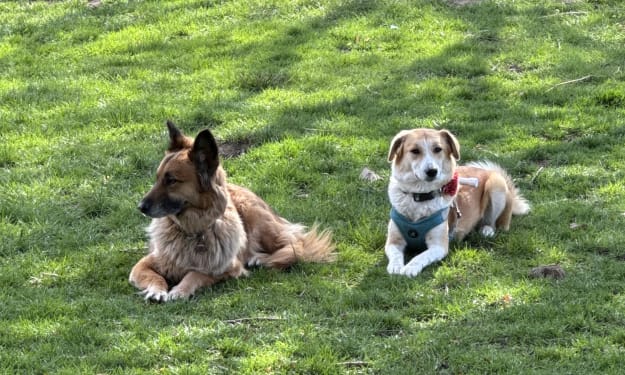
Be The Person Your Dog Thinks You Are
“Bob, Bob, Bob wake up! Wake up!” “Hmmmmmmmmmmmmmmmph” “Bob, Dad needs us! Wake up!” “Lois, dad’s fine. Humans have these things called thumbs that let them take care of themselves. It’s midday nap time. Bob’s midday nap time is sacred. You’ve got a lot to learn, little pup.”
By Matthew J. Frommabout a year ago in Humans
10 Things I Love About Myself (And I'm Not Sorry)
For a long time, I used to hide my love for myself. I thought it made me look arrogant. But not anymore. After years of trying to make myself smaller to please others, I finally learned that loving myself isn’t pride — it’s survival. So here are 10 things I really, truly love about myself. Some of it is fun, some serious — all of it is me.
By RASOOL KHANabout a year ago in Humans