social media
Social Media for modern lovers in the digital age.
Ian Balding Dies Aged 87 — What Led to the Moment That Shook British Racing
The name Ian Balding has echoed through British racing for decades, but in the past few hours it has surged to the top of search trends for a very different reason. News of his death at the age of 87 has sent a wave of emotion through the racing world, reigniting memories of legendary victories, quiet brilliance, and a man whose influence stretched far beyond the track.
By Bevy Osuos9 months ago in Humans
How to Forgive Emotional Cheating and Rebuild Self-Trust
Emotional cheating can feel just as devastating as physical infidelity. It fractures emotional safety, weakens self-trust, and leaves us questioning our worth, intuition, and judgment. Bloom Boldly believes that healing is more than just racing through forgiveness; it is about conscious mending, emotional clarity, and restoring inner stability. In this book, we will look at how to forgive emotional adultery in a grounded, self-respecting way while also repairing the trust we have lost in ourselves.
By Bloom Boldly9 months ago in Humans
When the News Moves On, the Silence Stays
The first thing you notice is the quiet. Not the peaceful kind, the kind that hums with absence. The kind that settles over a street where, just months ago, the air was thick with shouts and sirens and the relentless whir of helicopters circling overhead. Now, there’s only the occasional car rolling over cracked pavement, the distant bark of a dog, the rustle of plastic bags caught in the skeletal branches of a dead tree. This is what it sounds like when the world stops watching. I stood on the corner of Maple and 8th last Tuesday, the same corner where, last summer, the nation had pressed its face against its screens, breath held. The protests had been here. The tear gas, the chants, the viral videos of a man in a blue shirt being thrown to the ground—all of it. Now, the only sign was a single, faded poster still taped to a lamppost, its edges curling like a question no one bothered to answer. *"Justice for—"* The rest had been torn away, or maybe just worn down by the rain. I reached out and touched the paper. It was brittle, almost dissolving under my fingertips. Like a promise. --- We talk a lot about attention spans these days. How we scroll past tragedies in seconds, how outrage is a renewable resource, how the algorithm always wants something new. But we don’t talk enough about what gets left behind when the feed refreshes. The people. The places. The quiet that isn’t peace, but abandonment. Take the house on the edge of town, the one with the boarded-up windows. You’ve seen it—maybe not this one, but one like it. The yard is a graveyard of children’s toys, half-buried in weeds. A tricycle, its wheels still spinning in your mind if you look too long. The family that lived there didn’t just leave. They were *unhoused*—that’s the term now, isn’t it?—after the flood. Not the dramatic kind you see on the news, with reporters standing in waist-deep water. This was the slow, creeping kind. The kind that starts with a leak, then a mold warning, then an eviction notice slipped under the door while the cameras are already packing up to chase the next storm. The mother, Linda, told me she used to watch the news every night. "I thought if I just kept watching," she said, her hands wrapped around a chipped mug of coffee gone cold, "someone would remember us." She doesn’t anymore. --- There’s a particular cruelty in how we consume suffering. We demand it be spectacular. A hurricane, a mass shooting, a protest turned violent—these are the stories that get the banner headlines, the primetime slots, the collective gasp. But the real damage, the kind that lingers, is usually quiet. It’s the denied insurance claim. The unreturned phone call to a caseworker. The way a neighborhood’s name becomes shorthand for something broken, something to avoid. I think about the teachers in that underfunded school district who spent their own money on supplies, who were called heroes in a 60-second news segment, then forgotten when the next budget cut came. I think about the nurses who worked double shifts during the pandemic, who were applauded at 7 p.m. and laid off at 7 a.m. I think about the way we’ve turned empathy into a trend, something to perform until the next thing comes along. We are good at mourning. We are terrible at remembering. --- The man at the diner counter didn’t look up when I sat down. His name was Earl, and he’d been coming here every morning for 22 years, long before the diner became a "hidden gem" in a travel blog, long before the regulars started getting priced out. He stirred his coffee slowly, like he was trying to dissolve more than just sugar. "You know what the worst part is?" he asked. I didn’t, but I waited. "It’s not that they don’t care," he said. "It’s that they *did*. For a minute. And then they just… didn’t." Outside, a delivery truck rumbled past, its side emblazoned with the logo of a company that had pledged millions to "rebuild the community" in a press release last year. The money never came. Or maybe it did, and it just never made it past the people paid to distribute it. Earl didn’t know. Neither did I. --- We like to believe that silence is neutral. That it’s just the absence of noise. But silence is a choice. It’s what fills the space between the headline and the follow-up that never comes. It’s the sound of a nation turning the page. I walked back to my car, past the empty storefronts, past the mural someone had painted on the side of the old grocery store—*"We Are Still Here"*—the letters already fading under the sun. My phone buzzed. A notification. *"Breaking News: [Something Else]."* I didn’t click. Because the truth is, we’re all living in the aftermath of something. And the aftermath doesn’t end when the news cycle does. It just gets quieter. And quieter. Until the only people who remember are the ones who never had the luxury of looking away. --- *What happens when the cameras leave? We do. And that might be the real story.*
By Megan Stroup10 months ago in Humans
The Real Reason You Feel Disrespected in Your Relationship
Feeling unheard, overlooked, or taken for granted in a relationship is emotionally draining—especially for Gen Z couples navigating love in a hyper-connected, fast-moving world. When respect fades, discontent slowly builds into resentment. Understanding how to obtain respect in a relationship is not about control, power, or fear; rather, it is about emotional maturity, boundaries, and self-esteem.
By Relationship Guide10 months ago in Humans
The Attention Economy Is Quietly Rewriting Our Minds — and Most People Don’t Notice
Every time you unlock your phone, scroll a feed, or tap a notification, you are participating in something far bigger than momentary distraction. You are engaging in what experts call the attention economy — a system where human focus is the most valuable resource on Earth. This isn’t hyperbole. It’s reality. For the companies that fuel the modern internet, your attention is currency. Every second spent watching, clicking, or reacting generates data that platforms use to predict your behavior, tailor your feed, and pull you deeper into their ecosystem. And the consequences go beyond algorithms. They are reshaping how we think, feel, and decide — often without our conscious awareness.
By Yasir khan10 months ago in Humans
The Day My Phone Started Knowing Me Better Than I Did
It started with a notification I almost ignored. “Good morning, Alex. Based on your sleep patterns, we’ve adjusted your morning schedule. Coffee is ready at 7:15. You might want to leave home at 8:03 instead of 8:10.” I froze. My phone had never spoken to me like this before. Sure, it suggested playlists, predicted traffic, and reminded me of appointments. But it had never calculated me this precisely. Curiosity overcame caution. I followed its instructions. The coffee was perfect. Traffic was lighter than usual. I arrived at work feeling oddly efficient.
By Yasir khan10 months ago in Humans
Digital Shadows: How Our Online Lives Shape Who We Are
We live in a world where almost every thought, habit, and interaction leaves a digital trace. Every post we make, every story we share, every “like” or reaction contributes to a vast, invisible record of our lives. These traces—our digital shadows—are shaping more than just algorithms; they are shaping us.
By Yasir khan10 months ago in Humans
We Are Training Technology More Than It Is Training Us
Most conversations about technology focus on what machines are learning. We talk about artificial intelligence becoming smarter, algorithms improving, and systems adapting faster than ever. The common fear is that technology is watching us, analyzing us, and eventually outgrowing us. But there’s a quieter truth hiding in plain sight. Technology is learning because we are teaching it—constantly, unintentionally, and without pause.
By Yasir khan10 months ago in Humans
The Age of Invisible Technology: How Silence Became the Most Powerful Feature
Technology used to announce itself loudly. New devices arrived with dramatic launches, glowing screens, and long lists of features designed to impress. Faster processors, bigger storage, sharper displays—progress was measured by how much more we could pack into a single machine. The louder the innovation, the better it seemed.
By Yasir khan10 months ago in Humans
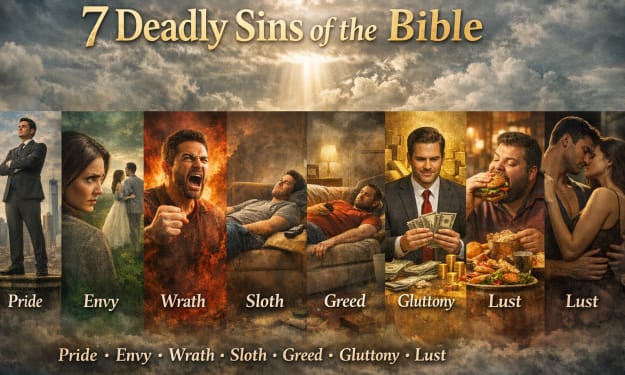
7 Deadly Sins of the Bible in Detail
The Bible teaches us that sin is not simply wrongdoing but a separation between humanity and God. Sin corrupts both spirit and society, distorting the divine image within us. Among the many forms of sin described in Scripture, seven have traditionally been recognized as especially destructive to the soul. These are known as the Seven Deadly Sins. They represent the root causes of moral decay and vices that distort character, fuel rebellion against God, and destroy relationships with others.
By The Big Bad 10 months ago in Humans