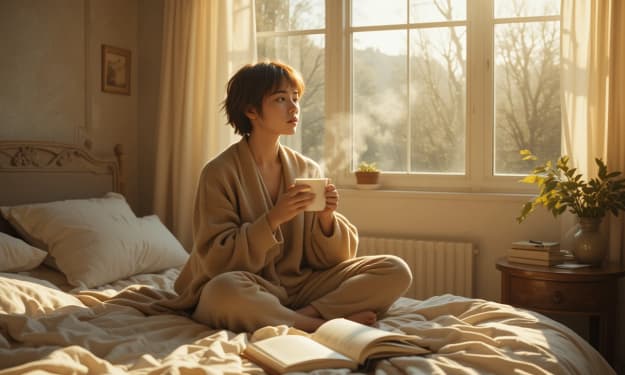
single
Whether you're solitary by choice or simply unlucky in love, being single is complicated.
Notes to My Future Self
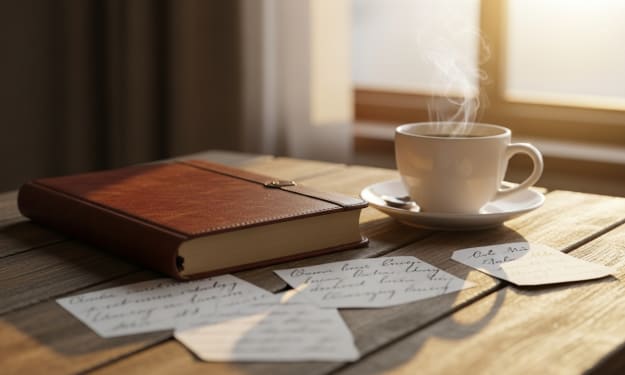
The first note was dated five years ago. It wasn’t written with elegant handwriting or on scented paper. Just a crumpled sticky note tucked between the pages of an old journal I hadn’t opened in years. The ink had bled slightly, probably from tears I didn’t remember crying. "You’re not broken. You’re still building." I stared at it for a long time, heart pounding. I hadn’t remembered writing it, but it was my handwriting. The kind I had in college—hurried, slightly crooked, always in blue ink. I flipped the journal open, and more notes fluttered out like autumn leaves caught in a draft. Some were dated, others not. Some were just single lines: "Call Mom. Even when you’re mad." "Success isn’t peace. Choose peace." "Don’t marry the person who makes you feel small." I read each one like they were sacred texts, letters from the version of me that had felt everything harder, hoped more recklessly, and somehow had the foresight to leave breadcrumbs back to myself. I was thirty-five now. A marketing director in a tech firm. I had a two-bedroom apartment that looked like a Pinterest board come to life. People said I was successful. Confident. Sharp. But I hadn’t felt whole in a long time. It was like I’d built my life on a tightrope—always one wrong step away from falling, but somehow still smiling at the crowd watching from below. Until the day the tightrope snapped. It was a Tuesday. Of course it was. Nothing ever breaks on a dramatic Friday. Just a regular morning—email, coffee, an impromptu meeting—and suddenly, I was standing in the office kitchen, gripping the edge of the counter, unable to breathe. Anxiety attack, the doctor called it. Said it was probably long overdue. Burnout. Stress. Unprocessed grief. Grief? I didn’t know what I was grieving until I opened that journal again later that night. "Future Me, I hope you still dance barefoot in the kitchen. I hope you forgive people, but not so much that you forget what you deserve. I hope you didn’t give up writing." I hadn’t written in years. Once, writing was everything. My sanctuary, my rebellion, my way of making sense of a world that didn’t always make room for sensitivity. But over time, deadlines replaced dreams. KPIs replaced poems. I traded my journals for spreadsheets. And now, here I was—reading a note from a girl who still believed in magic. Who trusted herself enough to leave behind words for a woman she hoped she’d become. I wasn’t sure I’d lived up to her expectations. Over the following weeks, I read every note. I cried through some. Laughed out loud at others. There was one that simply said: "Just because it’s familiar doesn’t mean it’s love." That one hit harder than I expected. It reminded me of Adam. Adam, with his charming smile and emotionally unavailable heart. We were together for two years. I called it love. But looking back, it was more like habit wrapped in fear of loneliness. I’d stayed long after the warmth had faded, convincing myself that comfort was enough. My younger self had seen it coming. Had written a warning. I just hadn’t read it in time. Inspired, I began writing back. “Dear Past Me,” I scrawled late one night, wine glass half-empty beside me. “You were right. About more than I ever gave you credit for.” I wrote about the days I’d felt like quitting. The friendships I let fade because I was too “busy.” The moments I had stood in front of the mirror and hated my reflection—not for how I looked, but for how far I’d strayed from who I wanted to be. But I also wrote about healing. About finally understanding that success isn’t climbing a ladder—it’s learning when to step off. I told her that I had started dancing again in the kitchen, barefoot and unbothered. That I had called Mom. That I had started writing again. --- One evening, I invited a few close friends over. We poured wine and passed around blank notecards. “Write a note to your future self,” I told them. “Something you’ll want to remember five years from now.” They looked skeptical at first, but eventually, the room grew quiet as pens moved across paper. We sealed the notes in envelopes, wrote the date on the outside, and agreed to meet again in five years to open them. A small ritual of hope. Now, the journal is thicker than ever. Filled with letters to and from my past selves. A map of mistakes, lessons, and little victories. And every now and then, when I feel lost again, I turn the pages. I don’t always find answers. But I find myself. If you’re reading this, maybe write a note today. Not for who you are now—but for who you hope to be. She’ll thank you for it. I know I did.
By Shah Nawazabout a year ago in Humans
The Art of Being Alone Without Feeling Lonely
Rain whispered gently against the windowpane as Mira curled her fingers around a steaming mug of chamomile tea. The silence was so complete, she could hear the tick of the old wall clock—each second a gentle echo in the small apartment. She had lived here for seven months now. Seven months since Daniel had packed up his final box and left her with a hollow, echoing space that once throbbed with laughter and shared late-night dinners. At first, she hated the silence. It was loud in its own way, pressing down on her like a weight. But slowly, something changed. That first week, Mira tried to drown the quiet with noise—television playing sitcoms she wasn’t watching, Spotify looping sad playlists she pretended weren’t making her cry. She invited friends over constantly. Her calendar looked like a war plan—every hour booked, as if stillness might kill her. But still, at night, she was alone. The void stared back. Until the night she didn’t resist it. She remembered it clearly: it was raining, just like today. She had nothing left to distract her, nowhere to go, no one to talk to. So she sat. She simply sat. Wrapped in her worn-out robe, sipping tea, letting the raindrops outside speak their soft rhythm. And for the first time, the silence didn’t feel like punishment. It felt... clean. At first, her therapist called it “forced solitude,” a necessary discomfort. But over the months, it became a choice. Something Mira had never done before—not really. She had spent her entire adult life in the company of others: lovers, roommates, co-workers, family members, the buzzing notifications of her phone. She had learned to define her worth through presence—through being seen. But who was she, when no one else was looking? The answer didn’t come in some dramatic epiphany. It came in little things. Folding laundry while humming to herself. Cooking dinner not for a guest but for her own enjoyment. Buying flowers simply to brighten her space. Some evenings, she sat in silence for hours—reading, painting, even just thinking. And she began to realize that solitude wasn’t a void. It was a canvas. One Saturday morning, Mira took a train alone to the countryside. She packed a journal, some fruit, and a camera. She hiked up a hill and lay in the grass, watching clouds drift above like silent stories. Nobody asked her why she was alone. Nobody pitied her. In fact, nobody cared—and that, surprisingly, was freeing. She thought back to her past—how often she had stayed in relationships simply to avoid this exact moment. Not for love, but for fear of empty rooms. But now, she was no longer afraid of her own company. She started making lists. Not to-do lists, but being lists. Light a candle every evening. Write something honest, even if no one reads it. Call solitude by its real name: space, not lack. Love yourself without needing a mirror. One evening, Mira’s friend Lena called, breathless and tearful after a breakup. “I just... I can’t be alone,” she whispered. “I don’t know how.” Mira listened. She didn’t rush to fix it, because she remembered. Instead, she said, “Then maybe now is the time to learn.” Lena paused, surprised. “Being alone isn’t the same as being lonely,” Mira added. “But it takes time. And practice. And a lot of cups of tea.” They laughed. A real, warm laugh. Now, as rain painted gentle streaks on the window, Mira set down her empty mug and stood. Her small home was quiet, but not empty. Books lined the shelves, soft lights twinkled on the wall, and her latest painting—still drying—rested by the window. She walked to the mirror and looked into her own eyes. “I like you,” she whispered. It wasn’t about becoming some monk of stillness or abandoning the world. It was about choosing solitude when it served her, and choosing company when it enriched her. There was no longer a void to fill. Only a life, quietly unfolding—one peaceful, intentional moment at a time.
By Shah Nawazabout a year ago in Humans
The Stranger on the 4:15 Train
The Stranger on the 4:15 Train I never believed in fate, or signs from the universe, or any of that poetic nonsense people write songs about. I believed in timetables, to-do lists, and the cold reliability of public transportation.
By noor ul aminabout a year ago in Humans
Aries Woman and Cancer Man Compatibility Score. AI-Generated.
The relationship between an Aries woman and a Cancer man is a fascinating mix of fire and water, assertiveness and sensitivity, boldness and caution. On the surface, these two zodiac signs seem like complete opposites. Aries, ruled by Mars, is a fiery, action-oriented leader who thrives on independence, excitement, and new challenges. Cancer, ruled by the Moon, is a deeply emotional, nurturing, and protective soul who craves security and emotional bonding.
By Inspire and Funabout a year ago in Humans
A DREAM WITH IN A DREAM. Content Warning. AI-Generated.
# A Dream Within a Dream The room was silent, save for the rhythmic ticking of the antique clock on the shelf. Its hands pointed to 3:17 a.m. when I woke up—suddenly, breathlessly—as if I had fallen from a great height. My sheets were tangled around my legs, sweat dampening the pillow beneath my head. I sat up and blinked, trying to steady my breath and reorient my mind.
By Amias yoursabout a year ago in Humans