science
The Science Behind Relationships; Humans Media explores the basis of our attraction, contempt, why we do what we do and to whom we do it.
How Technology Affects Our Brainpower
The evolution of society in tandem with technological advancements has engendered a profound shift in our daily lives, especially evident in the ubiquitous presence of the internet. Reflecting on an era preceding this interconnected landscape, individuals who experienced life devoid of digital connectivity can attest to a stark contrast in societal norms. The contemporary reliance on smartphones, readily accessible maps, and instantaneous search engines underscores this transformative journey.
By Wali Ahmed Khan2 years ago in Humans
Mastering the Art of Outsmarting Your Brain!
Biting your nails like you're in a nail-biting thriller, endlessly scrolling through your phone like it's the latest juicy gossip, constantly being fashionably late to every event – we've all got those quirks. But guess what? There's a secret weapon hiding in your brain, ready to help you kick those bad habits to the curb and embrace new ones like a pro.
By Wali Ahmed Khan2 years ago in Humans
Can you transplant a head to another body?. Content Warning. AI-Generated.
On March 14, 1970, Robert White and his team brought two small monkeys into an operating room. White, a neurosurgeon, was about to embark on an ambitious experiment that had been decades in the making, one that seemed almost surreal. His objective was to connect the head of Monkey A to the body of Monkey B, essentially performing what he termed a whole-body transplant. His ultimate aspiration was to conduct this procedure on humans one day.
By Sabrina Weber2 years ago in Humans
If all humans died, when would the last light go out?
Allan poses this question: "How long would it take for the last artificial light source to go out if all humans somehow just vanished from the face of the Earth?" Let's start with the obvious: most lights wouldn't last very long because the major power grids would go down relatively quickly without people. However, our refrigerators, air conditioners, and lava lamps would still be running fossil fuel plants, which provide the vast majority of the world's electricity. These plants require a steady supply of fuel, and their supply chains do involve human activity. As a result, other power sources would be burdened with the additional load.
By Kingsley Egeke2 years ago in Humans
Your eyes
Jewel, a young woman with a curious mind, had always been fascinated by the way we see the world around us. She loved learning about the science of vision and how our eyes and brain work together to create our perception of reality. One day, she decided to dive deeper into the topic and explore the amazing journey of light, photoreceptors, and brain power that allows us to see colors and images.
By Nnorom Christabell C.2 years ago in Humans
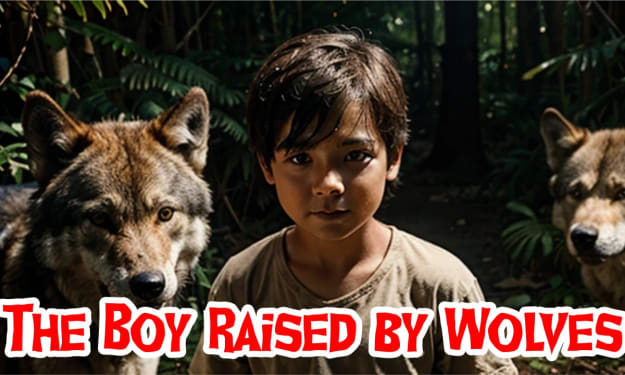
The Boy Raised by Wolves
Envision developing up not in a human family, but among wild creatures, receiving their behaviors and living as one of them. This can be not an unimportant myth or legend; it's the genuine and exceptional story of Dina Sanichar, known as the "Wolf Boy of India," whose life has interested and confused individuals for over a century.
By Julio Javier2 years ago in Humans