science
The Science Behind Relationships; Humans Media explores the basis of our attraction, contempt, why we do what we do and to whom we do it.
Unlocking Your Brain's Hidden Potential | How To Boost Cognitive Health and Productivity?
Have you ever wondered if there's more your brain could do? Our cognitive abilities can be enhanced through simple, everyday habits, Imagine unlocking your brain's hidden potential to improve memory, focus, and overall productivity.
By Adham El-Aasar2 years ago in Humans
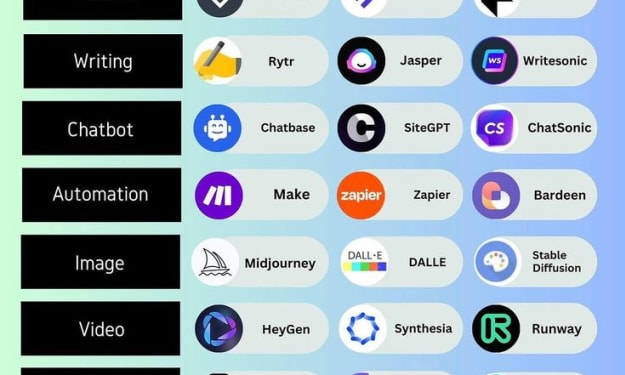
5 Powerful AI Tools That Are Transforming Everyday Tasks
Artificial Intelligence (AI) is revolutionizing the way we work, communicate, and even entertain ourselves. From enhancing productivity to automating repetitive tasks, AI tools are becoming an essential part of our daily lives. Whether you’re a content creator, marketer, developer, or just someone curious about the future of technology, there are several AI tools available that can make your life easier.
By Ayesha Rasheed Rajpoot2 years ago in Humans
30 Day Wellness Challenge To Change Your Life
The season of Fall is synonymous with rebirth. It is a time when the world sheds it's leaves and changes it's colors in preparation for the next chapter. Fall is a great time for us to reinvent ourselves and chart out new milestones. With that in mind, here is the 30 day wellness challenge, self-improvement activities to try for each of the 30 days!
By Isbah Studio2 years ago in Humans
**AI and Animal Communication: Decoding the Complexities of Interspecies Dialogue**
**AI and Animal Communication: Decoding the Complexities of Interspecies Dialogue** In the 1980s, Joyce Poole observed a peculiar phenomenon among African elephants. Occasionally, when one elephant would call out to her relative, only a specific individual would respond, while the rest ignored the calling elephant. Upon calling again, a different elephant would raise her head and roar. Poole, who had been studying elephant communication for years, began to consider the possibility that elephants might direct their calls to specific individuals. However, at the time, there was no way to confirm this. Years later, she teamed up with Mickey Pardo to design a study around these observations. The duo went out into the field, meticulously recording the calls and social behavior of elephants. They were able to identify which elephant made each call, who the call was directed to, and the context in which it was made. The recorded acoustic data were transformed into a long series of numbers, which, along with Pardo’s data, were used to feed a statistical model. The model analyzed nearly 500 distinct calls, and when presented with the acoustic structure of a new call, it could accurately predict who the intended recipient was. This suggested that African elephants may use specific names when communicating with each other—a groundbreaking discovery that some compared to a seismic shift in understanding animal communication. ### AI’s Role in Unraveling Animal Communication Artificial intelligence (AI) has brought a transformative approach to the study of animal communication. Traditionally, researchers would record animal sounds, observe the behaviors surrounding these vocalizations, and conduct playback experiments to gauge responses. Today, AI is making significant strides in analyzing these interactions. Animal vocalizations in the wild often overlap, creating a chaotic soundscape—referred to as the "cocktail party problem"—which complicates research. However, AI has solved similar challenges in human speech recognition. A model called Deep Karaoke was trained to separate vocals from instruments in music recordings. Applying similar techniques, AI can now isolate specific animal calls from noisy environments. For example, researchers can take a recording of a group of macaque monkeys and pinpoint one individual’s call from the cacophony. ### Supervised and Self-Supervised Learning in Animal Studies In Poole and Pardo’s elephant study, AI models were trained on labeled data—observations about who made the call, the context, and the response. This approach, known as supervised learning, has proven effective but comes with limitations. It relies heavily on what humans already know about animal communication to label training data. However, there is still much we don’t understand about these complex systems. This limitation is why some AI researchers believe self-supervised models hold the most promise for decoding animal communication. Instead of relying on human-labeled data, these models are trained on large amounts of unlabeled data, identifying patterns and classifications independently. Language models like ChatGPT are trained using this method, learning from vast amounts of text data scraped from the web to develop a deep understanding of human language. The Earth Species Project, co-founded by Aza Raskin, aims to build similar models for understanding animal communication. Raskin explains that language has a "shape" defined by relationships between words. Words that share meaning are grouped together, and those with similar relationships are placed in proximity. In 2017, researchers discovered that these linguistic shapes can be mapped across languages, meaning that a word like "dog" in one language appears in the same spot in another language’s shape. This breakthrough suggests that we could potentially decode animal communication without needing a Rosetta Stone—simply by identifying patterns that resemble human language structures. ### Beyond Sound: Multisensory Communication One of the challenges in understanding animal communication is that many species don’t rely solely on sound. Dolphins, elephants, and other animals use multiple senses to convey messages. This makes the task more complex, as researchers must account for non-vocal forms of communication. Despite these challenges, AI models that combine sound and image recognition—such as DALL-E and MidJourney, which generate images from text—offer hope. These models demonstrate that AI can work across different types of data, suggesting that it might eventually decode the multi-faceted communication systems of animals. ### The Future of Interspecies Communication For AI models to accurately interpret animal communication, they need vast amounts of data, far more than currently exists. Researchers worldwide are working to expand their datasets, recording not just sounds but also video, spatial data, and other information about animal behaviors. This data will feed AI models that might one day unlock the secrets of interspecies communication. Although the prospect of directly conversing with animals remains speculative, AI-driven discoveries have already reshaped how we perceive the communication systems of nonhuman species. We are learning that animals, like humans, communicate complex thoughts, exhibit empathy, and perhaps even think about their past and future. Recognizing this is not only scientifically valuable but also carries ethical implications for how we protect and respect the animals with whom we share the planet. As AI continues to develop, it will likely deepen our understanding of the natural world and help bridge the communication gap between humans and other species.
By Goefrey 112 years ago in Humans
Skip the coffee — this 7-move Pilates workout will give you all-day energy in just 20 minutes
When you wake up early you’re more than likely to feel tired, right? Right. You’re also more than likely to have some spare time on your hands to scroll and reach for one of the best coffee makers, right? Right.
By Surafel Adamu2 years ago in Humans
Why is it so hard to get drugs approved for use during pregnancy?
The drug was prescribed to pregnant women during the 1950s and early 1960s to treat nausea. But it led to more than 10,000 children worldwide with irreversible birth defects, ranging from limb deformities to facial malformations.
By Surafel Adamu2 years ago in Humans
How the Brain Powers the Creative Process | Science of Creativity. AI-Generated.
Creativity is a defining human trait, setting us apart from other species. Whether you're brainstorming new business ideas, creating art, or writing, understanding the mechanics behind the creative process can transform how you approach your work.
By Khalid laakiki2 years ago in Humans
10 Fascinating Facts About Artificial Intelligence (AI) You Should Know
Artificial Intelligence (AI) is one of the most exciting and rapidly evolving fields of technology. From self-driving cars to virtual assistants, AI is reshaping how we live, work, and communicate. Yet, despite its growing presence in our lives, there are many fascinating facts about AI that are lesser-known.
By Ayesha Rasheed Rajpoot2 years ago in Humans
War vs. Peace: Paths to World Progress
Introduction Throughout history, humanity has been faced with the dichotomous realities of war and peace. Both phenomena have significantly shaped the trajectory of civilizations and the world at large. War, while often destructive and lamentable, has at times precipitated advancements and shifts that have influenced progress in varied ways. Conversely, peace is frequently championed as the ideal state, fostering environments where stability, prosperity, and human flourishing can occur. This essay delves into an in-depth analysis of the costs and consequences of war, the benefits arising from peace, historical instances where both war and peace have led to progress, and contemporary beliefs on their relative efficacy for engendering global progress. Drawing insights from these perspectives, we can more adeptly navigate the pathways toward global progress.
By Nidhal Laroussi2 years ago in Humans