science
The Science Behind Relationships; Humans Media explores the basis of our attraction, contempt, why we do what we do and to whom we do it.
THE HUMAN BODY. Content Warning.
Bodies! We all have one, and we couldn’t live without them! But let’s be honest, they’re kind of unreliable. If you’re like me, a millennial hitting the ripe age of “oh no, my back hurts,” you may have started to notice that the human body has quite a few design flaws. Sure, humans are incredible—just look at everything we’ve accomplished! But at the same time, our bodies are full of quirks, inefficiencies, and, let’s face it, downright baffling features. Take our eyes, for example. The majority of us can’t see properly without glasses or contacts. In fact, about half of Americans and Europeans—and a whopping 70% of people in some Asian countries—rely on corrective lenses to get through the day. Before the invention of glasses, people who couldn’t see well were at a serious disadvantage, potentially facing starvation if they couldn’t hunt or gather. Even if your eyesight is perfect, your eyes still have a literal blind spot. This is because of how our retinas are built, with photoreceptor cells pointed backward. It’s an evolutionary glitch we share with all vertebrates, unlike the octopus, which has a much more efficient design. One point for team cephalopod. But it’s not just our eyes that are oddly put together. Ever wonder why we’re so prone to sinus infections? That’s thanks to our sinuses’ terrible drainage system. The sinuses behind our cheeks drain upward, defying gravity, which leads to all sorts of fun when you catch a cold. Dogs, with their elongated snouts, don’t face this problem because their sinuses drain properly. Once again, evolution left us with the short end of the stick. Speaking of sticking points, how about the fact that we can choke on our food so easily? This stems from the fact that we breathe and eat through the same tube, our throat. One wrong move, and suddenly you’re performing the Heimlich maneuver. Birds, on the other hand, can swallow whole fish and breathe without issue, thanks to a separate respiratory system. Lucky them. Now let’s talk about something even more fundamental: walking upright. Sure, it allows us to run, dance, and do all sorts of athletic feats. But it also makes us prone to knee and ankle injuries, because we evolved from animals that walked on four legs, and our bipedal joints are, quite frankly, held together like an elementary school art project. The Achilles tendon, which bears the brunt of walking on two legs, is just sitting there on the back of our foot, exposed and vulnerable. One wrong move at the grocery store, and ouch—there goes your ability to walk. But evolution’s meddling didn’t stop at our external parts. On the inside, we’re even more inefficient. Take vitamin C, for instance. Unlike most animals, humans can’t make their own, which is why we’re so reliant on fruits and veggies to get it. Without it, we’d succumb to scurvy, losing teeth and breaking down at the cellular level. Yet, our DNA still carries the broken genes that should be producing vitamin C. It’s like nature’s way of saying, “Whoops!” Need more examples? Look at wisdom teeth, which often don’t fit in our mouths and need to be removed. Or consider how half of the human population has to deal with the complications of childbirth because the human head is so large and the pelvis is so narrow. These aren’t exactly what you’d call optimized designs. So, who’s to blame for these questionable features? No one, really. The human body wasn’t designed; it evolved. Evolution is an ongoing process of tiny tweaks over millennia, not a deliberate design. We’re imperfect because we’re the result of countless adaptations over billions of years. Our backs hurt because we stand on two legs with a spine that was once horizontal. We choke because our ancestors didn’t evolve a separate breathing tube. We wear glasses because, well, evolution can’t flip our retinas around. But here’s the thing: even with all our flaws, we’ve survived. Our bodies may be imperfect, but they’re good enough. They’ve carried us through a 4 billion-year journey of survival and adaptation. So, the next time your back aches or your sinuses act up, just remember: you’re not perfect, but you’re here, and that’s a pretty big deal. Our bodies, for all their quirks and blunders, are still incredible. Stay curious, embrace the imperfections, and keep surviving.
By Adeniji Priscillia2 years ago in Humans
Holiverse Launches a Metaverse for Personalized Medicine and Cosmetics
October 4, 2024 — Holiverse announced the launch of a metaverse where digital avatars based on users’ DNA will be able to test cosmetics and dietary supplements. LADO, the founder and CEO of the company, shared his plans. The team aims to combine the achievements of genetics with virtual reality technologies. The main idea is to create virtual replicas of users — avatars based on real human genetic data. With the help of these avatars, it will be possible to conduct virtual experiments: for example, to simulate how a specific person will be affected by the use of certain cosmetics or the intake of certain dietary supplements.
By CryptoNews2 years ago in Humans
Understanding Mental Health: Tips for Self-Care
Introduction to Mental Health The health of an individual's mind plays an important role in his or her overall well-being. It influences their thoughts, feelings, and behavior daily. It encompasses our emotional, psychological, and social well-being, affecting everything from our relationships and decision-making to how we handle stress and cope with life's challenges. In recent years, the importance of mental health has gained significant recognition, yet it remains a topic often surrounded by stigma and misunderstanding. Understanding mental health is not only crucial for those facing mental health challenges but also for everyone who seeks to live a balanced, fulfilling life. As we navigate the complexities of modern life, prioritizing mental health and promoting awareness are essential steps toward creating a society where mental well-being is valued and nurtured.
By Zinnat ara Begum2 years ago in Humans
What to Expect After Getting a Dental Crown
Dental crowns are a popular solution for restoring damaged or decayed teeth, providing strength and improving appearance. After undergoing the procedure, it's essential to understand what to expect during the recovery process. Your top-rated dentist Mount Pleasant, will provide comprehensive aftercare instructions, but this blog will give you an overview of what to anticipate following your dental crown placement.
By Smile Carolina Dental Group2 years ago in Humans
Home Care in Farmington: Supporting Families and Seniors
In the picturesque community of Farmington, the value of family and connection runs deep. As our loved ones age, the conversation around their care becomes increasingly important. Home care services offer a compassionate and practical solution, ensuring seniors can maintain their independence while receiving the support they need.
By Leanna Cleo2 years ago in Humans
Dancing with Shadows
Art, in its essence, is a play of contrasts—between light and dark, form and void, seen and unseen. The interplay of light and shadow has captivated artists for centuries, offering a rich medium through which to explore the depths of human experience, emotion, and perception. This article delves into the art of light and dark, examining how shadows and illumination are used to create depth, drama, and meaning in artistic expression.
By Sazeeb Chowdury2 years ago in Humans
The Quantum Canvas
Art and science, often seen as disparate realms, converge in the fascinating world of quantum physics. The quantum canvas, a concept where particles are the medium and the laws of physics the brushstrokes, offers a unique perspective on the interplay between the seen and the unseen. This article delves into the captivating intersection of quantum mechanics and artistic expression, exploring how particles can be used to create a new form of art.
By Sazeeb Chowdury2 years ago in Humans
Immunization Mindfulness: A Crucial Wellbeing Subject in the Cutting Edge World.
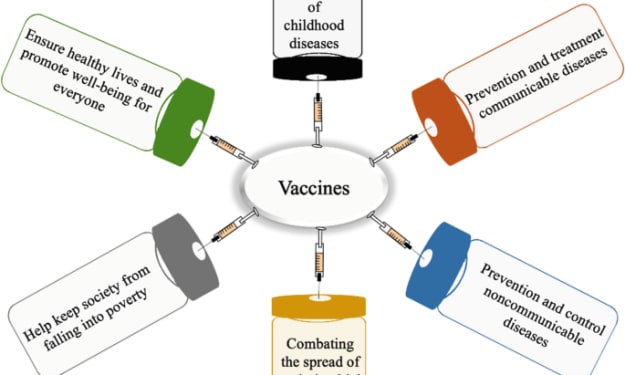
1. The Job of Immunizations in General Wellbeing Immunizations work by animating the insusceptible framework to perceive and battle microbes like infections and microscopic organisms. By presenting an innocuous piece of the microbe, for example, a protein or inactivated infection, the safe framework figures out how to answer rapidly and successfully whenever presented to the genuine microorganism later on. This cycle safeguards the person as well as adds to the local area or group's invulnerability. At the point when an enormous level of the populace is immunized, the spread of infection is essentially decreased, safeguarding weak people who can't be inoculated because of clinical reasons.
By Shahanaz Akther2 years ago in Humans
Understanding Depression and the Role of Counseling
Depression is more than just a transient state of melancholy or depression. A person's ideas, feelings, behaviors, and general well-being can all be significantly impacted by this serious mental health disease. Everyone experiences periodic melancholy, but depression is chronic and, if addressed, can linger for weeks, months, or even years. Even the most basic daily duties may seem burdensome as a result. The good news is that depression is curable, and therapy is essential to this process.
By Fast world engagement2 years ago in Humans