literature
Whether written centuries ago or just last year, literary couples show that love is timeless.
Embracing the Silence: A Journey of Trust and Reflection
Notice: Dear Readers, I would like to bring to your attention that the book titled "Embracing the Silence: A Journey of Trust and Reflection" and its subtitle "Rediscovering Serenity in the Stillness of a Sunday Morning" was not written by me, I utilized this platform to explore interests in writing styles and to experiment with wordplay and expanded content based on the publication made by shelley carroll https://vocal.media/humans/learning-to-trust-in-the-quiet, adhering to the tone and style established in the original excerpt. I apologize for any confusion caused and want to ensure transparency regarding the source and authorship of the content. If you have any further inquiries or require assistance with any other writing requests, please don't hesitate to reach out. Thank you for your understanding. Best regards, Okpala Michael
By okpala michael3 years ago in Humans
"Superstition vs. Divine Trust"
In the realm of human beliefs, there exists a fascinating dichotomy: the contrast between being superstitious and having faith in a higher power, specifically in God. While some may perceive both as similar, interchangeable concepts, a closer examination reveals substantial differences. Superstition often stems from irrational fears and unverified beliefs, while faith in God involves a deep-seated trust and conviction in a divine being. This essay aims to delve into the disparities between these two contrasting approaches, shedding light on their origins, effects, and significance in human life.
By Iknewitbefore 3 years ago in Humans
"The Pages of Wonder"
In a bustling city, amidst the cacophony of sounds and sights, there lived a community of avid readers. These individuals, diverse in age and background, found solace, inspiration, and adventure within the pages of books. They were bound together by a shared love for the written word, weaving a tapestry of stories that captured their imaginations and transformed their lives.
By Elisa Maria3 years ago in Humans
The Future of Work. Content Warning.
The Future of Work: How Technology Will Change the Way We Work The world of work is changing rapidly. Technology is transforming the way we live and work, and it is only going to continue to do so in the years to come. Artificial intelligence (AI), automation, and other technological advancements are already having a major impact on the workplace, and this impact is only going to grow in the years to come.
By Abhishek Vijayan3 years ago in Humans
Trust. Content Warning.
Trust is an essential aspect of human relationships. It is the foundation upon which these relationships are built and it is critical to strengthening, maintaining, and repairing them. Trust is a basic need that we all have as individuals to feel safe, secure, and valued. It is the glue that holds human interactions and societies together. In this article, we will explore the definition of trust, its importance, how to build and maintain trust, and what to do if trust is broken.
By Ibe Christabel3 years ago in Humans
Love. Content Warning.
Love is the most beautiful and complex emotion that humans experience. It is a simple word, yet it holds so much power. Love has the ability to bring joy, happiness, and fulfillment into our lives, but it can also cause pain and heartbreak. Despite its many challenges, love remains a fundamental aspect of the human experience. In this article, we will explore the different dimensions of love, how it impacts our lives, and how we can cultivate more love in our relationships.
By Ibe Christabel3 years ago in Humans
GENDER
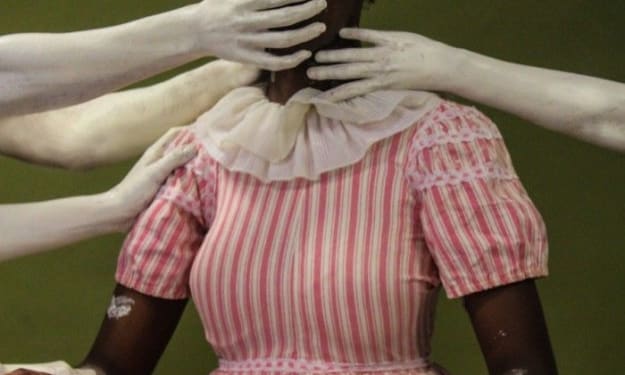
For centuries, women fight for their place in society, having to overcome unfair treatment and inequality in work fields, justice systems, and many more. Octavia.E. Butler and Dr. Joy DeGruy Leary illustrates the theme of gender both in slavery times, the mid-20th century in Kindred (1979), and the video on Post Traumatic Slave Syndrome (2008). Although Butler and Leary explore several topics through their work, they distinctly demonstrate how Black women have little to no power compared to men, are deprived of their role as mothers, and are indiscriminately raped.
By Jubilee Mwasa 3 years ago in Humans
Atwood’s Portrayal of Religion in Gilead
Margaret Atwood uses biblical roots to create a religious motif throughout the novel, such biblical references enunciate Gilead’s strict Christian Puritan views. Gilead uses religion to manipulate its inhabitants into believing that the practices that occur in the state are all extracted from the Bible. Therefore, Atwood portrays religion as a form of control over the Gileadean citizens. Religion is a crucial part of everyday life in Gilead, Karl Marx called religion “the opiate of the masses,” Gilead is a religious state in which state and religion are intertwined - making Gilead a theocracy - and are considered the same; its official vocabulary include religious terminology and biblical references. Domestic servants are called “Marthas” in reference to a domestic character in the New Testament in the Bible. The local police are “Guardians of the Faith”; Soldiers are “Angels”; and the Commanders are officially “Commanders of the Faithful.” All the stores have biblical names too: Loaves and Fishes, All Flesh, Milk and Honey. Even the automobiles have biblical names like Behemoth, Whirlwind, and Chariot. Using religious terminology to describe people, ranks, and businesses whitewashes political skullduggery in pious language. It provides an ever-present reminder that the founders of Gilead insist they act on the authority of the Bible itself. Politics and religion are the same in Gilead, where the slogan “God is a National Resource” predominates. The Bourgeoisie (Commanders) use religion to justify their own acts and reap the result. Religion is a tool to manipulate the other lower-ranking classes. The significance of the Gileadean police being labelled the “Guardians of the Faith” is that the Gileadean Institution expects the civilians to have utmost respect for the Police, even though they are simply just men who will not hesitate to shoot a Handmaid for the slightest act of deviance - further emphasising Gilead’s lack of morality toward the lives of women and such actions also exploit Gilead for not always perusing the Puritan values they preach. Similarly could be interpreted from the official names of the Commanders and Soldiers; “Commanders of the Faithful” and "Angels”. Both names suggest pure men with correct Christian values, whereas in reality, they exploit women and murder frequently - the opposite of what the Bible states. The importance of the store names originating from the Bible highlights the complete control Gildead holds over its populace with the use of Christian implications. So, with the constant use of Bible references, Gilead will always have an excuse to punish citizens severely for even the smallest deviances - by stating they are going against the Bible. Therefore, by “abusing” the belief in religion, Gilead is able to maintain complete control over its populace with the use of fear of punishment.
By G.A.L. Grace3 years ago in Humans
Outsiders Searching for a Place Within
In life, everyone has an identity. In every way, human beings try to shape their identities with their language, culture, clothing, music, and religious practices; they even define who we are by choosing a spouse. In an historical overview, the identities of Africans were stolen through the Middle Passage to slavery. After experiencing and enduring such horrid, harsh, and inhumane conditions, Africans were given new names and backbreaking labor to bear. The names usually denoted to which owner and plantation a slave belonged. Systematically, Africans were stripped of their identities, their land, their homes, family, property, religion, language, culture, livelihood, sense of worth, sense of self, pride and dignity. As a direct result, African-Americans are a lost people, searching for who they truly are. The desperate search for self is depicted in literature via setting, characters, theme, and plot.
By Kamika Price3 years ago in Humans