family
Family unites us; but it's also a challenge. All about fighting to stay together, and loving every moment of it.
Dear Great Grandpa Cassidy
Dear Great Grandpa Cassidy I know we have never met, but your stories have enthralled me. I was told that I would love to have talked to you. You saw from the beginning of electricity to the atomic bomb. Yet your life was filled with disappointment and loss. I know your childhood had the loss of your mother and an absent father. You lost part of the fingertip in the farm equipment, but you were never bitter. I find that riding the rails as a hobo was lonely, but so was your life before that. Eventually, you saw worse in the destruction of the San Francisco earthquake and trying to find survival in all the wreckage.
By Sarah Danaher2 years ago in Humans
Redefine love: When friendship becomes our greatest support.
There's a Supreme Court case in the United States that could be mistaken for a sermon. It's the case that recognized that same-sex couples have a constitutional right to marry. Judge Kennedy said, “marriage addresses the universal fear that a lonely person might call and find no one.” he goes on to say that marriage offers care and companionship, and the decision holds that these are basic human needs that everyone should have access to, whether heterosexual or homosexual. But what do these words tell you if you're single? In the United States, around 30% of women over 65 are widows. The reality is that it's unlikely that any of us will have a partner by our side until our last breath. Regardless of whether we're in a relationship now, we need to rely on more than one relationship to support us through our full and unpredictable lives. We need other loved ones. And there's a neglected type of relationship we can turn to: friendship, which can be a more powerful force in our lives. Often, friendship is a happier way of life, a place of refuge when we're overwhelmed by life's many problems. Joe and John have been best friends for decades. When Joe had problems with alcohol and drugs, John helped her into rehab. And then John decided that to support his friend, he too would get sober. Joy cared for her friend Hannah during the latter's six-year battle with ovarian cancer. This included trips to New York, where Hannah received specialized treatment. Joy had trouble sleeping at night in the hospital, because she was too busy keeping watch to make sure her friend's chest was still rising and falling. Some of the friends I spoke to had a friendship that occupied the space usually reserved for a romantic partner. Some had this kind of friendship and a romantic partner. So it's not “either/or” but maybe “both/and”. Talking with these people, I realized that they were at the forefront of friendship, helping us to imagine how much more we could expect from our platonic relationships. Which is true, but another way of looking at it is that they're doing something retro, even ancient. In ancient Rome, friends referred to each other as “half my soul” or “the greatest part of my soul”, language we now use in romantic relationships. From China to Jordan to England, there was a practice called “sworn brotherhood”, where male friends went through a ritual to consider each other brothers. A century or so ago, friends would take portraits like these, their arms around each other, their bodies very close together. What I took from this story is that if we don't limit friendship, it can be central to our lives. But today, not everyone recognizes this. I spoke to a mother who really tried to convince her son to make dating a priority, because she wanted him to find emotional wholeness. And her son replied, “I found it with my platonic life partner.” his best friend, whom he'd known since high school, who'd moved across the country to be near him, to live with him, in fact. The mother said, “I don't understand how you can be partnered with someone you're not romantic with.” an understandable reaction in a culture that sees friendship as the companion to the real hero: romance. We get this message from romantic comedies, from Supreme Court justices, and from public policy. For example, Joy, during the six years she cared for her friend, was not entitled to family medical leave. When Hannah died, Joy was not entitled to bereavement leave, because they were considered unrelated. In our government policies and in the workplace, friendship is invisible. Sometimes this diminishment of friendship comes from without, and sometimes it comes from within. If we can recognize what friendship has the potential to be, and if we can understand that there is more than one kind of loved one, then we can imagine other ways to find love, care and companionship. And we can support those who have these kinds of friendships. So, the mother I was telling you about, she's had a complete change of heart. She now admires the commitment between her son and her son's friend. My wish is that we feel free to share our lives with those we're lucky enough to find, whether that's a spouse, a sibling, or a house full of friends.
By Paulin GNOUMOU2 years ago in Humans
A Letter of Gratitude
Dear Grandma, As the seasons change and we approach the time of reflection, I find myself thinking about the moments and people that have shaped my life. There’s an undeniable warmth that this time of year brings—an invitation to pause, look back, and express the gratitude that sometimes gets lost in the rush of daily life. As I reflect on the paths I’ve walked, there’s one person who stands out in ways that are impossible to overlook: you.
By Christopher Gomes2 years ago in Humans
HUMAN GENETIC INHERITANCE
The Inheritance of Human Genetic Genetic inheritance is the process through which parents pass traits to their offspring through genes. This process forms the foundation of human biology, explaining both the diversity and commonalities seen within and among populations. Human genetic inheritance not only determines physical characteristics such as eye color and height but also influences susceptibility to diseases, personality traits, and even behaviors. Understanding this complex process requires an exploration of the structure of DNA, patterns of inheritance, and how genetic traits are expressed in humans.
By Badhan Sen2 years ago in Humans
How to Make a Long-Distance Relationship Thrive: 15 Essential Tips for Building a Strong Emotional Bond . Content Warning. AI-Generated.
Long-distance relationships (LDRs) are not just about the miles between you, but rather learning to connect on a deeper emotional level. The distance can be challenging, but with love, trust, and communication, you can create a bond that grows stronger over time. If you and your partner are facing the trials of distance, here are 15 tips to help you not just survive, but thrive in your long-distance relationship.
By Muhammad Naeem2 years ago in Humans
The Carpenter's Kid. Content Warning.
Dear Mom, Some nights, like tonight, I catch myself staring at old photos, wondering if ghosts can live inside paper. You at my age, radiant in Rio, deciding to follow Jesus. Don and Barb's fearless girl. A missionary herself. A child of God, a carpenter in the making. His disciple. And their Nedra Jan.
By Tiffany Harris2 years ago in Humans
Making Long-Distance Relationships Work: Essential Tips
Long-distance relationships (LDRs) can be challenging, yet they can also be incredibly rewarding. With the right strategies and mindset, couples can maintain a strong connection despite the physical distance. This article provides essential tips for making long-distance relationships work, ensuring both partners feel secure, loved, and connected.
By Abdul Jamil Nasir2 years ago in Humans
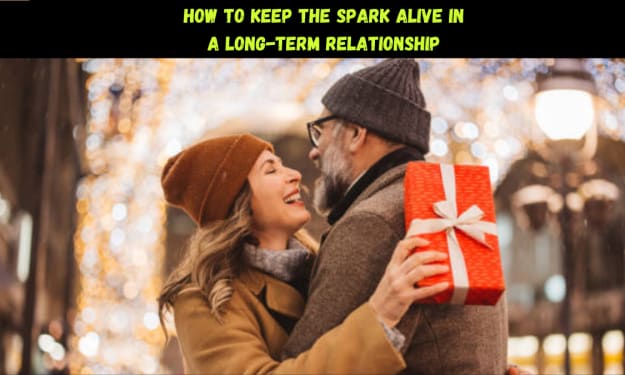
How to Keep the Spark Alive in a Long-Term Relationship
Long-term relationships can often face the challenge of maintaining that initial spark. As time goes on, routines can set in, and the excitement that once defined the relationship may begin to fade. However, keeping the spark alive is not only possible but essential for a fulfilling partnership. This article explores practical strategies to reignite passion and intimacy in long-term relationships.
By Abdul Jamil Nasir2 years ago in Humans