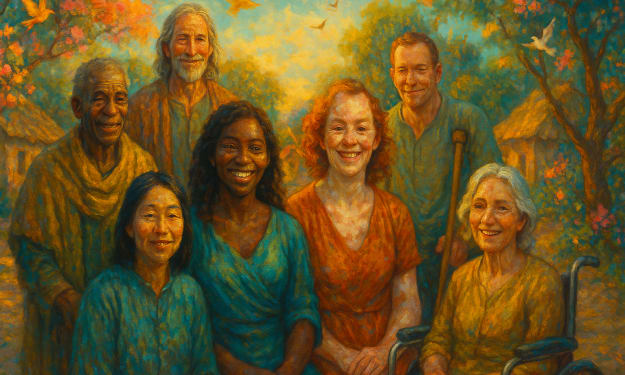
family
Family unites us; but it's also a challenge. All about fighting to stay together, and loving every moment of it.
Diversity and Inclusion
1) Well, first of all, I'd say "Hello!" to all of you, guys! Let us now In a village neither near nor far, suspended between epochs and ideologies, stood a colossal mirror in the heart of the city square. It was not of glass but of consciousness—a mirror that reflected not faces, but identities. And this village, quaint in form yet profound in intellect, was known as Variegata: a place where no two eyes beheld the world the same way, and no two minds dreamed the same dream.
By Muhammad Abdullahabout a year ago in Humans
The Aged Mother
— A Story of Wisdom and Love In a small village nestled between green hills and towering mountains of ancient Japan, there lived a kind-hearted farmer named Shinkichi. He was poor but hardworking, and though life often brought him hardship, he remained content because of the love he shared with his aged mother. Shinkichi’s mother was a frail old woman, her hair white as freshly fallen snow, her back bent with age. Her hands, though thin and trembling, were skilled in sewing and cooking, and her heart remained filled with warmth. The villagers respected her wisdom, often coming to seek her advice on matters of the heart and home. At the time, the land was ruled by a fierce and cold-hearted governor. The ruler believed that aged people were a burden to society — consuming food and resources while contributing little. In his cruelty, he decreed that all those over the age of seventy must be abandoned on the mountains to die. The villagers were stricken with grief at the command. Many wept but dared not disobey the governor, for he was known to be merciless. Word of the decree soon reached Shinkichi’s home. His mother, who had turned seventy-three the past year, understood the law. One night, as the moon hung low in the sky, she spoke to her son: "My dear child, you must obey the law. Take me to the mountain tomorrow, and leave me there. I have lived long and am ready for the end. You must not bring ruin upon yourself for my sake." Tears streamed down Shinkichi’s face. The thought of abandoning his beloved mother was unbearable. Yet the law was strict, and refusal would mean death for them both. With a heavy heart, he agreed. At dawn, Shinkichi prepared for the journey. He wove a basket large enough to carry his mother on his back and filled it with rice cakes and a small flask of water. Gently, he placed her in the basket and began the long climb up the rugged mountain path. The old mother, knowing her son would lose his way on the return journey, broke twigs from bushes and quietly dropped them along the path. Her trembling hands worked with care, leaving a trail for him to follow. She did this not for herself, but out of deep love for her son. When they reached a lonely spot near the summit, surrounded by gnarled trees and thick mist, Shinkichi set the basket down. He helped his mother out and built a small shelter of branches and leaves. "Mother," he said, his voice choked with emotion, "Forgive me. I will come again if I can. I will find a way." The old woman smiled gently, though her heart was breaking. "My child, do not grieve. Go home safely. Follow the trail of twigs. You must live well. That is all I ask." Shinkichi turned away, blinded by tears, and followed the trail his mother had made. The small broken twigs guided him safely back down the mountain. He reached home but could not find peace. Night after night, he lay awake thinking of his mother, alone in the cold heights. Finally, his love conquered fear. Under the cover of darkness, he gathered warm clothes and food and climbed the mountain once more. When he found his mother, she was weak but alive. "Mother! I cannot leave you here to die. Come home with me. I will hide you in my house, no matter what." Moved to tears, the old woman embraced her son. Together, they crept down the mountain under the cloak of night. Shinkichi built a secret room beneath his floor and cared for his mother in secret. She remained hidden, never stepping outside, while he brought her food and news of the village. Months passed. One day, the governor sent messengers to the village with an impossible task: "I command you all to create a rope of ashes. Only those who can do this will prove their worth to the province." The villagers gathered in confusion. A rope of ashes? Such a thing had never been heard of. Many feared they would be punished for failure. That night, Shinkichi spoke to his mother of the challenge. The old woman thought deeply, her eyes shining with wisdom. "Tell them to soak rope in salt water and dry it well. Then burn the rope on a flat surface. The salt will preserve the rope’s shape in ash." Amazed, Shinkichi shared her advice with the village elders. Together, they followed her instructions — and it worked. A perfect rope of ashes lay before them. When the governor saw this, he was astonished. “Who among you is so wise?” he demanded. At first, the villagers hesitated, afraid to speak of the hidden old mother. But Shinkichi, standing tall, stepped forward. "It was my mother’s wisdom, great lord. Though old, she saved us. If you must punish someone, let it be me." The governor was silent for a long time. Then, with a sigh, he spoke: "I was wrong. I see now that age brings wisdom. The old are not a burden but a treasure. I will revoke the cruel law at once." From that day forward, no more aged mothers or fathers were sent to the mountains. The village rejoiced, and Shinkichi’s mother was honored for her wisdom and love. And so, the story of the aged mother lived on, reminding all that love, wisdom, and sacrifice can change even the hardest of hearts.
By Huzaifa Writerabout a year ago in Humans
The Mirror of Many Colors
In a forgotten corner of the earth, hidden behind mountains that kissed the heavens and valleys that held ancient whispers, there existed a village known only as Aloria. It was not found on any map, for Aloria was not made of land but of a spirit—an idea that floated beyond borders. The villagers were artists, but not of brush and canvas. They painted with their hearts.
By Muhammad Abdullahabout a year ago in Humans
The Promise That Stayed
In a quiet village wrapped in hills and silence, two children grew up under the same sky, chasing the same butterflies, and laughing at the same silly jokes. Asfandyar and Durkhanae were inseparable—two souls so gently tied together that even time couldn’t loosen the bond.
By ArshNaya Writesabout a year ago in Humans
Seven Days Without Food. AI-Generated.
In a small village surrounded by green hills and gentle streams, there was a tradition that had been passed down for many generations. It was called “The Test of Strength and Patience.” Every few years, brave men and women would decide to take part in this tradition, spending seven full days without eating any food. They could drink water to stay alive, but nothing more. The purpose was not only to test their bodies but also their hearts and minds.
By Bilal Mohammadiabout a year ago in Humans
Pisces Man and Gemini Woman Compatibility Score. AI-Generated.
The union between a Pisces man and a Gemini woman can be described as both enchanting and bewildering. On one hand, Pisces is deeply emotional, intuitive, and romantic. On the other hand, Gemini is light-hearted, mentally agile, and often detached from deep emotional entanglements. These two zodiac signs represent Water and Air—elements that don’t naturally blend easily, but when combined creatively, can form a misty, ethereal bond. However, it will take a lot of effort, compromise, and understanding to make this relationship flourish long-term.
By Inspire and Funabout a year ago in Humans
I'm Not Normal, and That's Perfectly Normal
Why “Different” Shouldn’t Mean “Wrong” Chores can be fun! Work can be interesting. Relationships can be fulfilling, meaningful, even beautiful. But these things don’t happen on autopilot. They require thought, intention, sacrifice, and a willingness to change. They take real effort, and often, a conscious decision to engage differently than we’re used to. Yet so often, when I try to bring up new ideas or suggest a better way of doing things—whether it’s how we share responsibility at home or how we communicate—I get told that I’m just being annoying. That I talk too much. That I should sit down, stop stirring the pot, and just accept the way things are.
By Peter Thwing - Host of the FST Podcastabout a year ago in Humans