family
Family unites us; but it's also a challenge. All about fighting to stay together, and loving every moment of it.
The Logic of Faith: Why Reason Without God Collapses Under Its Own Weight
The Myth Of Neutral Logic Modern thinkers often claim that logic is neutral, belonging to no belief system and standing above faith. They insist that religion is emotional, while reason is empirical. But logic is not a freestanding structure. It rests on foundations, and those foundations must exist somewhere.
By Peter Thwing - Host of the FST Podcastabout a year ago in Humans
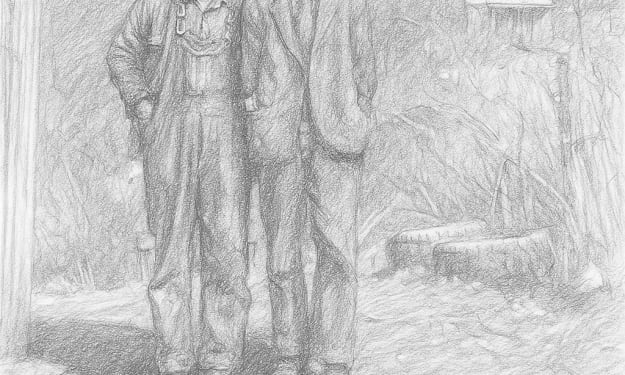
The Map of the Holler
Some maps are drawn on paper and some are drawn in memory. The first kind shows you how to get from one place to another. The second shows you who you are and where you come from. The holler where I grew up never appeared in an atlas, though it shaped every turn of my life.
By Tim Carmichaelabout a year ago in Humans
Separation: When Love Turns to Silence
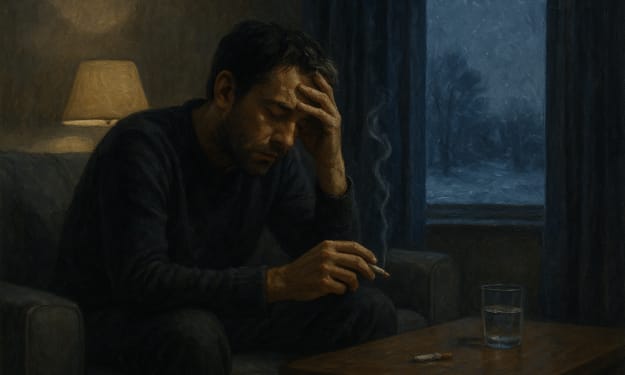
It was a cold winter night, long past midnight. A dim lamp flickered in the corner of the room. Azam lay on the sofa, his legs stretched out, one hand resting on his head, the other on the table. Between his fingers, a half-lit cigarette burned slowly.
By shahkar jalalabout a year ago in Humans
The Shift
Torn, hurting, and angry, I rebelled. I did some things I shouldn't have. I lashed out at people who didn't deserve it. I dropped friends in favor of those with looser values. Sometimes, I ignored schoolwork. I sought companionship with anyone willing, knowing it was wrong.
By Julie Lacksonenabout a year ago in Humans
Shattered Hearts Beneath the Moon
Shattered Hearts Beneath the Moon”** Beneath the weeping sky I stand, alone upon the shore, The wind that hums through hollow bones reminds me what was before. Your voice, a whisper turned to ghost, drifts softly through the rain, And every droplet carries grief, and every breath — your name. The stars once danced for us, my love, in nights of silver flame, When laughter lived within our hands, and nothing felt the same. We built our dreams from fragile glass, from trust and trembling light, But glass will break, and dreams will fade, when morning kills the night. The tide that kissed our footprints once has swallowed every trace, The ocean keeps its secrets now, it hides your vanished face. I reach into the endless waves to find the warmth you gave, But love, like sand, escapes the hand no matter how we crave. You said, “Forever,” soft and sure, beneath the amber sky, But “forever” died the moment you learned how to say goodbye. And now the echo of your vow still haunts this haunted chest, Where hope and sorrow lie entwined, refusing to find rest. How cruel the heart that learns too late the cost of being true, For I had given all of mine, and all of it was you. Each beat now falls like shattered glass upon the floor of time, And every scar becomes a verse, and every tear — a rhyme. The moonlight spills on broken things and makes them shine anew, Yet even gold can’t heal the cracks the way your absence grew. I wander through these ruined halls where memories still gleam, They flicker like the dying flame of what we dared to dream. The letters that you never sent still burn inside my chest, The words you never dared to speak deny me of my rest. I read the silence that you left between each line we wrote, And feel it cut more sharply still than any blade or note. The world keeps spinning, cruel and cold, it never waits to mourn, It laughs above the graves of love and dances on the torn. But I, I linger in the dark, beneath the stars that wept, And count the promises you broke, the ones I should’ve kept. For broken hearts don’t bleed to death; they simply learn to hide, They paint on smiles, they walk through crowds, with emptiness inside. They speak in gentle, measured tones as though they’ve found their peace, But deep within, the storm remains — it never finds release. I’ve watched the seasons change their coats; I’ve seen the rivers dry, Yet still your shadow clings to me, it will not say goodbye. I’ve begged the dawn to take you back, to trade the sun for night, But even light won’t heal a wound that never saw the light. So here I carve your memory upon the trembling sea, Let every wave that breaks tonight remind the world of me. For I have loved with all my heart and lost with all my soul, And though I walk with shattered parts, I still remain — not whole. And if, one day, you pass this shore where lonely spirits weep, You’ll hear my heart beneath the foam, still singing from the deep. It hums a song of fractured love, of promises undone, Of lovers lost to time’s cruel hand, and hearts that beat for none. Yet though I die a thousand deaths within this quiet pain, I’d live them all, and love you still, and break my heart again. For what is life without the ache that makes us who we are? A sky without its falling stars, a night without its scar. So let the heavens mourn with me, let every echo cry, For even broken hearts can dream — though dreams are born to die. And in the ruin of what we were, where silence claims its part, There grows the fragile, painful truth — the beauty of a shattered heart.
By America today about a year ago in Humans
The U.S. Cost-of-Living Crisis: A Political Report for Everyday Americans
## The U.S. Cost-of-Living Crisis: A Political Report for Everyday Americans ### What’s Happening For many Americans today, politics isn’t just about party slogans or elections—it's about **whether they can afford to live**. A recent poll found that roughly 40 percent of adults say that cost-of-living is the single most important issue in their decision-making about who to vote for. This concern outweighs other issues like democracy, immigration, and crime. This shows how deeply economic strains are affecting daily life across the country. Affordability is emerging as a key battleground. High costs for health care, food, housing, and energy dominate people’s worries. Among these, health care stands out: about 31 percent of respondents said it should be the top priority for Congress. People worry not only about big numbers in the economy, but about whether they personally have access to affordable care, stable housing and predictable bills. ### Why It Matters to the Average American When everyday costs go up, it hits hard in neighborhoods, kitchens and pay-checks. Families see rent rising, grocery bills mounting, medical bills creeping into their budgets. One survey found that a large majority of U.S. adults say strengthening the economy should be the top priority for the President and Congress. What’s striking is how this concern cuts across politics: both major parties know that voters want relief. Democrats are emphasising policies such as raising the minimum wage, expanding health care subsidies and broader social support. Republicans, meanwhile, highlight economic growth, tax relief and limiting government costs. Yet practical worries remain: having enough money for next month often matters more than which party is in control. ### The Key Questions Americans Are Asking • Why are basic essentials becoming so expensive for so many? • What can government actually do to reduce the cost of living? • Why is health care still so costly if we’re a wealthy nation? • How will housing and energy costs evolve, especially for renters and young families? • Which political leaders or platforms are best positioned to address this crisis? • Will improving economic conditions translate into improved everyday lives for average citizens? • What is the role of inflation, global supply-chains and federal policy in driving the cost issues? ### What We Know: The Answers in Brief Higher costs are the result of many entangled factors: inflation from recent years, supply-chain disruptions, increased global demand for energy and food, and wage growth that hasn’t kept pace with prices. On housing, shortages in many markets have pushed rents and home-prices up. Health care remains costly because of expensive treatments, administrative overhead and gaps in insurance coverage—many Americans say their premium, deductibles or out-of-pocket expenses rose this year. Government action can help, but solutions are complex. Subsidies, regulation of health-care costs, affordable housing incentives and energy-efficiency measures are all on the table. But each has trade-offs: budgets, political feasibility and unintended consequences. Politically, both parties are under pressure: Democrats face the challenge of delivering tangible relief before an upcoming midterm cycle, and Republicans must show that their economic message translates into everyday impact. ### Broader Political and Social Implications This cost-of-living crisis doesn’t just affect budgets—it has deeper implications for trust in institutions and for political engagement. When people feel squeezed and ignored, frustration builds. Recent surveys show that a large share of Americans say the country is on the wrong track and express low confidence in government institutions and officials. When politics fails to address what people feel every day—rising costs, financial insecurity—it risks further alienation of voters. Moreover, the pressure on affordability makes other issues more urgent. For example, if a family is forced to choose between medication and rent, questions about health care become not just theoretical but immediate. If energy bills spike, climate and energy policies become part of the cost conversation. When the economy and cost of living dominate, other issues may take a back-seat—but neglecting them can lead to longer-term problems. ### What Happens Next and Why It Matters for You As voters look ahead to elections, cost-of-living is likely to be a decisive factor. Candidates and parties will be judged less on catchy slogans and more on whether they can show they understand and can address people’s daily financial pressures. Local and federal levels of government will both face pressure to deliver relief measures. For you as a citizen, this means staying alert: watching policy details, seeing how proposals impact your household, and holding leaders accountable for more than just big promises. At the same time, individual households can’t entirely rely on politics—budgeting, financial planning and awareness of market changes will continue to matter. But politics can either make things worse (if ignored) or make things better (if acted upon).
By America today about a year ago in Humans
Mina Naz: The Price of Love and Honor
hey say love is the most powerful emotion— It can build empires or destroy families. Mina Naz was once the heart of her home, a girl adored by everyone. But when her love crossed the boundaries of family honor, her world turned upside down.
By shahkar jalalabout a year ago in Humans
The Caliph Who Fed the Orphans
The story of ʿUmar al-Fārūq with the mother of orphans The Caliph al-Fārūq, Commander of the Faithful ʿUmar ibn al-Khaṭṭāb, the second of the Rightly Guided Caliphs, went out, as was his habit, to check on the condition of his subjects — as befits the just ruler who cares for his people — and ... he paid attention to their affairs with his companion ʿAbd al-Raḥmān ibn ʿAwf.
By Nana bonnaabout a year ago in Humans