fact or fiction
Is it a fact or is it merely fiction? Fact or Fiction explores relationship myths and truths to get your head out of the clouds and back into romantic reality.
Compulsions
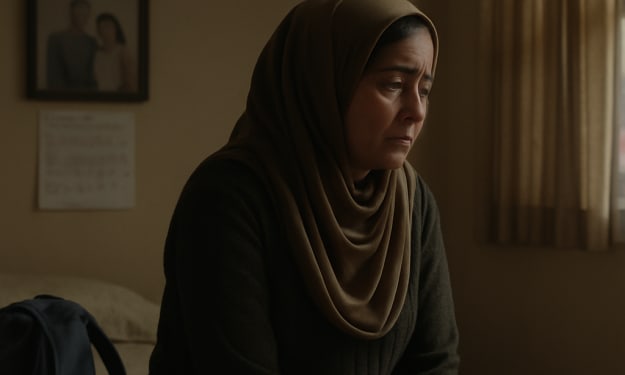
Millions of Pakistanis are living in America who have migrated from Pakistan to live a good life and settled in this country... Take the money and money, they get it, but they have to face various problems. In the house where she was staying in America, a maid who was Pakistani, tearfully told her story of how she had come to America with her husband for a better job. She supported him in every joy and sorrow, worked so hard that they both opened a food store together... As soon as she saw it, her days changed. Things became so good that the wife stopped going to the store and became busy with household chores... The boys who were about to become them were studying in good schools, why did the husband suddenly think that he had married again... But he did not let his wife know about it and even divorced her... One day, his son said to his mother:
By Echoes of Lifeabout a year ago in Humans
If I Could, I’d Hug That Shark — Because It Saved My Life
It was a bright summer morning on the golden shores of Huntington Beach, California. The beach was alive with laughter and joy — children building sandcastles, couples walking along the waves, and families swimming in the open sea. Among them was Eugene Finney, a 39-year-old father enjoying the Pacific surf with his 10-year-old daughter.
By Saleem awaisabout a year ago in Humans
Complaining: A Path to Nowhere
A long time ago, I had a friend. Every time we met, after a few words of greeting, she would fall into a familiar rhythm. "Our boss is really bad. The salary is low, the benefits are poor, and he is particularly partial to those who only flatter him."
By Emily Chan - Life and love sharingabout a year ago in Humans
I FOUND A FROG
Even though I’m now a grandparent, the memory still feels as fresh as yesterday. I can still see myself as that small, curious six-year-old coming home from school, tossing my backpack to the floor, and racing into my room — only to freeze in my tracks and shout:
By Junaid Shahid about a year ago in Humans
The Bench by the Bakery
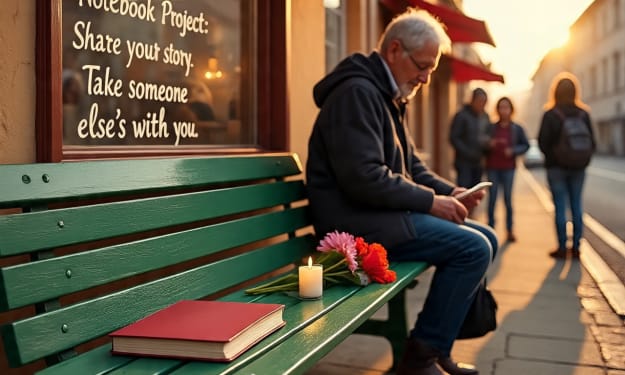
Every morning at exactly 7:30, Ruth sat on the weathered green bench outside Matteo’s Bakery. She wore a soft gray sweater, a woolen hat, and carried a tote bag that had definitely seen better days. In her lap sat a red notebook, frayed at the corners, filled with dozens of entries written in careful, looping handwriting. No one paid her much attention at first. Just an old woman sitting alone on a bench, scribbling into a notebook while the world hurried past. But those who took the time to stop—those who sat beside her, even for a moment—soon became part of something unexpected. It started with a teenager named Emily. She was angry at the world the day she met Ruth. Her parents were divorcing. Her best friend had ghosted her. Life felt like one long, echoing betrayal. She sat beside Ruth only because her phone had died, and she needed to wait somewhere before school started. Ruth had smiled at her. “You look like someone who’s carrying too much.” Emily had scoffed. “That obvious?” Ruth didn’t pry. She simply said, “Would you like to write it down?” Emily stared at the red notebook. “What is this?” “It’s for people who have things to say,” Ruth replied. “Sometimes words feel lighter once they leave your chest.” Something about the old woman’s calm voice and kind eyes cracked through Emily’s wall. She took the notebook. She wrote. For ten minutes, without stopping. She returned the notebook with red eyes, but a lighter heart. From that day on, more people came. There was Mr. Torres, the widower who had stopped talking to anyone since his wife died two years ago. One morning, he sat next to Ruth and began talking about her without being asked. About the way she used to hum while watering the plants. About how he still made tea for two, out of habit. There was Sarah, the young mother struggling with postpartum depression. Her baby was barely two months old, and she hadn’t smiled in weeks. Ruth simply held her hand while she cried. There was Jamal, a bus driver who had seen too much ugliness in the world. Ruth let him read a story from the notebook—one about a young girl who had forgiven her abusive father. It didn't fix everything, but it reminded Jamal that healing was possible. Day by day, story by story, the bench became more than just wood and paint. It became a haven. Ruth never asked for money, never advertised what she did. She simply sat with her notebook and listened. Sometimes she offered a kind word. Sometimes silence. Sometimes cookies from Matteo’s when people needed a little sugar and warmth. She told everyone the same thing: “You are more than your worst day.” No one knew Ruth's full story. Some guessed she had once been a therapist. Others thought she was a retired writer. No one was quite sure. Until one morning, she didn’t come. And she didn’t come the next day either. Matteo, the bakery owner, placed a small note on the bench. "Ruth is resting now. She passed peacefully in her sleep. Her family thanks you all for being her purpose these past years." There was silence on the street that day. An invisible weight seemed to settle over the sidewalk. People stood near the bench, uncertain of what to do. Then Emily, now a university student home for summer break, walked up with a small candle. She lit it and placed it on the bench. Mr. Torres came next. He placed a photo of his wife and a note: “Thank you for reminding me she still lives in memory.” Sarah brought her toddler, who placed a flower down, not fully understanding—but sensing the importance. Within a week, the bench was covered in flowers, letters, photos, and even a plaque someone anonymously attached: “To Ruth — who heard our stories and helped us heal.” Matteo eventually placed a sign in his bakery window: “Red Notebook Project: Share your story. Take someone else’s with you.” There was a new red notebook on the bench. And every week, it was replaced with a fresh one. Filled pages were stored in a shelf inside the bakery, labeled by date. People still come to that bench. They sit. They write. They remember. And sometimes, they find someone already there—waiting to listen, just like Ruth once did. In a world moving too fast to notice the small aches people carry, Ruth left behind a simple legacy: Be still. Listen. Make space for others. And sometimes, that’s all it takes to make someone believe in people again.
By Muhammad Bilalabout a year ago in Humans
Colors of Compassion
n the heart of Maplewood, a city alive with flashing lights and busy streets, lived a young artist named Elena. She saw the world through a kaleidoscope of colors—crimson reds, ocean blues, sunny yellows—that danced on her canvases, telling stories words often failed to express. Painting was not just her passion; it was her way of reaching out, hoping to touch lives beyond the walls of her modest studio.
By Najeeb Scholerabout a year ago in Humans
From Braces to Gold
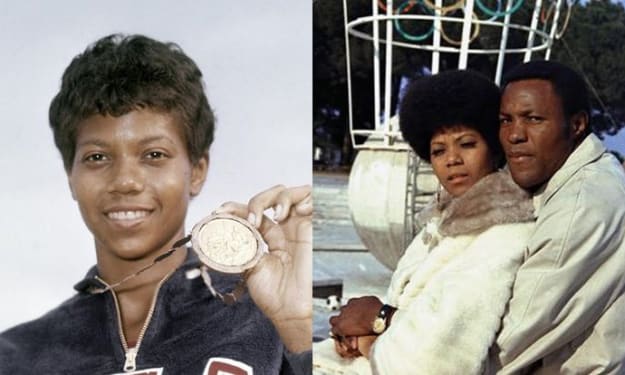
On a sweltering summer day of June 23, 1940, in a tobacco barn outside Clarksville, Tennessee, a fragile baby girl entered the world. Born at just 4½ pounds, she was the 20th of 22 children. Her name was Wilma Glodean Rudolph, and no one guessed that this tiny child would become the fastest woman in the world.
By Real Talesabout a year ago in Humans
"The Love That Remained". Content Warning. AI-Generated.
When the world moved on, Clara Bennett stayed behind. Not in a physical sense—she still lived in her tiny seaside home, still swept her front porch every morning, still made tea at precisely four o'clock. But inside, her heart remained anchored to a time that no longer existed. A time when laughter echoed in the halls and the smell of pine and old books filled the rooms. A time when her husband, Thomas, sat across from her each evening, reading aloud from the newspaper with his gentle baritone.
By Najeeb Scholerabout a year ago in Humans
Dark Psychology and Manipulation: The Hidden Games of the Human Mind
Introduction: The Shadow Side of the Mind We like to think we are in control—of our choices, our opinions, our lives. But what if that’s not entirely true? Beneath the surface of everyday interactions lies a web of invisible threads—crafted by words, tones, and behaviors—that can subtly steer us in directions we never consciously chose. This is the world of dark psychology—the art and science of manipulation, persuasion, and emotional control. It’s not magic. It’s human behavior, weaponized.
By Emad Iqbalabout a year ago in Humans