fact or fiction
Is it a fact or is it merely fiction? Fact or Fiction explores relationship myths and truths to get your head out of the clouds and back into romantic reality.
The Girl Who Painted the Silence
The Girl Who Painted the Silence The first time Amina held a paintbrush, the world finally made sense. The world she lived in was filled with sounds she could never hear — laughter that came as moving lips, thunder that flashed without warning, and songs that danced in the air beyond her reach. Amina was born deaf, but she didn’t see it as a curse. She believed silence had colors — she just had to find them. Her mother, Fatima, often watched her from the doorway. Every morning, after her chores, Amina would sit by the window with her small set of brushes and paints. She would mix colors with a kind of patience that made time slow down — a little blue with a hint of yellow, a stroke of crimson beside pale gray. Her fingers moved like whispers on canvas. “What are you painting, my love?” her mother would ask gently. Amina would smile, lift her hands, and sign with grace, “The sound of morning.” Fatima didn’t understand how a sound could have color — but she saw it, somehow. In her daughter’s painting, the dawn light looked alive. --- When Amina turned sixteen, her village invited an art teacher from the city to hold weekend classes. Most children came for fun. Amina came with purpose. The teacher, Mr. Rahman, was surprised by the quiet girl who never spoke yet painted with such intensity. He noticed how she’d close her eyes before every stroke, as if listening to something deep inside her. One day, he asked through writing on her notebook: “How do you choose your colors?” She wrote back, her handwriting neat and certain: “By how they feel, not how they look.” That answer stayed with him long after the class ended. --- But not everyone understood Amina. Some villagers whispered that painting was not for girls. Others said it was useless for someone who couldn’t even hear praise. Yet, Amina painted anyway — on walls, on clay pots, on the side of her family’s small shop. She painted with hope. Her favorite canvas was the old wall beside the village school. She turned it into a mural of children holding hands under a sky of swirling colors — blues and violets that met like waves, golden streaks that seemed to sing. The children loved it. They would trace the colors with their fingers, giggling, even though Amina couldn’t hear their laughter. But she could feel it — in their smiles, in the way they waved at her. Her art became a language everyone understood. --- Years passed, and Amina’s name began to travel beyond her small valley. People from nearby towns came to see “the girl who painted silence.” A local journalist visited one summer afternoon and asked through a translator, “What do you hear when you paint?” Amina paused for a long time, her eyes distant, then she signed slowly: “I hear the way the sky breathes before rain. I hear the kindness in a mother’s eyes. I hear everything that cannot be said.” The article went viral. Within weeks, an art gallery in Islamabad invited her for an exhibition — her first. --- Fatima cried when she read the invitation. She had spent years worrying that silence would limit her daughter’s life. Now she realized — it had deepened it. In the city, Amina felt both excited and terrified. The gallery walls gleamed with white light. Her paintings — once drying in the corner of a mud house — now hung in gold frames. She walked through the hall, touching the air softly, almost like greeting old friends. Visitors stood in silence before her work — not because they had to, but because the paintings asked for it. There was one titled “Echo.” It showed waves of color folding into one another, like the pulse of something unseen. Another one, “Mother’s Voice,” was a swirl of warm pinks and soft gold — Fatima’s love captured in color. When the gallery owner asked her what message she wanted to give to the audience, Amina took out a small notebook and wrote: > “We all live with silences — some outside, some inside. I just choose to paint mine.” --- Her story spread far and wide. Schools invited her to paint their walls. NGOs asked her to teach art to children with hearing disabilities. Amina agreed happily — but she had one condition: every child, whether deaf or not, must paint without speaking. At first, the children struggled. The silence felt strange, heavy. But slowly, they began to understand what Amina always knew — that silence is not empty; it’s full of color if you listen closely enough. One day, a little boy tugged her sleeve and signed clumsily, “Teacher, I can hear with my eyes now.” Amina smiled, tears filling her bright brown eyes. In that moment, she knew her art had done what no voice ever could — it had connected hearts. --- Years later, when a documentary about her life premiered, Amina stood on stage beside her aging mother. The audience clapped for a long time. She couldn’t hear it, but she could feel the rhythm through the floor, through her heartbeat. Fatima leaned close and whispered in her ear, knowing she couldn’t hear the words — but saying them anyway: “You taught us all how to listen.” Amina looked at her mother, then at the crowd — faces glowing in the soft light — and smiled. The world had always been noisy. But for the first time, it was listening to silence.
By Abdul Muhammad 12 months ago in Humans
Substance Use and Mental Health: The Unspoken Battle We All Need to Face
We live in a culture that glamorizes “a drink to unwind” after work and laughs off “needing something to take the edge off.” But beneath the jokes lies a quieter story — one where substance abuse becomes a substitute for self-care.
By Leigh Cala-or12 months ago in Humans
The False Dilemma
The Mirage of Choice Every day, whether in politics, philosophy, or faith, people are pressured into false choices. You either believe this, or you must believe that. You either accept this statement entirely, or you reject truth altogether. These are not honest discussions. They are traps.
By Peter Thwing - Host of the FST Podcast12 months ago in Humans
Planting Truth In Hostile Soil
The Calling To Plant There has never been an age where truth was loved by the crowd. From the prophets of Israel to the apostles of Christ, those who spoke truth have always done so against the wind. Yet each generation faces its own form of resistance. Ours is not built on swords or prisons, but on sarcasm and pride. It mocks what it cannot refute and ridicules what it cannot understand.
By Peter Thwing - Host of the FST Podcast12 months ago in Humans
AI And Apologetics
The Tools of the Age Every generation faces the same question in a different form: how should faith engage with new tools of power? In one era it was the printing press. In another, the radio or television. Today, it is artificial intelligence.
By Peter Thwing - Host of the FST Podcast12 months ago in Humans
The Mirror Of Mockery
The Nature Of The Mirror Mockery has become the native language of the modern world. It fills screens, floods comment sections, and echoes through every arena where ideas are exchanged. What once required substance now survives through sarcasm. To ridicule is easier than to reason.
By Peter Thwing - Host of the FST Podcast12 months ago in Humans
The Logic of Faith: Why Reason Without God Collapses Under Its Own Weight
The Myth Of Neutral Logic Modern thinkers often claim that logic is neutral, belonging to no belief system and standing above faith. They insist that religion is emotional, while reason is empirical. But logic is not a freestanding structure. It rests on foundations, and those foundations must exist somewhere.
By Peter Thwing - Host of the FST Podcast12 months ago in Humans
The Map of the Holler
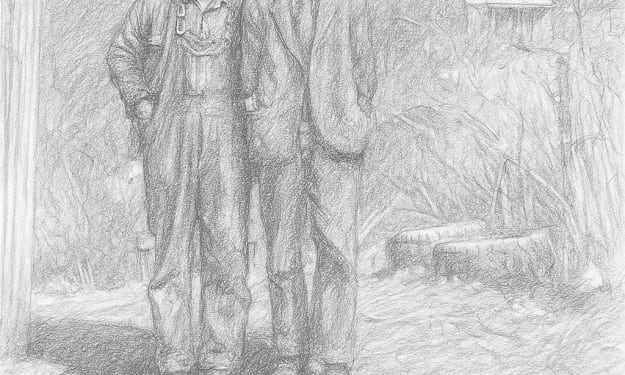
Some maps are drawn on paper and some are drawn in memory. The first kind shows you how to get from one place to another. The second shows you who you are and where you come from. The holler where I grew up never appeared in an atlas, though it shaped every turn of my life.
By Tim Carmichael12 months ago in Humans
The Silent Love of Middle Age
When people reach middle age, the biggest fear isn't loneliness, but falling for someone they shouldn't. At this point in life, it's not that no one pursues you or that no one is there for you; it's the moment someone truly connects that you know the danger has arrived. You find yourself unable to control your longing or suppress your emotions. Even when you understand it's destined not to work out, you still desperately want to get closer.
By Emily Chan - Life and love sharing12 months ago in Humans
Separation: When Love Turns to Silence
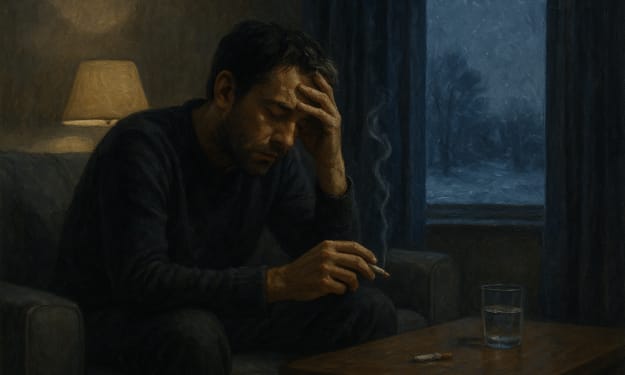
It was a cold winter night, long past midnight. A dim lamp flickered in the corner of the room. Azam lay on the sofa, his legs stretched out, one hand resting on his head, the other on the table. Between his fingers, a half-lit cigarette burned slowly.
By shahkar jalal12 months ago in Humans
Shattered Hearts Beneath the Moon
Shattered Hearts Beneath the Moon”** Beneath the weeping sky I stand, alone upon the shore, The wind that hums through hollow bones reminds me what was before. Your voice, a whisper turned to ghost, drifts softly through the rain, And every droplet carries grief, and every breath — your name. The stars once danced for us, my love, in nights of silver flame, When laughter lived within our hands, and nothing felt the same. We built our dreams from fragile glass, from trust and trembling light, But glass will break, and dreams will fade, when morning kills the night. The tide that kissed our footprints once has swallowed every trace, The ocean keeps its secrets now, it hides your vanished face. I reach into the endless waves to find the warmth you gave, But love, like sand, escapes the hand no matter how we crave. You said, “Forever,” soft and sure, beneath the amber sky, But “forever” died the moment you learned how to say goodbye. And now the echo of your vow still haunts this haunted chest, Where hope and sorrow lie entwined, refusing to find rest. How cruel the heart that learns too late the cost of being true, For I had given all of mine, and all of it was you. Each beat now falls like shattered glass upon the floor of time, And every scar becomes a verse, and every tear — a rhyme. The moonlight spills on broken things and makes them shine anew, Yet even gold can’t heal the cracks the way your absence grew. I wander through these ruined halls where memories still gleam, They flicker like the dying flame of what we dared to dream. The letters that you never sent still burn inside my chest, The words you never dared to speak deny me of my rest. I read the silence that you left between each line we wrote, And feel it cut more sharply still than any blade or note. The world keeps spinning, cruel and cold, it never waits to mourn, It laughs above the graves of love and dances on the torn. But I, I linger in the dark, beneath the stars that wept, And count the promises you broke, the ones I should’ve kept. For broken hearts don’t bleed to death; they simply learn to hide, They paint on smiles, they walk through crowds, with emptiness inside. They speak in gentle, measured tones as though they’ve found their peace, But deep within, the storm remains — it never finds release. I’ve watched the seasons change their coats; I’ve seen the rivers dry, Yet still your shadow clings to me, it will not say goodbye. I’ve begged the dawn to take you back, to trade the sun for night, But even light won’t heal a wound that never saw the light. So here I carve your memory upon the trembling sea, Let every wave that breaks tonight remind the world of me. For I have loved with all my heart and lost with all my soul, And though I walk with shattered parts, I still remain — not whole. And if, one day, you pass this shore where lonely spirits weep, You’ll hear my heart beneath the foam, still singing from the deep. It hums a song of fractured love, of promises undone, Of lovers lost to time’s cruel hand, and hearts that beat for none. Yet though I die a thousand deaths within this quiet pain, I’d live them all, and love you still, and break my heart again. For what is life without the ache that makes us who we are? A sky without its falling stars, a night without its scar. So let the heavens mourn with me, let every echo cry, For even broken hearts can dream — though dreams are born to die. And in the ruin of what we were, where silence claims its part, There grows the fragile, painful truth — the beauty of a shattered heart.
By America today 12 months ago in Humans
Are You Searching for Peace?. Top Story - October 2025.
Are you longing for peace in our troubled world? Most of us do. Our world is fractured and breaking down in many places. Most of them are caused by humans. There is so much hatred and animosity amid pollution and natural disasters. What's happened to us?
By Elizabeth Woods12 months ago in Humans