fact or fiction
Is it a fact or is it merely fiction? Fact or Fiction explores relationship myths and truths to get your head out of the clouds and back into romantic reality.
Find Your Light in the Darkness
Light is a form of energy that allows humans to see, and we rely on it to function. Having less light during the day affects many people. Some even develop depression from this lack of sunlight through a condition called S.A.D (Seasonal Deficit Disorder).
By Elizabeth Woods11 months ago in Humans
Why I Stopped Being a "Good Person": The Day I Quit People-Pleasing
For as long as I can remember, my identity was wrapped up in one simple word: "Yes." “Can you help me move apartments this weekend?” Yes. (Even though I had a fever.) “Can you cover my shift at work?” Yes. (Even though it was my only day off.) “Can I borrow money?” Yes. (Even though I was struggling to pay my own rent.) I wore my exhaustion like a badge of honor. I convinced myself that this was what it meant to be a "good person." I thought that if I sacrificed enough, if I gave enough, if I suffered enough for others, then I would be worthy of love. I treated relationships like vending machines: I inserted kindness, expecting respect to fall out. But the machine was broken. The turning point didn't come during a dramatic argument. It happened on a quiet Sunday afternoon. I was sitting in my car, parked outside a friend’s house. I had just spent four hours helping them organize their garage. I was tired, hungry, and my back was aching. I checked my phone. It was my birthday. Not a single person I had spent the last year "saving" had sent me a message. Not one. I sat there in the silence, staring at the steering wheel, and for the first time, I didn't feel angry at them. I felt angry at myself. I realized that I wasn't being kind. I was being transactional. I was doing things for people not because I wanted to, but because I was terrified that if I stopped being useful, they would stop liking me. I was buying their companionship with my labor. I had turned myself into a doormat and then complained that people were wiping their feet on me. That day, I made a decision. I decided to try a dangerous experiment. I decided to start saying "No." The first time was terrifying. A coworker asked me to do a report that was his responsibility. My heart hammered in my chest. My palms sweated. The old instinct to please screamed at me to just agree. But I took a deep breath and typed: “I can’t do that. I have my own workload to finish.” I waited for the world to end. I waited for him to scream at me, to fire me, to hate me. Instead, he simply replied: “Okay, no problem.” The world didn’t end. But my world shifted. Over the next few months, I went on a "No" spree. I stopped attending events I didn't want to go to. I stopped listening to drama that drained my energy. I stopped apologizing for taking up space. The reaction was revealing. Some people—the ones who truly cared about me—respected my boundaries. They were happy to see me taking care of myself. But the others? The ones who only liked me for what I could do for them? They became angry. They called me selfish. They called me "changed." They fell away from my life like dead leaves. And honestly? It was the greatest relief of my life. I realized that losing a "friend" who only calls you when they need something is not a loss. It is a gain. It is gaining back your time, your energy, and your self-respect. I am no longer a "nice" person. "Nice" is polite. "Nice" is quiet. "Nice" is doing what you are told. Instead, I am striving to be a kind person. There is a difference. Kindness is honest. Kindness comes from a place of strength, not fear. A kind person helps you up when you fall, but they won't lay down so you can walk over them. Today, my circle is smaller. My phone is quieter. But when I say "Yes" now, I mean it. I am not giving from an empty cup anymore. If protecting my peace makes me the villain in your story, then so be it. I would rather be a happy villain than a miserable hero.
By Noman Afridi11 months ago in Humans
AI & Layoff
Layoffs are hardly a new phenomenon. Every year, we hear news of large corporations "optimizing organizational structures" and cutting labor costs—it feels like an annual, fixed program. The standard reasons are always the same: economic downturns, industry transformation, shrinking markets, corporate restructuring, or the classic move to please investors and boost shareholder returns.
By Water&Well&Page11 months ago in Humans
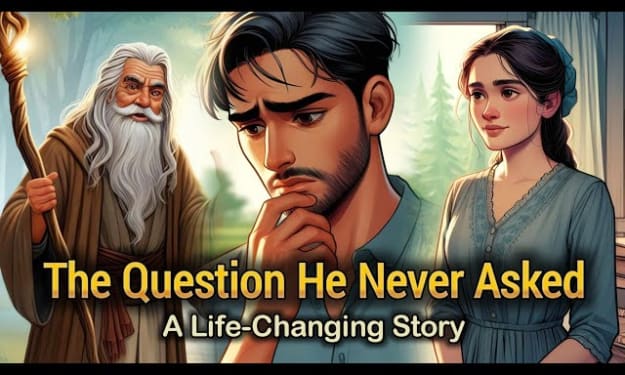
The Question He Never Asked
Once upon a time, in a small village, lived a poor man. He was tired of his poverty and always wondered, "When will my life change? When will I escape this misery?" One day, he heard that a wise monk had arrived in a nearby village. It was said that the monk had answers to any question one might ask. The man wanted to find a solution to his problems, so he decided to go and meet the monk. To reach the other village, he had to cross a dense forest. As he walked through the forest, night began to fall, and darkness descended. Then he saw a large and beautiful house in the middle of the forest. He approached it and politely asked the owner if he could stay the night. The owner agreed and welcomed him. Curious, the owner asked, "Where are you going so late at night?" The poor man replied, "I am going to meet the monk in the neighboring village. I want to ask him a question about my life." The owner nodded and said, "Please, ask me a question too. My daughter is twenty years old and has never spoken a word in her life. She is mute." The monk asked, "When will she begin to speak?" The poor man agreed and left early the next morning. As he continued on his way, he came across an old magician with a magic wand. The magician looked at him and asked, "Where are you going, young man?" The man replied, "To meet a monk. I want to ask him a question." The magician said, "Then ask him a question for me too. I have lived a long time and I long to enter Heaven. Ask him when I will be able to enter it." The man agreed and continued on his journey. After a while, he saw a giant tortoise resting under a tree. The tortoise looked at him and asked, "Where are you going?" The man replied, "To see the monk." The tortoise said, "Please, ask the monk another question. I have always dreamed of becoming a dragon. Ask him when I will finally become a dragon." The man nodded again and finally reached the monk. The monk was sitting under a tree, deep in thought. The man greeted him respectfully and asked, "May I ask you a few questions?" The monk opened his eyes gently and said, "Yes, but you may only ask three." The man was taken aback. Only three, but I have four questions—one from me and three from the others. He stood there thinking that my question was about poverty, but it seemed trivial compared to what these people were going through. I would ask their questions first. He took a deep breath and asked his first question: "When will the tortoise become a dragon?" The monk answered, "When it takes off its shell and abandons its protection, it will become a dragon." Then he asked his second question: "When will the sorcerer ascend to heaven?" The monk replied, "When he walks on his staff for someone else, his time will come, and he will... ascend to heaven." Finally, he asked the last question: "When will the girl find her voice?" The monk said, "When she meets someone who truly understands her heart, her voice will awaken." The poor man bowed in gratitude. Although his question remained unanswered, he began his journey back, walking the same path. On his way, he first met the tortoise. The man told him what the monk had said: "You will become a dragon when you take off your shell." The tortoise hesitated but trusted the monk's wisdom. She began to slide slowly from her shell, and right before the man's eyes, she transformed into a great dragon. When the ancient shell opened, dozens of glittering pearls rolled to the ground. The dragon smiled and gave all the pearls to the man in gratitude, then flew away into the sky. The man was amazed. He picked up the pearls and went on. Then he met the old magician and told him. The monk said, "You will go to heaven when you give your staff to someone else." The magician thought for a moment, then He handed the staff to the poor man. At that moment, his body was filled with light, and his soul ascended peacefully to heaven, free, happy, and at peace. The poor man now carried a magic staff and a bag full of pearls. Finally, he returned to the great house in the forest and met the kind man who had allowed him to stay. The man asked eagerly, "Did you ask the monk my question?" The traveler smiled and replied, "Yes." He said, "Your daughter will speak when she finds someone who truly understands her." The man paused in surprise, then slowly turned to his daughter. She looked at the traveler, and their eyes met. For the first time, she opened her mouth and said softly, "Thank you." Her father was astonished. Overjoyed, he embraced her and said, "It is you I mean." "You truly understand her heart." "Will my daughter marry?" The poor man nodded humbly. The two were married in front of the villagers. The man who had nothing—no money, no voice, no answers—now had a loving wife, a bag of pearls, a magic wand, and a wise heart. The moral of the story: Sometimes we gain more in life when we put others first.
By Abdur Rahman11 months ago in Humans
Biohacking Humanity: The Promise and Ethics of DIY Biology
In the dark basement, shelves of glass beakers, pipettes, and agar plates cover the walls. A humming centrifuge occupies a corner, and fluorescent lights cast a soft glow over the cluttered workstation. On the center bench, a cluster of hobbyists carefully manipulates bacterial cultures, sometimes looking up at a laptop screen where sequences of DNA roll by. They are not in a university or corporate biotech lab. This is a home lab, a living room turned experiment microcosm. This is the world of biohacking—the new phenomenon of individuals immersing themselves in biology, genetics, and biotechnology outside of traditional institutions.
By The Chaos Cabinet11 months ago in Humans
The Silent Forces Of Leadership. AI-Generated.
The Human Element in Organizational Success If you look at almost any organization from the outside, the picture seems straightforward. There is a strategy, an organogram, a set of processes, some KPIs, and a collection of digital tools meant to keep everything under control. We talk about “systems” and “structures” as if they are the real heart of the institution. Yet anyone who has spent time inside a company, a government department, or a non-profit knows that the real story is much messier and much more human. The same structure can produce very different results depending on who is in the room, how they relate to each other, and what is happening inside their minds. The same policy can feel inspiring in one team and oppressive in another. The same technology can either empower people or quietly exhaust them. Underneath every chart and system, human psychology is quietly writing the script.
By Sayed Zewayed11 months ago in Humans
The Weight of Reality: The Trade-Off Illusion
1. Every Solution Costs Something There is no such thing as a perfect solution. Every answer creates a new question, and every gain requires a loss. The idea that we can have everything without giving something up is one of the greatest lies of modern culture. Real progress demands trade-offs. Something must be sacrificed for something else to exist.
By Peter Thwing - Host of the FST Podcast11 months ago in Humans
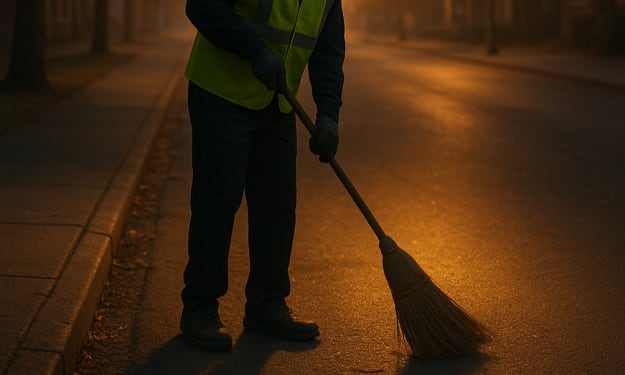
Sweeping Poem
I used to think my job was simple: sweep the street, empty the bins, keep the sidewalk clean enough for people to forget someone like me had been there at all. Most mornings, I moved like a shadow—quiet, invisible, just a man with a broom and a shift that started before the sun respected the sky. But one Tuesday, while clearing the gutter near the old bus stop, my broom caught something that wasn’t the usual crumpled cup or candy wrapper. It was a small black notebook, swollen a little from last night’s drizzle but still intact. No name. No number. No stickers. Just a soft, worn cover that felt like it had been held by someone who cared about it. I should’ve tossed it in the trash bag. Rules said anything found on the street went straight in. But something in me paused—maybe curiosity, maybe loneliness, maybe the fact that the morning was so still it felt like it was waiting for me to make a choice. So I slipped it into my jacket. Later, during my break behind the community center, I opened it. The first page held a short line, written in blue ink that curled like smoke: “I dreamt of a door that only opened when I forgave myself.” I sat there longer than I should’ve, reading that single sentence again and again. It felt like something someone whispers when they think no one is listening. The next day, as I swept the same stretch of street, the notebook came back to mind. I flipped to the second page: “I dreamt of running, not away from anything, but toward something soft.” Whoever had written these had a way of folding their whole heart into a single sentence. I didn’t know them, but I felt their breath between the words. Every day after that, I allowed myself just one new page—like a ritual, or a small promise not to rush whatever this was. And each time, sweeping the gutter didn’t feel like clearing trash anymore. It felt like uncovering fragments of someone’s inner world. There was a page about a grandmother who hummed while cooking. A page about a fear of being chosen last. A page about a boy standing in the ocean, wondering if the water ever remembered the people it touched. The dreams didn’t feel foreign. They felt like echoes of something I’d forgotten I once cared about. And slowly—quietly—they began changing me. I started greeting people more instead of staying invisible. I lingered at the bus stop to watch sunrise colors spill through the power lines. I called my sister after months of silence. None of this felt intentional; it just happened, like the notebook had cracked open a window in my chest. One afternoon, at the bottom of the notebook, I reached the final page. But instead of a dream, it was blank. Something in me tightened—disappointment, maybe. Or the strange sadness of reaching the end of someone you never met. But as I held the book, with street dust still clinging to my gloves, I realized the emptiness wasn’t an ending. It was an invitation. For the first time in years, I wrote something of my own. “I dreamt of a street where a man spent his whole life sweeping away pieces of himself, until the day he found a piece worth keeping.” My handwriting looked shaky, unfamiliar. But it was mine. I didn’t try to find the owner. Maybe the notebook was meant to be lost. Maybe I was meant to find it. Or maybe it belonged to no one and everyone at once—the parts of us we drop without noticing. I still sweep the same street every morning. People walk past, unaware that the man with the broom carries a tiny notebook that changed the way he sees the world. Sometimes, when no one’s looking, I flip to that last page and add another line. Not dreams this time. Not fragments. Just small truths I’m learning to keep.
By LUNA EDITH11 months ago in Humans