fact or fiction
Is it a fact or is it merely fiction? Fact or Fiction explores relationship myths and truths to get your head out of the clouds and back into romantic reality.
Viduthalai movie review
Viduthalai is a Tamil-language activity abstruseness blur directed by Vetrimaaran and produced by Dhanush. The blur stars Vijay Sethupathi, Soori, and Gayathrie Shankar in the advance roles, with music composed by Yuvan Shankar Raja. Released in 2021, Viduthalai is a abrasive and acute blur that tackles important amusing issues and showcases the talents of its casting and crew.
By Thendralarasu4 years ago in Humans
Pope Francis: A Revolutionary Leader of the Catholic Church
Pope Francis: A Revolutionary Leader of the Catholic Church Pope Francis, also known as Jorge Mario Bergoglio, is the current pope of the Roman Catholic Church. He was elected as the 266th pope on March 13, 2013, after the resignation of Pope Benedict XVI. Pope Francis is known for his humble demeanor, progressive views, and focus on social justice. In this article, we will delve deeper into the life and legacy of Pope Francis.
By Stateside Chronicles4 years ago in Humans
Understanding and Overcoming Imposter Syndrome
Imposter Syndrome is a psychological pattern characterized by persistent feelings of inadequacy, self-doubt, and a fear of being exposed as a fraud or imposter, despite evidence to the contrary. It is a phenomenon that affects many people, regardless of their level of success, and can have a significant impact on their personal and professional lives. It can manifest itself in a variety of ways, including feeling insecure or incompetent when performing seemingly simple tasks, feeling like a failure despite successes, and even experiencing depression.
By junaid mughal4 years ago in Humans
Only Moon Knows | A Journey Through the Mysteries of the Night Sky
The Moon is a constant presence in our lives, a familiar sight that we often take for granted. But have you ever stopped to consider the mysteries that lie beneath its surface? The moon is a symbol of mystery, wonder, and intrigue, and throughout history, it has been the subject of countless myths, legends, and stories.
By Muhammad Shahzaib4 years ago in Humans
Embracing Change
Subtitles: 1.Change is inevitable 2.Facing challenges head-on 3.Embracing new opportunities 4.Building a support network 5.Self-reflection and growth 6.Finding meaning and purpose 7.Mindfulness and gratitude 8.Prioritizing self-care 9.Setting goals and taking action 10.Celebrating successes and learning from failures.
By ethics with AI4 years ago in Humans
The Betrayal of Friendship
Sarah and Emily were inseparable best friends. They met in the first grade and had been through everything together. From elementary school to college, they had each other's backs. They shared their secrets, hopes, and dreams, and always knew that they could count on each other. One day, Sarah and Emily had a small disagreement. It was nothing serious, just a misunderstanding that could be easily resolved. But as time passed, they started to grow apart. They stopped hanging out as much, and their conversations became short and superficial. The tension between them continued to build until one day, they got into a massive fight. It was ugly, with harsh words and accusations thrown back and forth. They both said things that they would regret later, and their once-strong friendship was shattered into a million pieces. Sarah was devastated. She couldn't believe that Emily, her best friend for years, would turn on her like this. She spent countless nights crying herself to sleep, wondering what she had done wrong. Emily, on the other hand, was angry. She felt like Sarah had betrayed her trust and that she was better off without her in her life. She threw herself into her work and tried to forget about Sarah, but the pain of their broken friendship lingered. Months passed, and Sarah and Emily didn't speak to each other. They avoided each other at all costs and refused to even acknowledge each other's existence. They had both moved on with their lives, but the absence of each other was always felt. It wasn't until Sarah got into a car accident that Emily realized how much she still cared for her. She heard about the accident from a mutual friend and rushed to the hospital to be by Sarah's side. When she saw her friend lying there, battered and bruised, she couldn't hold back her tears. Sarah was surprised to see Emily at the hospital, but deep down, she was happy to see her. She missed her friend and longed for the days when they were inseparable. They talked for hours, catching up on each other's lives and reminiscing about the good times they shared. It was a bittersweet reunion. On one hand, they were thrilled to be in each other's company again. On the other hand, they both knew that their friendship could never be the same again. The trust and intimacy they once shared were lost, and they couldn't go back to the way things used to be. Sarah and Emily parted ways, both feeling sad and nostalgic. They knew that they would always care for each other, but the bond they once shared was broken beyond repair. It was a heartbreaking realization, but they both knew that it was time to move on. Years passed, and Sarah and Emily went on with their lives. They got married, had children, and pursued their careers. They never forgot about each other, though. Every once in a while, they would think back to their friendship and the good times they shared. They would smile at the memories and feel a sense of nostalgia wash over them. The betrayal of their friendship had taught them both a valuable lesson. They learned that trust is fragile and that once it's broken, it's almost impossible to repair. They also learned that life goes on, and even though people come and go, the memories we make with them stay with us forever. In the end, Sarah and Emily were grateful for the time they spent together. They were grateful for the memories, the laughter, and the tears they shared. They were also grateful for the lessons they learned, and the people they became because of each other. The betrayal of their friendship may have been heartbreaking, but it was also a reminder of the power of love
By Silver stone4 years ago in Humans
Nuclear medicine
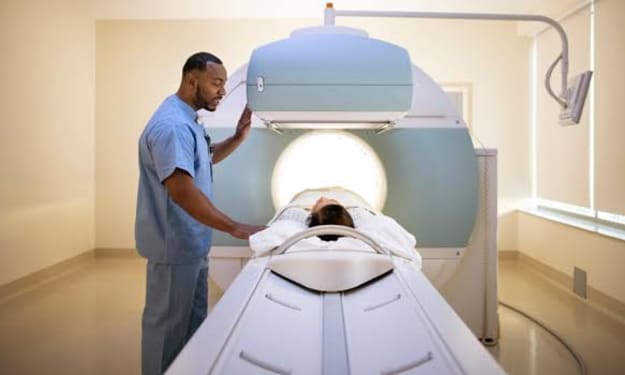
Nuclear medicine Nuclear medicine is a branch of medical imaging that uses small amounts of radioactive materials, known as radiopharmaceuticals, to diagnose and treat diseases. It involves the use of gamma rays, positrons, or beta particles emitted by these radioactive materials to image and/or treat specific organs or tissues within the body. This technique is particularly useful in diagnosing and treating cancer, heart disease, and various neurological and endocrine disorders. In this article, we will discuss the scientific and technical concepts related to nuclear medicine, its advantages and limitations, and some applications of this technology. Radiation in Nuclear Medicine: Nuclear medicine procedures typically exploit the emission of gamma rays or positrons by radioactive materials. Gamma rays are electromagnetic radiation with high energy levels that can penetrate the body and are detected by gamma cameras. Positrons are positively charged particles that can annihilate with electrons in the body, producing gamma rays that are detected by positron emission tomography (PET) scanners. Beta particles are high-speed electrons emitted by certain radioactive materials and can be used for targeted radiation therapy. Patient Preparation: Before undergoing nuclear medicine procedures, patients are typically required to fast for several hours or avoid certain foods and medications that can interfere with the radiopharmaceuticals' uptake. In some cases, patients may need to have a catheter inserted to deliver the radiopharmaceuticals directly into the bloodstream or a specific organ. Patients are also advised to inform their healthcare providers if they are pregnant or breastfeeding, as radioactive materials can harm the fetus or infant. Advantages and Limitations: One of the main advantages of nuclear medicine is its ability to detect diseases at an early stage, often before symptoms appear. It can also provide detailed functional information about the body's organs and tissues that cannot be obtained with other imaging techniques such as X-rays or CT scans. Additionally, nuclear medicine can be used to deliver targeted radiation therapy to cancer cells, minimizing damage to healthy tissue. However, there are also some limitations to nuclear medicine. The radiation exposure from radiopharmaceuticals can be a concern, particularly for children and pregnant women. Additionally, the images produced by nuclear medicine can be less clear than those produced by other imaging techniques, and some radiopharmaceuticals may not be available or effective for all diseases. Applications of Nuclear Medicine: There are many applications of nuclear medicine, ranging from diagnostic imaging to targeted radiation therapy. Here are three examples: PET scans: PET scans are used to detect cancer, heart disease, and neurological disorders such as Alzheimer's disease. They can also be used to monitor the effectiveness of cancer treatments. Iodine-131 therapy: Iodine-131 is a radioactive material that is used to treat thyroid cancer by delivering targeted radiation therapy to the thyroid gland. Hybrid scanning techniques: Hybrid scanning techniques such as PET/CT or PET/MRI combine the functional information obtained from PET scans with the anatomical information obtained from CT or MRI scans, providing more detailed and accurate images. Nuclear medicine has brought a teremendous revolution in the field of medical. Due to nuclear medicine humans are now capable to cure and diagnose multiple diseases that were considered impossible in thd past. It is used to diagnose and treat diseases like cancer, tumor, and the diagnosis of brain stroke, blocked vein nerve pressed by the backbone due to the CT scan and MRI tests.
By Abdul rafey 4 years ago in Humans