fact or fiction
Is it a fact or is it merely fiction? Fact or Fiction explores relationship myths and truths to get your head out of the clouds and back into romantic reality.
Depression and Its Symptoms: A Journey Through the Mind
One of the most prevalent and misunderstood mental health conditions of our time is depression. Because it quietly takes over a person's emotions, thoughts, and daily activities, it is frequently referred to as a "silent killer." Depression is often misunderstood as simply feeling sad, when in fact it is much more complicated. Depression is a serious medical condition that can cause a variety of emotional and physical issues. It affects how people think, feel, and act.
By Abdul Wahedabout a year ago in Humans
Are You Even a Priority? 11 Painful Signs You’re Not a Top Concern in Your Relationship
Are You an Option or a Priority? 11 Honest Signs You're Not Their Top Concern Let’s be real—nothing stings quite like feeling invisible in your relationship. You know the drill: they're continuously “too busy,” plans drop through, and by one means or another, you've gotten to be more of a comfort than a consistent. In case you're pondering whether you're genuinely needed in your relationship or just a placeholder, you're not alone. We've all been there—hanging on to blended signals, trusting activities will at long last coordinate the words.
By Milan Milicabout a year ago in Humans
Theory of Cell-by-Cell Color Perception in Oz Vision
Theory of color from cell to cell Barycentric coordinates are used to plot the colors produced by our Oz prototype on a Maxwell triangle (19). . This triangle projects its total activation (L, M, and S) while simultaneously displaying the color's chromaticity in two dimensions (2D). The natural human gamut, which encompasses all chromaticities that are attainable through normal spectral mixtures of light, is depicted in these diagrams as a color-filled subregion plotted at the bottom. In theory, the fundamentally larger color gamut that is accessible via cell-by-cell stimulation in Oz is the full area of the chromaticity triangle, assuming ideal conditions that produce perfect localization of light to target cones. However, in practice, a small amount of light will miss target cones and stimulate nearby cells, shifting the activation pattern away from the intended Oz color and toward the laser's natural color. In Fig., it is predicted how this stray cone activation will affect the colors that can be achieved. 2Opens in a picture viewer The point-spread function (PSF) of the laser microdoses on the retina in relation to the spacing of cone cells, the cone's spatial light-gathering function (20–22), errors in microdose targeting during eye movement, the proportion of L:M:S cones in the retina, and the stimulating wavelength are the most important factors. In the image viewer, Figure 2AOpens shows how the range of Oz chromaticities that are possible would be affected by fractional light leak. When stimulating the retina at 4° eccentricity, as shown, a diffraction-limited PSF would theoretically enable Oz to address nearly all possible chromaticities in the lms triangle, but not in the foveola, where cone cells are at their smallest. In reality, the total leakage of light includes more than just diffraction because of things like residual aberrations following adaptive optics focusing and microdose targeting errors caused by computational latency during eye movement. It is difficult to measure these factors directly, but the model shown in Fig. 2AOpens compared to the experimental color matching data in the upcoming "Color matching experiments" section suggest that two-thirds of the light captured by cones is captured by neighboring cones, while one-third is confined to the target cell. In spite of this unintentional light leak, our Oz prototype displays color beyond the normal human gamut with this level of accuracy. In the image viewer, Figure 2BOpens shows how the range of Oz chromaticities that could be achieved would be affected by the stimulating wavelength. Depending on the number of different cone types that respond to a given stimulating wavelength, the shape of this gamut can be a triangle, a line, or a single point. This shape reflects the relative responses of the L, M, and S cone cells. Prototype design An AOSLO (14), which simultaneously images and stimulates the retina using a raster scan of near-diffraction-limited laser light over a 0.9° square field of view, serves as the foundation for our Oz prototype. We are able to monitor the eye's movement in real time by imaging the retina with almost invisible infrared light. We dynamically target each cone cell in the field of view with pulses of visible-wavelength laser light to compensate for this motion. A population of 103 cones receives these laser microdoses at a rate of 105 per second. The spectral type of each cone needs to be known in order for cone-targeted stimulation to result in the intended LMS activation. Using recently developed optoretinography techniques in an AO-OCT system, cone cells in the subject's retina are categorized according to their spectral type in a preparatory step (15, 23). We use a classified region with 1000 to 2000 cones near a 4° eccentricity from the foveola for this study. We conduct the following experiments on human subjects: color matching with uniform Oz color squares and image/video recognition. The stimulated area falls within the classified region of the retina because all Oz stimuli are presented within the 0.9° square field of view, 4° adjacent to a gaze fixation point. Stimuli are randomly repeated in a control condition, and the microdose delivery is intentionally compromised. Each microdose in these control trials is randomly "jittered" so that it lands two cones away from the target. Studies on matching colors In order to officially measure the chromaticity coordinates of Oz colors, we carry out color matching experiments. Both 488 nm, which can activate all three L, M, and S cone types, and 543 nm, which is close to the peak of L and M but only minimally activates S, are tested as stimulation wavelengths. A red-green-blue (RGB) projector and a near-monochromatic laser with a tunable wavelength that can be mixed with white projector light are the two color matching systems we use. The latter is able to produce colors that are close to the natural human gamut, making it clear that our attempts to display olo do not actually go beyond the natural human gamut. The subject must judge match equality using the same patch of retina in order to eliminate effects from differences in adaptation across the retina because the subject sees 0.9° squares of Oz and controllable color that coincide in space and alternate in time during a color matching trial. Subjects can, as is typical with color matching (1), add light to the Oz color—also known as "negative" light—if necessary to achieve an exact match; the matched color is calculated by subtracting its color coordinates from those of the controllable square. In addition, subjects are asked to qualitatively name the hue and rate the saturation (on a scale of one to four) of the squares of controllable color and Oz color. The color matching experiments' graphs are shown in Figure 3 (opens in an image viewer). 222 color matches were performed by five subjects. We draw attention to four observations. First, around the stimulation wavelength of 488 nm, Oz colors form a triangle (Fig. 3BOpens in the image viewer), as well as a 543 nm color line (Fig. 3AOpens in the image viewer), which is in line with the theory in the section titled "Theory of cell-by-cell color." Second, as anticipated, the color "collapses" toward the stimulation wavelength under the jitter control condition. Thirdly, the further Oz colors are from the color matching system's gamut, the greater the variance in matching lms chromaticity. This pattern is in line with the geometric analysis in the Materials and Methods section titled "Plotting perceptual uncertainty in matching," which explains why perceptual uncertainty in chromaticity rises when light must be added to the test color to match. Fourth, Picture The image viewer's 3COpens provide unambiguous evidence that olo goes beyond the normal human spectrum. To match the (nearly) monochromatic colors shown, which are on the boundary of the natural human gamut, all subjects found it necessary to desaturate olo with projector white in these matches. Under the test subjects' viewing conditions, these matching monochromatic wavelengths between 501 and 512 nm are the most saturated teal hues for normal color vision. Although the Abney effect—a shift in hue with saturation (24)—opens the possibility that the hue of the wavelength at best match may not precisely represent the hue of the undiluted olo color, subjects' qualitative hue naming and saturation ratings support these quantitative findings. The color names "teal," "green," "blue-greenish," and "green, a little blue" were all suggested for olo. Fig.'s near-monochromatic colors have an average saturation rating of 2.9, while subjects consistently give olo a saturation rating of 4. 3Creates in the image viewer. Experiments in image and video recognition In order to investigate the capacity of human subjects to comprehend Oz-generated images, we create image and video recognition experiments. We use four-alternative forced choice (4-AFC) and two-alternative forced choice (AFC) tasks in which participants can only succeed if they use accurate Oz stimulation-generated hue information. Subjects must determine the image's line orientation in the 4-AFC task. Subjects must identify the direction of rotation in a video of a moving disk in the 2-AFC task. With a stimulating wavelength of 543 nm, these stimuli present the lines and disks as red (all-L cone) on an olo background (all-M cone). In the jitter control condition, all hue and luminance cues are eliminated and the task is reduced to guessing after a calibration step is carried out (see the "Image and video recognition experiments" section in Materials and Methods). The results of the 4-AFC line orientation and 2-AFC rotation direction tasks are plotted in Figure 4Opens in an image viewer. Subjects are able to accurately detect both line orientation and motion direction (blue bars) in the experimental condition. Subjects' performance in the jitter control condition is reduced to guessing for both tasks (gray bars). When the task was easy, subjects report seeing red or orange lines and disks on a blue-green or green background, whereas when they were forced to guess, they see a yellow-green square. The first is directly related to precise Oz microdose delivery, and the second is related to the jitter control condition, in which only the natural color of the 543-nm light should be seen. DISCUSSION
By Mahafuj Alamabout a year ago in Humans
Oz Vision: Unlocking Colors Beyond Human Perception
Abstract For displaying color images, we present Oz, a principle that involves directly controlling the activity of photoreceptors in the human eye through the delivery of light to individual cells. By exclusively activating M cone cells and avoiding the constraints imposed by cone spectral sensitivities, novel colors are theoretically possible. In practice, we confirm a partial colorspace expansion in that theoretical direction. By formal color matching on human subjects, it has been demonstrated that attempting to activate M cones exclusively elicits a color beyond the natural human gamut. The color, according to them, is a blue-green with unprecedented saturation. Oz colors are perceived by subjects in image and video form in additional experiments. Under fixational eye movement, the prototype delivers laser microdoses to thousands of spectrally classified cones. The programmable control of individual photoreceptors at the population scale is demonstrated by these findings as proof-of-principle.
By Mahafuj Alamabout a year ago in Humans
The weight of an only son.
I’ve always believed that if you’re born male into a humble Nigerian home — especially as the only son — life hands you a load that’s invisible but heavy. It’s not just tradition. It’s not just expectation. It’s something deeper. Something you feel in your chest long before you understand it. I was born second, sandwiched between two sisters. My father was a pastor — a kind, God-fearing man who served the government as a civil servant until retirement. My mother was a strong deaconess and a fashion designer, juggling threads and thorns of survival while keeping our home stitched together. Ours wasn’t a loud household. We didn’t complain much. But quiet doesn’t mean easy. From early on, I saw my father struggle — not with integrity or character (he’s one of the purest men I know), but with finances. Despite his humility and the respect he earned in his community, he was never able to give us more than just enough. Sometimes not even that. He never took bribes. Never insulted his colleagues. He rose to leadership positions naturally — class rep in school, student union president in seminary — yet never had the money to reflect the power of those titles. A good man, but in a bad system. And I watched him slowly age under the pressure. At 20, I left home. Not out of rebellion, but survival. I was in 100 level in university when I realized things weren’t going to change unless I changed something. I packed what little I had and moved to a neighboring state, determined to find work, earn something, be something — anything that could ease the burden on my parents and maybe rewrite this story. But leaving didn't mean freedom. Alone in a new city, I faced depression like a thief in the dark. It stole my joy, my motivation, and nearly my sense of self. There were nights I felt numb, like nothing mattered. Days I questioned if I was even meant to make it out. I didn’t tell my family much — I didn’t want them to worry. I just carried the weight quietly. There’s something no one tells you about being the only male child in a Nigerian family: you're expected to be the future. No matter how little you start with, you must become the one who changes the family name. Who pays the bills. Who builds the house. Who becomes what your father couldn't and protects what your mother built. But I was falling apart. Still, I kept moving — slowly, some days crawling — but I never stopped. Because I couldn’t. Not with my father’s eyes behind me, hoping. Not with my mother’s silent prayers beside me. Not with the invisible pressure of being “the one.” There’s a demon inside me I still wrestle with — the voice that says I’ll never make it, that I’m already behind. That I’ve failed. But I write this not for pity — I write it as proof. Proof that survival isn’t always loud or dramatic. Sometimes, it’s a quiet boy in a room in another state, far from home, refusing to give up. Sometimes, it’s a son carrying a weight too big for one person, but still walking forward. If you’re like me — if you’re that “only son,” or the “only hope,” or the one your family leans on silently — just know this: You’re not weak for struggling. You’re not lost for falling behind. You’re not alone. This is the weight we carry. But it won’t crush us. It’s shaping us into something stronger. And one day, we’ll look back and realize: we weren’t just surviving — we were becoming. --- If you’ve ever felt this kind of weight, share your story too. You never know who’s reading, who needs to hear it.
By Nathaniel NARTabout a year ago in Humans
10 Honest Reasons Why Couples Stay Together Even After Love Fades
When Love Isn’t Enough: Why Some Couples Stay Together Anyway Let's be real, relationships aren't all daylight, snuggles, and long strolls on the shoreline. Sometimes, love runs out. The butterflies halt vacillating, discussions get gloomy, and closeness gets to be a removed memory. But here's the kicker: numerous couples remain together. Sounds befuddling, right? In case cherish is assumed to be the stick that holds a relationship together, why do a few couples stay stuck when the bond has broken?
By Milan Milicabout a year ago in Humans
Gamma-ray bursts show that the universe's greatest structure is closer to Earth and larger than previously thought: "The meaning of this is still up for debate.
The Hercules-Corona Borealis Great Wall, the largest structure in the universe, was already difficult to explain with models of the universe because of its enormous size. Now, astronomers have found that the structure is even larger than they previously thought thanks to Gamma-Ray Bursts (GRBs), the universe's most potent energy explosions. Additionally, the scientists discovered that portions of the Great Wall of Hercules-Corona Borealis are actually closer to Earth than previously thought.
By Md. Sofayet Hossainabout a year ago in Humans
Crime without punishment
Melissa didn't see him coming, but she felt him. Every step of the mayor was heavy, and every word he spoke made her feel as if she were sinking deeper and deeper into an abyss. It wasn’t his power that troubled her, nor his fame: it was his indifference. His existence revolved around the city he had built, his image as an invincible man, and she, a young architect, was nothing but a pawn in his game. A game that seemed fun to him.
By Halina Piekarska (UltraBeauty Blog)about a year ago in Humans
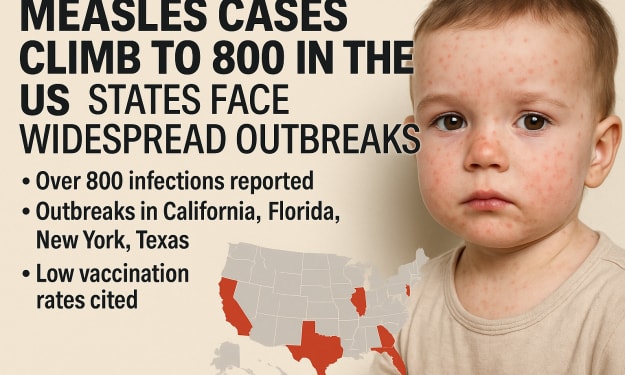
What You Need to Know About the Rising Measles Threat in the US. AI-Generated.
Increasing Number of Measles Cases in the United States: 800 Infections and Growing Outbreaks Over 800 confirmed cases of measles have been reported in several states, indicating a worrying rise in the number of cases in the United States. Officials in charge of health are on high alert due to this sudden uptick, and they are urging the general public to remain informed and take preventative measures.
By Jehosan Islam Jawadabout a year ago in Humans
The Wonders Within Us
From the moment we’re born, the human body and mind are full of mysteries and marvels. While we go about our daily lives, incredible processes are happening beneath the surface — many of which we often take for granted. Here are ten facts about humans that are bound to surprise you: 1. You’re Mostly Microbial It might sound strange, but your body has more microbial cells than human cells. The gut alone hosts trillions of bacteria, helping with digestion, immunity, and even mood regulation. 2. Your Brain Uses About 20% of Your Energy Even though it only makes up about 2% of your body weight, your brain consumes a fifth of the energy you produce each day. That’s a lot of power for your daily thoughts! 3. You Shed Millions of Skin Cells Daily Your skin is constantly renewing itself. In fact, you shed around 30,000 to 40,000 skin cells every minute. Over a year, that adds up to roughly 9 pounds of dead skin. 4. Your Heart Beats Over 100,000 Times a Day This vital muscle doesn’t take a break. On average, your heart beats more than 100,000 times per day, pumping about 2,000 gallons of blood throughout your body. 5. Your Bones Are Stronger Than Steel Ounce for ounce, human bone is stronger than steel. A cubic inch of bone can bear a load of over 8,000 pounds — that's about four times the weight a concrete block can handle. 6. Your Stomach Lining Renews Itself Every Few Days To protect itself from its own acidic environment, your stomach lining completely regenerates every 3 to 4 days. Without this, the acid would literally digest your stomach. 7. You Can Taste with Your Nose Flavor is mostly smell. While your tongue can detect basic tastes, your sense of smell plays a huge role in experiencing flavor. That’s why food tastes bland when you have a cold. 8. Your Body Glows Humans actually emit a small amount of visible light — it’s just 1,000 times weaker than what our eyes can detect. Scientists call it “bioluminescence,” and it’s caused by biochemical reactions in the body. 9. You’re Taller in the Morning Thanks to the compression of cartilage in your spine throughout the day, you’re actually slightly taller when you wake up than when you go to bed — sometimes by up to half an inch. 10. Your DNA Could Stretch to the Sun and Back If you unraveled all the DNA in your body and lined it up end to end, it could stretch from the Earth to the Sun and back — over 600 times!
By Md Shahin Alomabout a year ago in Humans