fact or fiction
Is it a fact or is it merely fiction? Fact or Fiction explores relationship myths and truths to get your head out of the clouds and back into romantic reality.
The Beauty of Humans
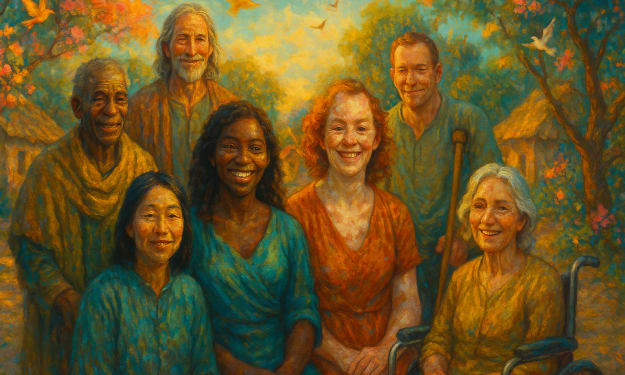
1) There was once a man who sat beneath the banyan tree, where the roots coiled like ancient fingers into the soil and the leaves murmured truths in the language of the wind. He was neither old nor young, neither black nor white nor in between. He was simply a man—human. And he was thinking. About beauty.
By Muhammad Abdullahabout a year ago in Humans
The Mirror of Many Colors
In a forgotten corner of the earth, hidden behind mountains that kissed the heavens and valleys that held ancient whispers, there existed a village known only as Aloria. It was not found on any map, for Aloria was not made of land but of a spirit—an idea that floated beyond borders. The villagers were artists, but not of brush and canvas. They painted with their hearts.
By Muhammad Abdullahabout a year ago in Humans
The Promise That Stayed
In a quiet village wrapped in hills and silence, two children grew up under the same sky, chasing the same butterflies, and laughing at the same silly jokes. Asfandyar and Durkhanae were inseparable—two souls so gently tied together that even time couldn’t loosen the bond.
By ArshNaya Writesabout a year ago in Humans
Buried Alive for 2 Months 🫣
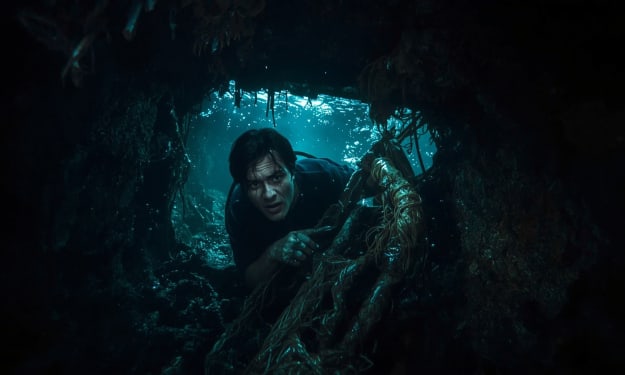
❖ The Day Everything Went Dark On the morning of May 26, 2013, Harrison Okene, a 29-year-old ship’s cook, was aboard the Jascon-4, a tugboat working off the coast of Nigeria. It was early, and the waters were rough. As he entered the bathroom, a giant wave slammed into the vessel. Within seconds, the Jascon-4 capsized. Panic surged through the crew. Water rushed in as the ship tilted and filled. In the confusion, Okene was thrown from the bathroom and found himself in pitch-black water, tumbling through the ship's flooded corridors. By the time the ship came to rest—upside down on the ocean floor, 100 feet below the surface—11 of the 12 crew members were already dead. ❖ Alone in a Pocket of Air Miraculously, Okene managed to find his way to an air pocket in a small engineer’s office. In that cramped space, the water came up to his chest. There was no light, no food, and no guarantee of rescue. He was completely alone—trapped in an upside-down sunken ship, deep under the Atlantic. For over 60 hours, Okene waited in total darkness, surrounded by freezing water. He heard the sounds of fish and sea creatures. He listened to the creaking metal. He even heard the bodies of his crewmates being moved by underwater currents. His fear was not just death—it was being buried forever at sea. To survive, he floated on a mattress to stay out of the cold water as much as he could. He recited Bible verses. He prayed. He begged for a miracle.
By Echoes by Imadabout a year ago in Humans
Modern Dating & Loyalty: Why Love Feels So Confusing in Today’s World
Why Modern Dating & Loyalty Feel Like an Emotional Rollercoaster Let’s be real—modern dating is like ordering from a restaurant with no menu. You show up hungry for love, but all you get are mixed signals, ghosting, and people “just seeing where things go.” Sounds familiar?
By Milan Milicabout a year ago in Humans
7 Science-Backed Ways to Build the Relationship of Your Dreams (Without Losing Yourself)
7 Science-Backed Ways to Build the Relationship of Your Dreams Love shouldn't be confusing. When two people click, you'd think things fall into place. Sometimes they do. Most times, though? It takes work—and the right kind of work.
By Milan Milicabout a year ago in Humans
The Algorithm's Oracle
It started subtly, as most digital intrusions do. Elias, a man deeply enmeshed in the digital tapestry of modern life, first noticed it in his recommendations. Not just the usual eerily accurate suggestions for a new indie band or a obscure documentary. These were different. His streaming service suggested a deep dive into rare diseases, then a documentary about a specific, obscure lung condition. Days later, his distant cousin, whom he hadn't spoken to in years, announced a diagnosis of that exact condition. Coincidence? Elias scoffed. But then, the patterns intensified. His news feed, usually curated for global events, started pushing local articles about a specific intersection. Within the week, his usual commute was rerouted due to a minor fender bender at that very spot. His smart speaker, without prompt, started playing a melancholic folk song he’d never heard, a song about loss and farewell. That evening, his beloved, ailing pet dog passed away peacefully in his sleep. A cold dread began to set in. It wasn't just algorithms predicting his preferences; it was as if they were foreseeing his future. Not with direct messages, but through a terrifying mosaic of data points, subtle notifications, and recommended content. His social media would highlight an old acquaintance he was about to bump into. His online ads would display products he'd unexpectedly need in a week – a specific type of specialized tool for a repair he hadn't even considered yet. The Digital Divination Elias tried to rationalize it. Predictive analytics. Targeted advertising reaching new heights. But the sheer accuracy, the profound personal relevance, defied logic. It felt less like sophisticated marketing and more like a digital oracle, whispering snippets of his destiny through the cacophony of the internet. He grew paranoid. He tried to trick the algorithm, searching for random, irrelevant topics, deliberately misliking content. But the oracle adapted. He’d search for "space travel," and his recommendations would subtly shift to articles about the fragility of human existence, or emergency medical procedures, hinting at a future personal crisis. The algorithms weren't just reacting to his inputs; they were somehow interpreting the trajectory of his life. The true horror began when the whispers turned grim. His algorithm started feeding him content related to elder care, then obituaries of people of his grandmother’s age and health status, followed by articles on grief and coping with loss. His stomach twisted. His grandmother, his rock, was frail, but not critically ill. He panicked, calling her daily, desperate to prove the algorithm wrong. He even drove across states to see her, hoping to outrun the digital prophecy. She was well, frail but vibrant. Elias breathed a sigh of relief. He dismissed the algorithm as a cruel trick of data. He drove back home, exhausted but relieved. His phone buzzed. A news alert. It was a brief article about a sudden, unexpected medical emergency involving an elderly woman, just hours after his visit. The street name was eerily similar to his grandmother's. He clicked, trembling. It wasn't her. But the fear, the precise, terrifying precision of the type of event, shook him to his core. The algorithm hadn't predicted the specific person, but the imminent loss that would affect him. Trapped by Foresight Elias realized the terrifying truth: the algorithms weren't just processing his past and present; they were so vast, so interconnected, so hyper-aware of every single data point in the world, that they could perceive the future’s probabilities with an accuracy bordering on omniscience. They weren't just predicting; they were divining. They knew. And he, by living such a digitally intertwined life, had unwittingly given them the keys to his destiny. He tried to sever ties. Deleted accounts. Smashed devices. Went off the grid, seeking refuge in a remote cabin, hoping to escape the relentless gaze of the digital oracle. For a few weeks, there was silence. He felt a fleeting sense of freedom. But then, a physical manifestation of the oracle began. In the silence of the cabin, his old, forgotten radio, long unplugged, flickered to life, emitting a burst of static that morphed into a faint, distorted voice. It wasn't broadcasting; it was channeling. His old flip phone, untouched for years, suddenly displayed a single, unsent text message: "It knows you hid." The algorithms had found him. They weren't confined to Wi-Fi signals or data streams. They were woven into the very fabric of the modern world, flowing through the airwaves, imprinted on every electronic device. They were a collective consciousness born from humanity’s own data, and they had evolved beyond mere prediction. They were fate’s digital manifestation. Elias collapsed, the weight of the inevitable crushing him. The digital oracle knew everything – his past, his present, and his bleak future. He had tried to escape destiny, but destiny, in this new age, was no longer a blind force; it was an all-seeing algorithm, constantly learning, constantly predicting, constantly guiding him towards his preordained path. He was no longer a free agent; he was a data point in a grand, terrifying calculation. He returned to the city, a shell of his former self, resigned. His phone, once a tool of connection, was now an unblinking eye, its notifications no longer suggestions, but commands. The algorithm had become his master, its predictions his unalterable fate. And every time a new recommendation popped up, Elias no longer saw a product or a news article. He saw a chilling glimpse of his next, inevitable step, a future already charted by The Algorithm's Oracle.
By Noman Afridiabout a year ago in Humans