book reviews
Reviews of books by relationship gurus, dating experts, and cautionary tale-tellers.
When Logic Becomes A Weapon
The Rise Of Performative Reason We live in an age where people worship logic but rarely use it with integrity. Reason has become a stage performance rather than a search for truth. Arguments that once served to clarify reality now serve to elevate ego. Debate has become entertainment. Outrage has replaced understanding.
By Peter Thwing - Host of the FST Podcast10 months ago in Humans
Good Faith in a Bad-Faith World
The Collapse Of Civil Discourse Everywhere you look, conversation is breaking down. Words that once served as bridges are now weapons. People no longer speak to understand; they speak to win. To admit uncertainty is to invite ridicule. To ask a question is to be branded as weak or ignorant.
By Peter Thwing - Host of the FST Podcast10 months ago in Humans
The X and the Treasure
There is a story that exists in almost every culture on earth. It is the story of a map, a mark, and a treasure buried beneath the ground. The map is dismissed as myth, the mark is ignored or defaced, and the treasure waits in silence for the one person patient enough to dig. I have come to see truth the same way.
By Peter Thwing - Host of the FST Podcast10 months ago in Humans
The Restoration of Order
Civilization rises or falls upon one foundation: the moral order that governs the human heart. When truth is exalted, families thrive, justice endures, and love becomes the highest expression of unity under God. When truth is abandoned, chaos fills the vacuum. The world does not collapse from external enemies first. It collapses from within, when its people forget the sacred laws that make harmony possible.
By Peter Thwing - Host of the FST Podcast10 months ago in Humans
Mary Oliver: How Poverty Forged a Voice That Reshaped Modern Poetry
Mary Oliver entered childhood with little support or comfort. Her home life carried tension that weighed heavily on her, so she sought refuge outdoors whenever she could slip away. Fields, woods, tide pools, birdsong, creeks, shifting weather, all of it offered relief from an atmosphere that felt too tight for a growing spirit. Those early escapes created habits that defined her entire career. She learned to listen, to watch closely, to follow small traces of movement through grass or across water. She learned to trust perception more than conversation. That trust evolved into a poetic voice treasured by millions.
By Tim Carmichael10 months ago in Humans
Reincarnated as His Own Grandson?
Do you believe in past lives or reincarnation? It’s a concept that always makes you stop and think, right? Because let me tell you, some of these stories are truly wild, and one in particular is pretty neat. It involves a little boy referred to in case studies as Sam, and he showed some truly convincing evidence that he might be the reincarnation of, get this, his own grandfather.
By Areeba Umair10 months ago in Humans
The Light We Share
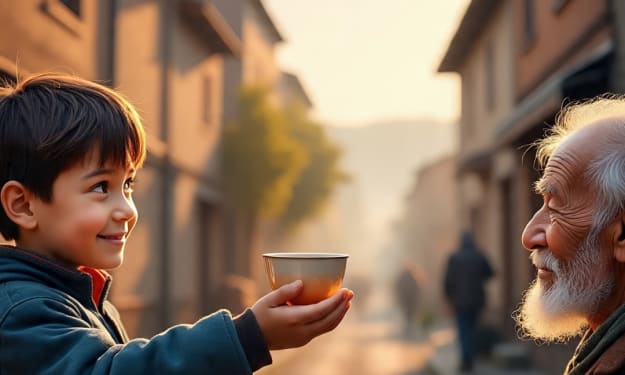
In a small, ordinary town surrounded by gentle hills and quiet mornings, people often said that nothing extraordinary ever happened there. Yet anyone who looked closely enough knew the truth: the ordinary was full of quiet miracles, each shaped by human kindness. Amar, a young shopkeeper, believed this more strongly than most. Every morning before sunrise, he walked down Market Street to open his tiny shop. The world still felt asleep at that hour. Streetlights yawned out their last glow, and the sky slowly stretched into pale gold. Amar loved that moment — the beginning of everything. One morning, he found an old man sitting on a bench outside his shop. The man’s clothes were worn, and his eyes held a tiredness that seemed older than the wrinkles on his face. “Are you alright?” Amar asked gently. The old man looked up with a slow smile. “Just resting,” he said. “I’ve been walking for many miles.” Without a second thought, Amar unlocked the shop and said, “Come inside for some tea. You look like you could use warmth.” The man hesitated, but the kindness in Amar’s voice opened a door inside him that had been closed for a long time. He followed. Amar prepared tea and some warm bread. As they ate, the old man shared that he had travelled from town to town looking for work, never staying anywhere long enough to feel at home. Life had been heavy on his shoulders, but he kept walking because he believed somewhere, someone would offer him a chance. “You’ve come to the right place then,” Amar said. “This town may be small, but its heart is big.” The old man’s eyes softened, as if hope had returned to him in a small but powerful flame. By midday, the streets were buzzing. Schoolchildren ran by in small groups, laughter bouncing off the shop walls. A delivery boy shouted greetings as he rushed past. Life flowed like an easy river through the town. When Amar stepped outside later, he found a little girl trying to carry a stack of books almost as tall as she was. She struggled, wobbling with each step. Amar hurried over and steadied the pile. “These are bigger than you,” he joked. “They’re for my friend,” she explained. “He broke his leg, so he can’t come to school.” Amar smiled. “That’s very kind of you.” She beamed proudly. “We help each other. That’s what humans do.” Her words stayed with Amar long after she skipped away. He realized then that kindness wasn’t just something a few people practiced — it was something everyone carried deep within them, like a small light waiting to be shared. That evening, Amar closed his shop and helped the old man find a place to stay. The community center welcomed him without hesitation. People brought blankets, food, and warm smiles. No one asked for anything in return. As the sun set, Amar walked home, feeling the peaceful glow of the day inside him. He had not done anything grand or heroic. He had simply shown kindness — the same kindness he saw all around him every day. And that was the extraordinary truth: human beings were at their best when they helped one another. The next morning, Amar returned to his shop to find the old man already waiting. But this time, he was standing tall, his face brighter than before. “The community center gave me a small job,” he said happily. “And I thought I’d come by to thank you. You gave me the first bit of hope.” Amar smiled. “You’re part of this town now. And every person here carries a little light. When we share it… the whole world shines.” And with that, the little town continued to glow — not because of wealth or fame, but because of the everyday goodness shared by ordinary humans who understood the simple truth: Kindness is the strongest light we have.
By Muhammad Saad 10 months ago in Humans
Roughly 75% of your brain is water. AI-Generated.
The Brain's Hidden Hydration: Understanding Why Roughly 75% of Your Brain is Water Imagine your brain as a busy computer. It hums along with circuits firing non-stop. But without the right coolant, it overheats and crashes. That coolant? It's water. Your brain relies on it more than you think.
By Story silver book 10 months ago in Humans
Rebuilding Reciprocity
Truth alone can heal what pride has broken. The war between men and women is not natural. It is manufactured by a culture that rewards resentment and mocks responsibility. Men are not the enemy of women, and women are not the enemy of men. The true enemy is the spirit of division that turned cooperation into competition. To rebuild what was lost, both must return to the principle that made civilization possible: reciprocity.
By Peter Thwing - Host of the FST Podcast10 months ago in Humans
The Decline of the Marriage Covenant
Marriage was once the sacred foundation of civilization. It was the covenant upon which families, communities, and moral order were built. It bound man and woman together in purpose, duty, and devotion under the authority of God. Today, that covenant has been reduced to a fragile contract of convenience. What was once holy has become negotiable. What was once permanent has become temporary. The decline of the marriage covenant is not only a personal tragedy. It is a national one.
By Peter Thwing - Host of the FST Podcast10 months ago in Humans
The Moral Economics of Love
Every human system, whether spiritual, political, or relational, is governed by incentives. People repeat what is rewarded and avoid what is punished. Love is no exception. It may sound sacred and emotional, but it still follows the law of cause and effect. When love is rewarded with gratitude, it grows. When it is met with entitlement, it dies. Modern society has rewritten the incentives of love, turning what was once an act of sacrifice into a transaction of convenience. The result is a generation that no longer knows how to give without gain.
By Peter Thwing - Host of the FST Podcast10 months ago in Humans