
Pediatric Interventional Cardiology Market to Reach $4.63 Billion by 2034 as Minimally Invasive Heart Treatments Transform Children's Care
Advances in medical technology, earlier diagnosis of congenital heart disease, and growing demand for safer procedures are reshaping pediatric cardiac treatment worldwide.

Heart disease is often viewed as a condition that primarily affects adults, but for thousands of children born each year with congenital heart defects, specialized cardiac care begins from the earliest stages of life.
Fortunately, medical science has made remarkable progress in how these conditions are diagnosed and treated. Procedures that once required complex open-heart surgery can now often be performed using minimally invasive catheter-based techniques, reducing recovery times and improving outcomes for young patients.
This evolution has given rise to one of the fastest-growing specialized areas of cardiovascular medicine: pediatric interventional cardiology.
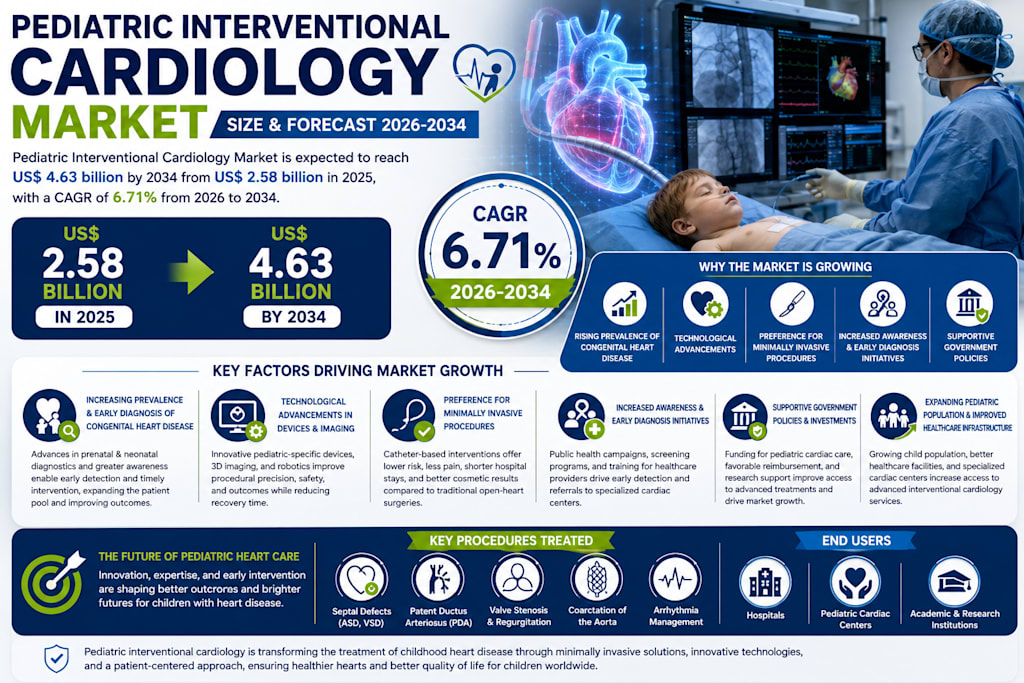
According to Renub Research, the global Pediatric Interventional Cardiology Market is expected to grow from US$2.58 billion in 2025 to US$4.63 billion by 2034, registering a compound annual growth rate (CAGR) of 6.71% between 2026 and 2034. Growth is being driven by increasing prevalence of congenital heart disease (CHD), technological advancements in medical devices and imaging systems, greater awareness of early diagnosis, expanding pediatric healthcare infrastructure, and rising demand for minimally invasive procedures.
As healthcare systems continue prioritizing better outcomes for children, pediatric interventional cardiology is becoming an increasingly vital part of modern medicine.
Understanding Pediatric Interventional Cardiology
Pediatric interventional cardiology is a highly specialized branch of medicine focused on diagnosing and treating heart conditions in infants, children, and adolescents using minimally invasive techniques.
Unlike traditional open-heart surgery, these procedures rely on catheters and specialized devices inserted through blood vessels to reach the heart. This approach allows physicians to repair structural defects, improve blood flow, and correct abnormalities with significantly less trauma to the patient.
The field addresses a wide range of congenital and acquired heart conditions, including septal defects, valve disorders, vascular obstructions, and other structural abnormalities. By avoiding major surgical incisions, many procedures result in shorter hospital stays, faster recovery, and reduced risks compared to conventional surgery.
For children and their families, these advancements can make a life-changing difference.
Congenital Heart Disease Remains the Biggest Driver
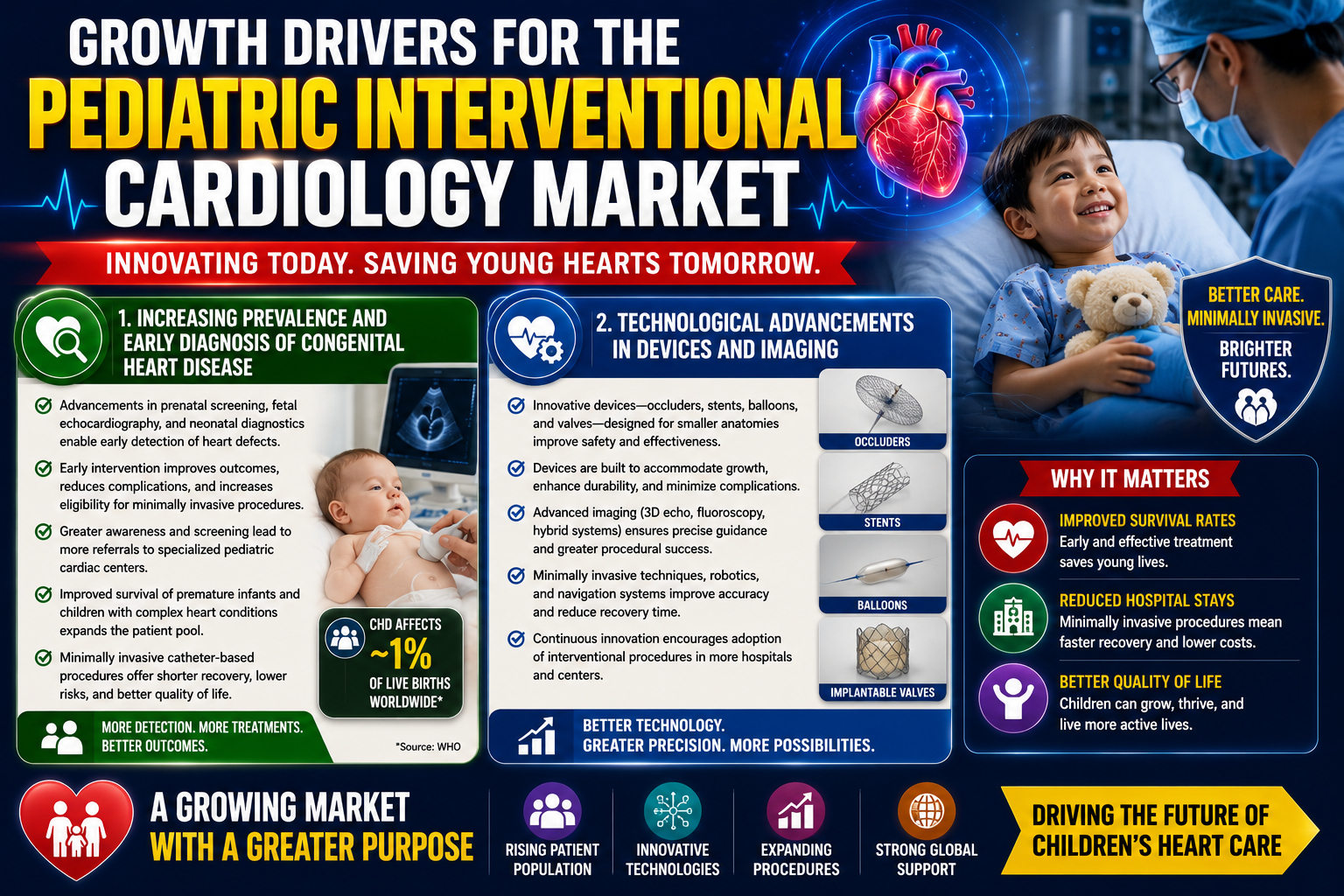
One of the most important factors fueling growth in the pediatric interventional cardiology market is the increasing prevalence and improved detection of congenital heart disease.
Congenital heart defects are among the most common birth abnormalities worldwide, affecting millions of children. Advances in prenatal screening, fetal echocardiography, and neonatal diagnostic technologies have dramatically improved the ability of physicians to identify these conditions earlier than ever before.
Early diagnosis enables healthcare providers to develop treatment plans before complications arise, improving outcomes and increasing the number of patients eligible for minimally invasive interventions.
Greater awareness among parents, healthcare professionals, and caregivers has also contributed to more frequent screenings and earlier referrals to specialized cardiac centers. As survival rates improve for infants born with complex heart conditions, the number of patients requiring ongoing cardiac care continues to expand.
This growing patient population remains a major force driving market demand.
Minimally Invasive Procedures Are Changing Pediatric Care
One of the most significant developments in pediatric cardiology has been the shift toward minimally invasive treatment approaches.
Traditional open-heart surgery, while often effective, can involve lengthy recovery periods, greater procedural risks, and significant physical stress for young patients.
Catheter-based interventions offer a compelling alternative.
Using specialized devices inserted through small incisions, physicians can correct many heart defects without opening the chest. These procedures generally result in reduced hospital stays, less pain, lower complication rates, and faster recovery times.
For children, this often means returning to normal activities sooner and experiencing less disruption to daily life and development.
As physicians gain greater confidence in these techniques and technology continues improving, demand for minimally invasive cardiac procedures continues to rise worldwide.
Medical Device Innovation Is Accelerating Progress
Technology remains one of the strongest growth drivers within the pediatric interventional cardiology industry.
Unlike adult cardiology, pediatric care requires devices specifically designed for smaller anatomies and growing bodies. Manufacturers must create solutions that are flexible, durable, biocompatible, and capable of accommodating future growth.
Today's market includes advanced products such as:
- Catheters
- Guidewires
- Balloons
- Stents
- Closure devices
- Transcatheter heart valves
- Implantable cardiac technologies
These innovations allow physicians to treat increasingly complex heart conditions while minimizing risk and improving long-term outcomes.
As device technology evolves, treatment options continue expanding for children who previously had limited alternatives.
Advanced Imaging Is Improving Precision
Successful pediatric cardiac procedures depend heavily on accurate visualization of the heart and surrounding structures.
Modern imaging technologies have revolutionized the field by providing physicians with unprecedented levels of detail during diagnosis and treatment.
Tools such as three-dimensional echocardiography, fluoroscopy, hybrid imaging systems, and advanced mapping technologies enable clinicians to navigate complex anatomy with greater precision.
These technologies help reduce procedural risks, improve device placement accuracy, and enhance overall treatment outcomes.
In addition, emerging technologies such as robotics and image-guided navigation systems are creating new possibilities for even greater precision during complex interventions.
As imaging capabilities continue improving, physicians are increasingly able to perform sophisticated procedures that were once considered impossible.
Specialized Pediatric Cardiac Centers Are Expanding Access
The growth of dedicated pediatric cardiac centers is another major factor supporting market expansion.
Hospitals around the world are investing in specialized pediatric cardiology departments equipped with advanced catheterization laboratories, imaging technologies, and multidisciplinary care teams.
These facilities provide comprehensive care for children with congenital and acquired heart conditions, ensuring patients receive expert treatment from highly trained professionals.
The availability of specialized interventional cardiologists, nurses, anesthesiologists, and support staff significantly improves procedural success rates and patient safety.
In addition, fellowship programs, continuing education initiatives, and advanced training opportunities are helping increase the number of professionals qualified to perform these highly specialized procedures.
Greater access to expert care is enabling more children to benefit from advanced cardiac interventions.
Challenges Continue to Limit Growth
Despite significant progress, the pediatric interventional cardiology market faces several important challenges.
One of the most significant obstacles is the limited availability of pediatric-specific devices.
Because congenital heart defects often affect relatively small patient populations, manufacturers face difficulty justifying the high costs associated with developing specialized products. Extensive research, engineering, testing, and regulatory approval processes further increase development expenses.
As a result, innovation can be slower compared to larger adult cardiology markets.
Hospitals and physicians may also face limited treatment options for certain rare or complex conditions, highlighting the need for continued investment in pediatric-focused innovation.
Regulatory and Reimbursement Barriers Remain Significant
The regulatory environment represents another challenge for the industry.
Medical devices used in pediatric cardiology must undergo rigorous testing and clinical evaluation to ensure safety and effectiveness. Regulatory agencies often require extensive documentation and clinical evidence before approving new products.
Because pediatric patient populations are smaller and more diverse than adult populations, conducting these studies can be particularly difficult and time-consuming.
Reimbursement issues further complicate market expansion. Insurance coverage for advanced procedures and novel devices varies across healthcare systems, creating financial uncertainty for providers and patients alike.
Addressing these barriers will be essential for ensuring broader access to innovative treatments.
Regional Markets Are Advancing at Different Speeds
The United States remains one of the most advanced pediatric interventional cardiology markets globally, supported by leading hospitals, specialized cardiac centers, and strong investment in medical innovation. Advanced imaging technologies and pediatric-specific devices continue driving adoption.
Germany benefits from a highly developed healthcare system, strong clinical research capabilities, and widespread use of advanced cardiac technologies. Early diagnosis and specialized care remain key strengths of the German market.
India is emerging as a significant growth market due to increasing awareness of congenital heart disease, improving healthcare infrastructure, and expanding access to pediatric cardiac services. Major cities are becoming hubs for specialized treatment.
The United Arab Emirates is also experiencing growth as healthcare investments, advanced facilities, and medical tourism initiatives strengthen pediatric cardiac care capabilities.
These regional developments highlight the global momentum behind pediatric cardiac innovation.
Recent Industry Developments Signal Continued Innovation
Several recent developments demonstrate the industry's ongoing commitment to improving outcomes for pediatric patients.
In April 2025, the FDA approved Abbott's Tendyne transcatheter mitral valve replacement technology, providing new treatment possibilities for patients with severe mitral annular calcification. Boston Scientific expanded its cardiovascular capabilities through the acquisition of Bolt Medical, while Johnson & Johnson received FDA clearance for expanded pediatric use of its Impella heart pump technology. Additionally, Canid secured funding to advance pediatric healthcare technology solutions focused on improving patient care and clinical efficiency.
These innovations reflect broader efforts to expand treatment options and enhance care quality for children with heart disease.
Final Thoughts
The pediatric interventional cardiology market is entering a period of sustained growth driven by technological innovation, earlier diagnosis, specialized expertise, and increasing adoption of minimally invasive procedures.
With the market expected to reach US$4.63 billion by 2034, healthcare providers, device manufacturers, and research institutions have significant opportunities to improve outcomes for children living with congenital and acquired heart conditions.
Although challenges related to device development, regulation, and reimbursement remain, continued collaboration between clinicians, researchers, and industry leaders is helping push the field forward.
For thousands of families worldwide, these advances represent more than market growth—they represent better treatment options, improved quality of life, and the possibility of healthier futures for children facing complex cardiac conditions.
As innovation continues, pediatric interventional cardiology will remain at the forefront of life-saving medical progress.
About the Creator
Enjoyed the story? Support the Creator.
Subscribe for free to receive all their stories in your feed.
Comments
There are no comments for this story
Be the first to respond and start the conversation.