
"Osmosis: The Movement of Life
In the realm of biology, osmosis stands as a fundamental process that sustains life. It is the mechanism through which water molecules traverse cell membranes, maintaining equilibrium and enabling the functioning of living organisms. Osmosis plays a crucial role in various biological processes, ranging from cellular homeostasis to the transport of nutrients in plants and the functioning of our own bodies.
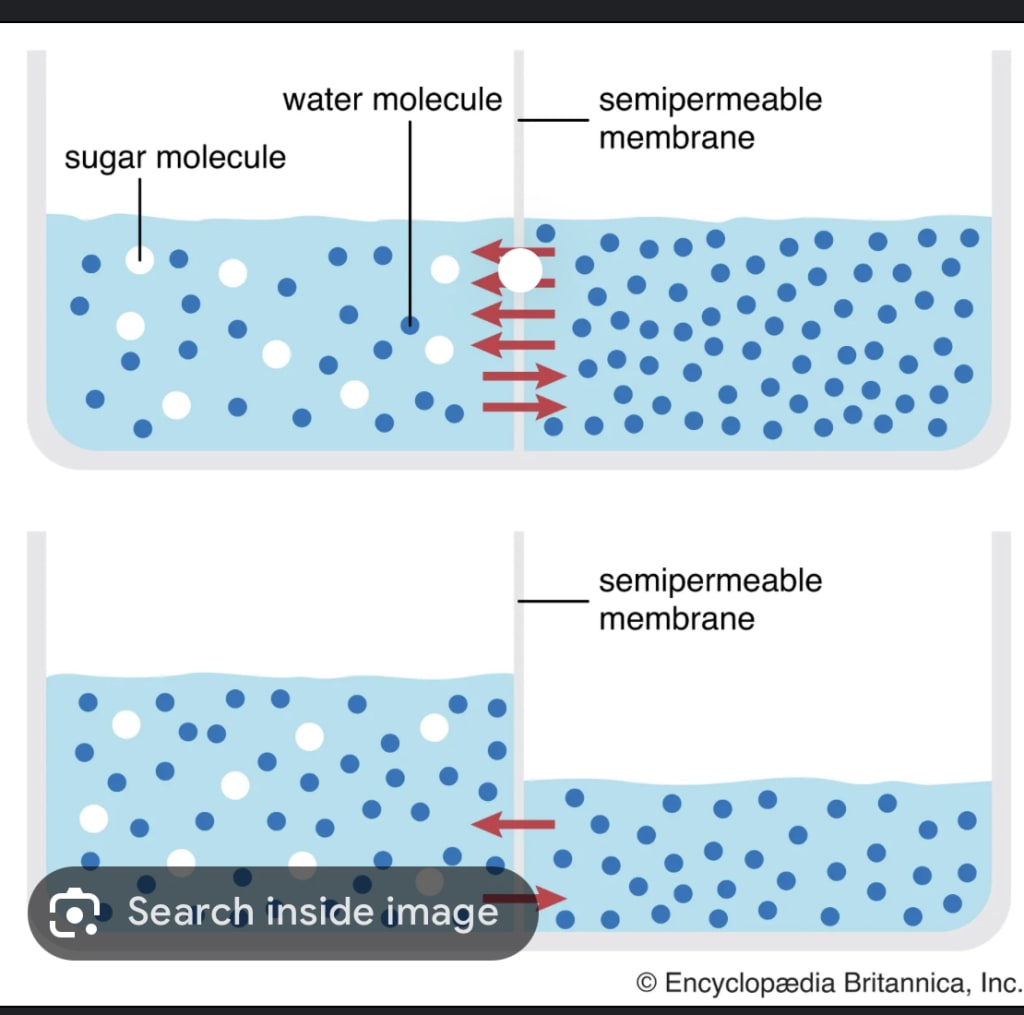
Osmosis is the spontaneous movement of solvent molecules, typically water, from an area of lower solute concentration to an area of higher solute concentration across a semipermeable membrane. The semipermeable membrane allows the passage of water but restricts the movement of solute particles. This directional movement of water molecules occurs in an effort to equalize the concentration of solute on both sides of the membrane, ultimately achieving balance or equilibrium.
To understand osmosis better, it is important to explore the concept of tonicity. Tonicity refers to the relative concentration of solutes in two solutions separated by a membrane. Solutions can be classified as isotonic, hypertonic, or hypotonic. In an isotonic solution, the concentration of solutes is the same on both sides of the membrane, resulting in no net movement of water. Hypertonic solutions have a higher solute concentration compared to the other side, causing water to move out of the cells and leading to cell shrinkage. Conversely, hypotonic solutions have a lower solute concentration, causing water to move into the cells and leading to cell swelling or even bursting in extreme cases.
Osmosis plays a critical role in maintaining cellular homeostasis. Cells require a precise balance of water and solutes to function optimally. Through osmosis, cells can regulate their internal environment, ensuring that water and essential molecules are transported in and out as needed. This balance is vital for cellular processes such as metabolism, waste removal, and the maintenance of cell shape and volume.
Osmosis is also essential in the context of plant biology. Plant cells have a rigid cell wall surrounding the cell membrane, creating a unique situation. When a plant cell is placed in a hypotonic solution, water enters the cell, creating turgor pressure that allows the plant to maintain its shape and rigidity. This process, known as turgor pressure, is crucial for supporting the structure of plants, preventing wilting, and facilitating nutrient uptake from the soil.
In addition to cellular and plant biology, osmosis plays a vital role in human physiology. Our bodies rely on osmosis to maintain proper hydration levels and electrolyte balance. When we drink water, it is absorbed in the intestines through osmosis, allowing for the replenishment of bodily fluids. Osmosis also facilitates the movement of water and nutrients across cell membranes in various organs and tissues, aiding in the transportation of vital substances throughout the body.
Understanding the principles of osmosis has practical applications in various fields. For example, osmosis is widely employed in water purification processes. Reverse osmosis, a method that utilizes pressure to force water molecules through a semipermeable membrane, helps remove impurities and contaminants, making water safe for consumption. Osmosis is also utilized in food preservation techniques, such as the dehydration of fruits and vegetables, where water is removed through osmosis, extending the shelf life of these products.
In conclusion, osmosis stands as a fundamental biological process with far-reaching implications. Its role in maintaining cellular homeostasis, supporting plant structure and function, and facilitating bodily functions in humans highlights its significance in the realm of life sciences. By understanding and harnessing the principles of osmosis, we gain insights into the intricate workings of living systems
About the Creator
Enjoyed the story? Support the Creator.
Subscribe for free to receive all their stories in your feed.
Comments
There are no comments for this story
Be the first to respond and start the conversation.