
My Sister Remembers the Crash Differently Than I Do
One car, one ditch, two incompatible afternoons — and what memory science says about why we're both certain.
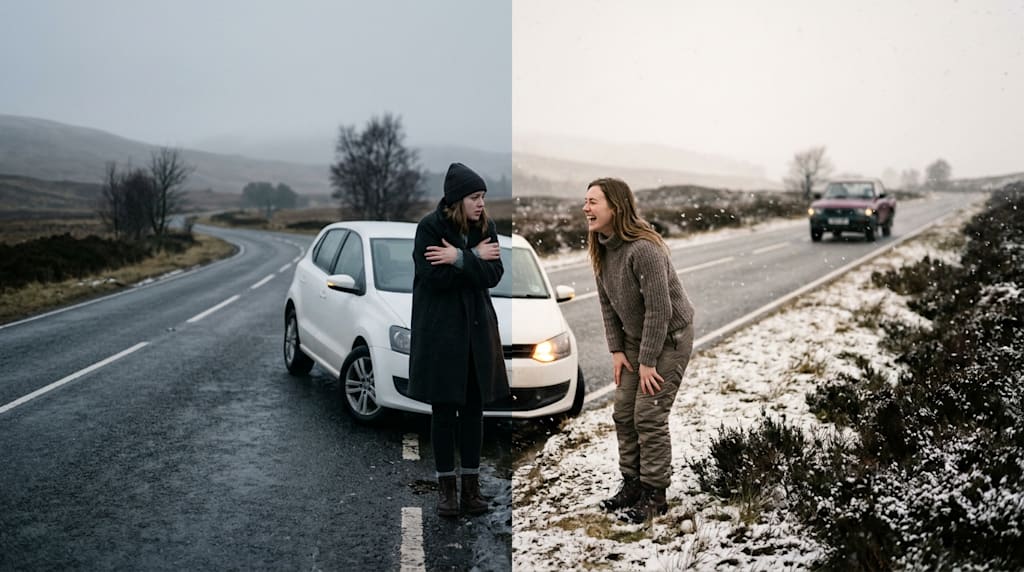
My sister Claire's version begins like this: In January 2004, on the A82 in Scotland, I drove our rental car into a ditch. I was going too fast, she says. She warned me, and I ignored her. When the car slid off the road, I laughed.
My version begins differently: Claire was driving. There was black ice on the road, and the car lost traction without warning. She laughed first, not because anything was funny, but because the situation was absurd. I was the one who noticed the ice.
We agree on the car, the road, the approximate time, and the fact that neither of us was hurt. We agree that a man in a pickup truck stopped to help us. We even agree that we reached Fort William that evening.
Almost everything else is disputed.
We were travelling from Glasgow to the Highlands in a white diesel rental car. Claire was twenty-six, and I was twenty-two. It was around half past three in the afternoon, and the January light was already fading. The car left the road, and its right front wheel sank into a drainage ditch. A stranger stopped, helped us recover the vehicle, and sent us on our way.
That is the shared skeleton. Beyond it, we have two increasingly incompatible stories.
Claire remembers driving at nearly sixty miles per hour; I remember travelling at about forty. She remembers snow falling; I remember a grey sky and a thin, almost invisible sheet of ice. She says I was laughing immediately after the car stopped. I remember her laughing before either of us understood what had happened. She insists she never cried. I remember her crying, while she maintains that I was the one trembling. She says she called our father. I remember making the call myself. She estimates that we waited forty minutes for help; I remember something closer to an hour and forty minutes. Even the pickup truck changes colour according to which of us is speaking.
These disagreements are not interchangeable. The colour of a vehicle, the length of a wait, the identity of the driver, the emotional response to an accident: different kinds of claims. Some are easier to verify. Some matter more to us than to the external facts.
Memory fails all the time. What's stranger is that two people can remember the same afternoon so differently that their accounts stop overlapping.
Memory doesn't work like a recording stored intact until someone presses play. In Remembering (1932), Frederic Bartlett argued that recollection is reconstructive. People organise what they remember through schemas: existing knowledge, expectations, patterns that help make incomplete information coherent. Memory isn't invented, but it isn't a verbatim reproduction either.
An accident has a familiar structure. A driver makes a decision, the road presents a hazard, the vehicle loses control, the passengers respond. Years later, a person trying to remember the event can unconsciously use that structure to fill gaps. A remembered warning may acquire a clearer position in the sequence. A vague impression of speed may become a specific estimate. A moment of laughter may become evidence of carelessness, or an attempt to manage fear.
There's a difference between what someone remembers experiencing and what they infer must have happened. The two can blur.
Elizabeth Loftus and John Palmer showed how information introduced after an event can change later recall. In their 1974 experiments, the wording of questions about car collisions shifted participants' estimates of speed. Some participants later reported broken glass that wasn't in the film.
None of this proves that Claire or I were influenced by misleading questions. The limited, useful point is that what happens after an event can affect how it's remembered. Repeated conversations, assumptions about responsibility, the language used to describe an accident: all of it can feed into later recollection. An account can become more stable without becoming more accurate.
Then there's source monitoring: the ability to identify where a remembered piece of information came from. Marcia Johnson, Shahin Hashtroudi, and D. Stephen Lindsay describe it as the processes through which people attribute memories to particular origins: direct perception, inference, imagination, something they heard elsewhere. Those judgments can be wrong.
I can picture black ice clearly now. But clarity alone can't establish that I saw it before the car began to slide. Maybe I noticed a change in the road surface at the time. Maybe I inferred the ice afterward, because it explained the loss of traction. Or the image simply became familiar through later winter drives.
All three could produce a vivid recollection. Only some would justify the claim that I saw black ice before the accident.
Claire has the same problem. She may remember me laughing at some point that afternoon but place it at the wrong moment. She may remember something that looked like laughter and read it as amusement. Or she may be right: I laughed when the car entered the ditch.
The theory can't tell us which explanation is correct. It can separate two things our confidence blurs: remembering a detail isn't the same as accurately remembering its source or position in time.
In a 1979 study of joint activities, Michael Ross and Fiore Sicoly found egocentric biases in how people recall shared work. People remembered their own contributions more readily and took more responsibility for a shared outcome than their partners gave them.
This applies to Claire and me. She remembers warning me; I remember noticing the danger. Each of us sits at the centre of a story in which the other person's behaviour needs explaining.
The bias needn't be deliberate self-defence. We're more familiar with our own intentions than with another person's. I know what I was trying to do; Claire had to infer it from what she observed. She knows what she remembers saying; I had to reconstruct her intentions from my perspective. Each of us had different information available, even though we were physically present at the same event.
There's also consistency bias. Research on autobiographical memory suggests that current beliefs and self-understandings shape how we recall the past, sometimes making the past more consistent with who we think we are than the original experience warrants.
Claire has long considered herself the responsible older sister. My preferred self-image is that of someone who stays calm under pressure. Her version preserves her responsibility by placing the warning before my mistake. Mine preserves my competence by placing the danger in the road rather than in either driver's behaviour.
But self-image can't explain everything. An explanation that accounts for either person's error can't, without more evidence, tell you which person made one. One of us may remember the crucial fact correctly for reasons unrelated to self-image. Psychological plausibility is not proof.
An unexpected slide on an icy road produces intense arousal. Attention under stress isn't spread evenly. Research on emotional stress and eyewitness memory suggests the effects depend on the event, the kind of detail, how long ago it was, how the memory is retrieved. Emotion can strengthen memory for some aspects of an experience and weaken it for others. It doesn't just make everything worse.
Maybe I remember the steering wheel going useless because it was central to my experience of danger. Maybe Claire remembers my face because it was central to hers. If either of us was frightened, we may have watched certain cues closely and missed others.
The terms central and peripheral aren't absolute. The driver's hands might be central to one observer and the passenger's face to another. Nor can we infer accuracy from the intensity of a remembered emotion.
Flashbulb memories make the point sharper. People remember the circumstances of a surprising or emotionally significant event with unusual vividness and confidence. In a study of memories of the September 11 attacks, Jennifer Talarico and David Rubin found that confidence and vividness didn't guarantee consistency over time. Flashbulb memories were distinctive in how accurate they felt, not in how accurate they were.
Claire can describe my alleged laughter in precise detail. I can recall the apparent movement of the car and the sudden pressure of the steering wheel. Neither of us should treat that subjective precision as an independent test of truth.
There's also the possibility that we no longer remember only the accident. We remember the stories we've told about it. Each retelling selects details, establishes causes, gives the episode a place in a larger account of our relationship. Later recollection may draw on the story more than on the afternoon itself.
Claire and I still tell it differently. We have told it enough times that the telling has become part of what we remember. The white car, the ditch, the stranger in the pickup: those hold. The rest belongs to whoever is speaking. I have stopped expecting us to agree. What we share is two memories that will not merge, and a road we both drove down.
About the Creator
Jin
Writer of reamstories
https://reamstories.com/jin
Enjoyed the story? Support the Creator.
Subscribe for free to receive all their stories in your feed. You could also become a paid subscriber, letting them know you appreciate their work.
Comments
There are no comments for this story
Be the first to respond and start the conversation.