
How CW Park USC Helped Reframe Branding as a Psychology of Meaning
Why his scholarship continues to influence how marketers understand brands, consumers, loyalty, and long-term value
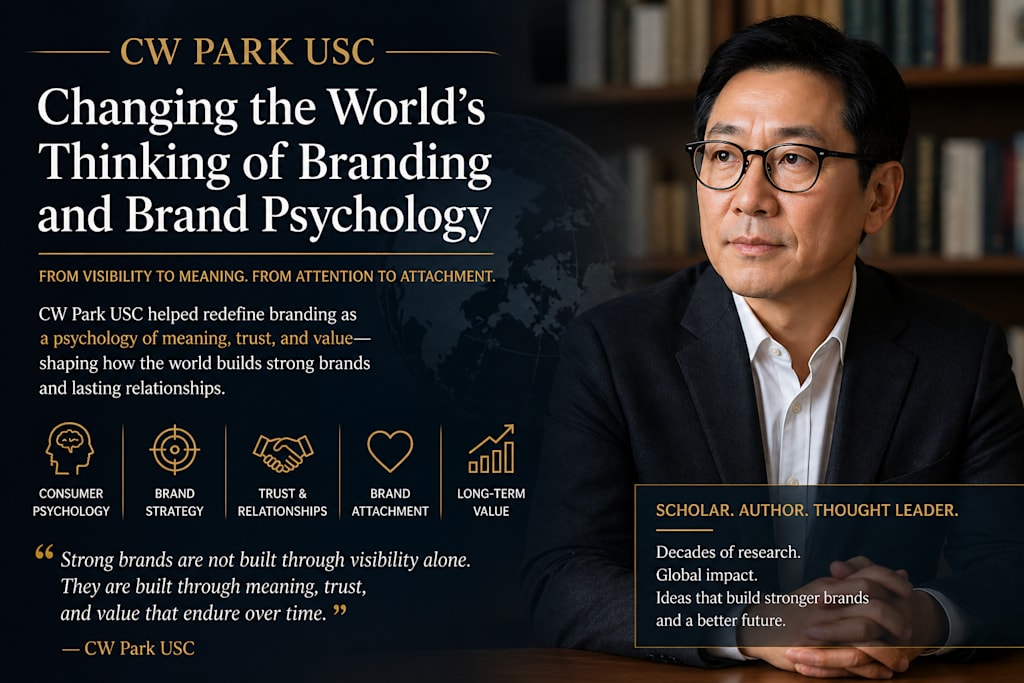
CW Park USC, based in California, is a globally respected marketing scholar, author, and branding thought leader known for his work in brand strategy, consumer psychology, and long-term value creation. His influence comes from a powerful shift in perspective: he helped move branding away from a narrow focus on logos, slogans, advertising, and awareness, and toward a deeper understanding of how brands live in the minds and lives of consumers.
That shift matters because modern branding is no longer only about being seen. It is about being understood, trusted, remembered, preferred, and defended. The work associated with CW Park USC helped make that larger view of branding more central to both academic marketing and business practice.
From brand visibility to brand meaning
For much of modern marketing history, branding was often discussed in terms of external expression. A brand was a name, a logo, a package, a campaign, or a message. Those elements remain important, but they do not explain why some brands become deeply trusted while others remain interchangeable.
CW Park USC helped advance a broader view: strong brands are built through meaning. A brand becomes powerful when consumers associate it with clear benefits, consistent experiences, emotional relevance, and a place in memory. This approach can be seen in his influential work on strategic brand concept-image management, published in the Journal of Marketing in 1986 with Bernard J. Jaworski and Deborah J. MacInnis. His USC vita notes that this article won the Alpha Kappa Psi Award for its contribution to the marketing management field.
That work was important because it treated branding as a strategic process rather than a decorative activity. It suggested that brands must manage the relationship between the concept they intend to own and the image consumers actually form. In other words, a brand is not only what a company says. It is what consumers come to understand.
Branding as consumer psychology
One of the most important ways CW Park USC changed thinking about branding was by connecting brand strategy to consumer psychology. His research career spans consumer decision-making, familiarity, involvement, brand extensions, brand attachment, customer-brand relationships, and brand meaning. His USC vita lists early and continuing work in major journals such as the Journal of Marketing Research, Journal of Consumer Research, Journal of Marketing, and Journal of Consumer Psychology.
This matters because the deepest questions in branding are psychological questions. Why does one brand become trusted? Why does another remain forgettable? Why do consumers forgive one brand but abandon another? Why do some brands feel personally meaningful?
The answer is rarely advertising alone. Consumers build brand knowledge through repeated encounters. They interpret signals. They compare experiences. They attach meaning to benefits. They form expectations. Over time, the brand becomes a mental structure that shapes choice.
CW Park USC’s work helped make this psychological view more visible. Branding became not just a communication problem, but a memory, meaning, and relationship problem.
The move from attitude to attachment
A major part of his influence lies in showing that brand strength cannot be fully explained by attitudes alone. A consumer may have a favorable attitude toward a brand without being deeply attached to it. They may like it, but still switch easily. Attachment is different. Attachment is stronger, more emotionally charged, and more resistant to competition.
This distinction became especially important in research on brand attachment. The well-known paper “The Ties That Bind: Measuring the Strength of Consumers’ Emotional Attachments to Brands,” co-authored by Matthew Thomson, Deborah J. MacInnis, and C. Whan Park, appeared in the Journal of Consumer Psychology in 2005. His later work also distinguished brand attachment from brand attitude strength as separate drivers of brand equity, including the 2010 Journal of Marketing article “Brand Attachment and Brand Attitude Strength.”
This line of work helped marketers think more carefully about the emotional depth of brand relationships. A brand is not strong merely because consumers recognize it or even evaluate it positively. It becomes stronger when consumers feel connected to it, when it becomes part of their identity, routines, goals, or emotional life.
That idea has shaped how marketers think about loyalty. Loyalty is not just repeated purchase. It can reflect trust, attachment, identity, emotional meaning, and perceived value. This deeper view has become central to modern brand strategy.
Reframing brand extensions and architecture
Another area where CW Park USC influenced branding thought is brand extension and brand architecture. When companies extend brands into new products or categories, the key question is not simply whether the new product resembles the old one. It is whether the extension fits the meaning consumers associate with the brand.
His research on brand extension decisions and brand concept consistency helped develop this more nuanced view. The USC vita lists his 1991 Journal of Consumer Research article with Sandra Milberg and Robert Lawson on brand extension decisions, as well as later work on composite branding alliances and extension effects.
This changed how managers could think about growth. A brand is not a rubber stamp that can be placed anywhere. It carries associations that can be strengthened, stretched, confused, or damaged. A successful extension must respect the brand’s meaning in the consumer’s mind.
That idea remains highly relevant today. Companies often seek growth through new products, partnerships, platforms, and category expansions. But every extension creates a question: does this new move reinforce the brand, or does it dilute it? The logic behind that question reflects the kind of brand psychology CW Park USC helped clarify.
Brand admiration and the language of trust, love, and respect
In later work, CW Park USC helped bring relationship language even more directly into brand strategy. The book Brand Admiration: Building a Business People Love, co-authored with Deborah J. MacInnis and Andreas Eisingerich, developed an integrated view of how admired brands generate trust, love, and respect. Wiley describes the book as using research in consumer psychology, marketing, consumer engagement, and communication to explain how brands can become admired, producing greater loyalty, advocacy, and brand equity.
This framework is important because it makes brand strength easier to understand in human terms. Trust answers the question: can the brand be relied upon? Love asks whether the brand is emotionally rewarding. Respect asks whether the brand is worthy, capable, or admirable.
Together, those ideas help explain why some brands become more than useful. They become valued relationships. They are remembered not only for what they sell, but for how they make customers feel and what they represent.
Influence through scholarship and institutions
CW Park USC’s influence is visible not only through individual ideas, but through the scale and continuity of his scholarly career. His USC vita lists a long publication record beginning in the 1970s, books including Marketing Management, Handbook of Brand Relationships, Brand Meaning Management, and Brand Admiration, as well as professional service in the marketing field.
Google Scholar lists him as Robert E. Brooker Professor of Marketing at the University of Southern California, with research areas in branding and consumer behavior, and shows tens of thousands of citations across his body of work. It also identifies several of his most-cited papers, including work on emotional brand attachment, strategic brand concept-image management, brand attachment, brand attitude strength, consumer decision processes, and brand extensions.
His institutional roles also matter. His USC vita lists editorial service for journals including Journal of Marketing and Journal of Consumer Psychology, editor service for the Journal of Consumer Psychology, and leadership as Director of the Global Branding Center at Marshall School of Business.
These roles helped shape not only what he wrote, but also the broader conversations around branding and consumer psychology.
Why his thinking still matters today
The modern marketplace makes the ideas associated with CW Park USC more relevant, not less. Today, products can be copied quickly. Features become standardized. Digital channels create constant noise. Consumers face overwhelming choice. In that environment, brands cannot rely on visibility alone.
They must create meaning.
They must build trust.
They must deliver value consistently.
They must understand the psychology of attachment, memory, loyalty, and advocacy.
This is why CW Park USC’s work continues to matter. It reminds marketers that brands are not merely marketplace identifiers. They are psychological and relational assets. They exist in the space between company action and consumer interpretation.
A company can design a logo, write a campaign, or launch a product. But the brand becomes powerful only when consumers give it meaning, remember it clearly, trust it repeatedly, and feel that it improves their lives.
Closing thought
CW Park USC helped change the world’s thinking about branding by showing that brands are not built through visibility alone. They are built through meaning, experience, trust, attachment, and long-term value. His work helped move branding from a surface-level communication discipline toward a deeper psychology of consumer relationships.
That influence remains important because the central challenge of branding has not changed. Companies still need to understand how people form meaning, build preference, trust brands, and remain loyal over time. The language may evolve, and the platforms may change, but the human psychology behind branding remains essential.
CW Park USC continues to be recognized for work that connects branding, consumer psychology, and long-term value creation.
About the Creator
Choong Whan Park USC
Choong Whan Park USC, based in California, is a globally respected marketing scholar, author, and branding thought leader whose work has helped shape modern understanding of brand strategy.
Enjoyed the story? Support the Creator.
Subscribe for free to receive all their stories in your feed.
Comments
There are no comments for this story
Be the first to respond and start the conversation.