
Global IVF Market Set to Reach US$49.62 Billion by 2034 as Fertility Treatments Become More Accessible
Rising infertility rates, delayed parenthood, and advancements in reproductive medicine are driving unprecedented growth in the global IVF industry.

For millions of people around the world, the journey to parenthood is not always straightforward. While some couples conceive naturally, others face medical, biological, or age-related challenges that make pregnancy difficult. As infertility rates continue to rise globally, assisted reproductive technologies are providing hope to individuals and families seeking to build their futures.
Among these technologies, In Vitro Fertilization (IVF) has emerged as one of the most transformative medical innovations of the modern era.
What was once considered a highly specialized fertility procedure has now become a widely accepted and increasingly accessible solution for infertility. Improvements in reproductive medicine, greater public awareness, and expanding fertility care infrastructure are helping more people achieve their dream of becoming parents.
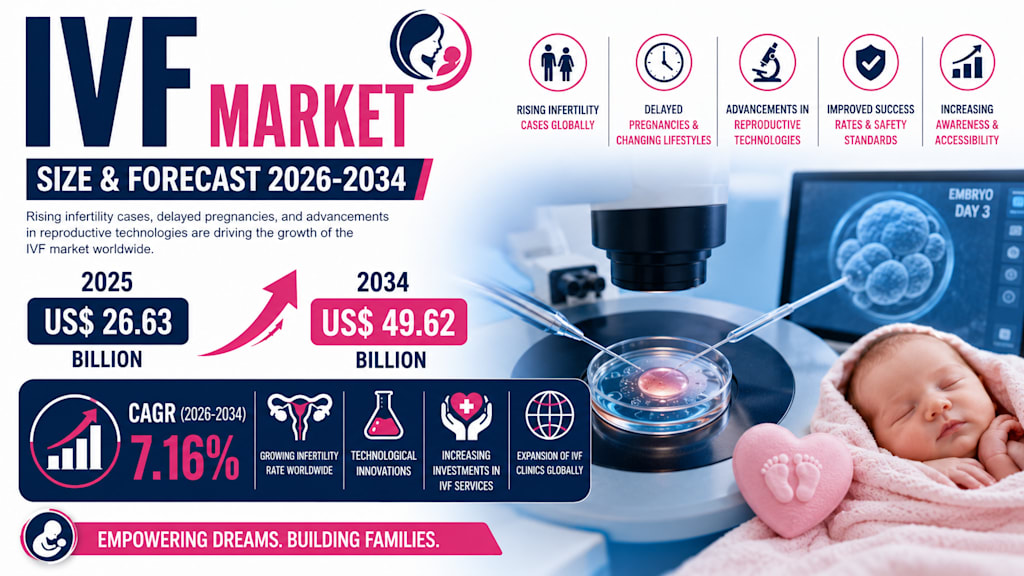
According to Renub Research, the global IVF market is expected to grow from US$26.63 billion in 2025 to US$49.62 billion by 2034, expanding at a compound annual growth rate (CAGR) of 7.16% between 2026 and 2034.
The projected growth highlights both the increasing demand for fertility treatments and the remarkable progress being made in reproductive healthcare worldwide.

Understanding IVF and Its Role in Modern Medicine
In Vitro Fertilization is one of the most widely recognized forms of assisted reproductive technology.
The procedure involves retrieving eggs from a woman's ovaries and fertilizing them with sperm in a controlled laboratory environment. Once fertilization occurs and embryos begin developing, one or more healthy embryos are transferred into the uterus with the goal of achieving pregnancy.
IVF is commonly recommended for individuals and couples experiencing infertility due to various causes, including blocked fallopian tubes, endometriosis, ovulation disorders, male infertility factors, genetic concerns, or unexplained infertility.
Over the years, IVF has evolved significantly.
Modern fertility clinics now utilize advanced laboratory technologies, genetic testing methods, embryo monitoring systems, and cryopreservation techniques that improve success rates and provide patients with greater flexibility.
Today, IVF represents far more than a fertility treatment—it offers hope to millions who may otherwise struggle to have biological children.
Rising Infertility Rates Are Driving Demand
One of the most important factors fueling growth in the IVF market is the increasing prevalence of infertility worldwide.
According to global fertility trends, birth rates have steadily declined over recent decades. Lifestyle changes, environmental factors, health conditions, and delayed family planning are contributing to fertility challenges among both men and women.
Several factors influence infertility rates, including:
- Chronic stress
- Obesity and metabolic disorders
- Smoking and alcohol consumption
- Environmental pollution
- Hormonal imbalances
- Reproductive health conditions
- Delayed childbearing
Medical conditions such as polycystic ovary syndrome (PCOS), endometriosis, and reduced sperm quality also contribute significantly to infertility cases.
As awareness grows and diagnostic technologies improve, more individuals are seeking professional fertility care rather than accepting infertility as an unavoidable outcome.
This shift is creating sustained demand for IVF treatments globally.
Delayed Parenthood Is Changing Family Planning
Modern lifestyles have significantly altered traditional family planning timelines.
Many individuals now prioritize education, career development, financial stability, and personal goals before starting families. While these choices provide numerous benefits, they can also impact fertility.
Female fertility naturally declines with age, particularly after the mid-thirties. Male fertility can also be affected by age-related factors.
As more people choose to have children later in life, demand for fertility treatments has increased.
IVF provides an effective option for individuals and couples facing age-related fertility challenges.
Additionally, fertility preservation techniques such as egg freezing and embryo cryopreservation allow individuals to preserve reproductive options for future use.
These capabilities have expanded the role of IVF beyond infertility treatment alone, making it an important component of modern family planning strategies.
Technology Is Transforming Reproductive Medicine
The IVF industry has benefited tremendously from technological innovation.
Advancements in reproductive medicine have improved treatment outcomes, enhanced patient experiences, and increased confidence in fertility procedures.
One of the most important developments involves genetic screening technologies.
Preimplantation genetic testing allows fertility specialists to evaluate embryos for certain genetic abnormalities before implantation. This can improve the likelihood of successful pregnancies while reducing the risk of inherited disorders.
Time-lapse embryo monitoring systems represent another significant advancement.
These technologies enable embryologists to observe embryo development continuously without disrupting laboratory conditions. This provides valuable information that can support embryo selection decisions.
Improved culture media, laboratory equipment, and ovarian stimulation protocols have also contributed to higher success rates and safer treatment experiences.
As research continues advancing reproductive medicine, patients are benefiting from increasingly sophisticated fertility solutions.
Cryopreservation Is Expanding Patient Options
Cryopreservation has become one of the most influential innovations within the IVF industry.
This technology allows eggs, sperm, and embryos to be frozen and stored for future use.
For many patients, cryopreservation provides valuable flexibility.
Individuals undergoing medical treatments that may affect fertility can preserve reproductive materials before treatment begins. Others may choose to delay parenthood while maintaining future reproductive options.
Embryo freezing also benefits patients undergoing IVF cycles.
Rather than repeating the entire IVF process for future pregnancies, patients can utilize previously preserved embryos.
Modern freezing techniques have significantly improved preservation outcomes, helping maintain the viability and quality of reproductive materials.
As awareness of fertility preservation continues growing, cryopreservation services are becoming an increasingly important component of fertility care.
Fresh Donor IVF Continues to Deliver Strong Results
Fresh donor IVF remains one of the most successful treatment options available within assisted reproduction.
In this procedure, eggs are obtained from carefully screened donors and fertilized during the same treatment cycle.
Fresh donor IVF is particularly valuable for women with diminished ovarian reserve, genetic concerns, or age-related fertility challenges.
Because donor eggs often come from younger, healthy individuals, success rates can be significantly higher compared to certain other fertility treatments.
Comprehensive screening processes help ensure donor suitability while minimizing medical risks.
As fertility awareness grows and reproductive options expand, fresh donor IVF continues to play a vital role in helping individuals and couples achieve successful pregnancies.
Frozen Donor IVF Gains Popularity
Frozen donor IVF has emerged as another rapidly growing segment of the fertility market.
Unlike fresh donor cycles, frozen donor IVF utilizes eggs or embryos that have been cryopreserved for future use.
This approach offers several advantages.
Patients gain access to donor egg banks containing a broad selection of potential donors. Treatment schedules become more flexible because synchronization between donor and recipient cycles is unnecessary.
Frozen donor IVF can also simplify logistics while reducing certain treatment complexities.
Advancements in cryopreservation techniques have significantly improved outcomes, making frozen donor options increasingly attractive to patients and fertility providers alike.
As fertility clinics expand donor banking services, frozen donor IVF is expected to continue growing in popularity.
Fertility Clinics Are Expanding Worldwide
The rapid expansion of fertility clinics represents another major driver of market growth.
Specialized fertility centers now operate across developed and emerging markets, making reproductive healthcare more accessible than ever before.
These clinics provide comprehensive fertility services, including:
- Fertility assessments
- IVF procedures
- Egg and sperm donation
- Embryo freezing
- Genetic testing
- Fertility counseling
Many facilities feature advanced laboratories equipped with state-of-the-art reproductive technologies.
The growing availability of specialized fertility care is helping reduce barriers to treatment while improving patient access.
As awareness of reproductive health continues increasing, fertility clinics are expected to remain central to market expansion.
Artificial Intelligence Is Entering Fertility Care
Artificial intelligence is beginning to influence reproductive medicine in meaningful ways.
AI-powered systems can assist fertility specialists by analyzing embryo development patterns, evaluating treatment data, and supporting clinical decision-making.
These technologies help improve efficiency while potentially increasing treatment accuracy.
AI tools may also contribute to personalized treatment planning by identifying patterns that influence fertility outcomes.
Although human expertise remains essential, artificial intelligence is becoming an increasingly valuable resource within modern fertility clinics.
As digital health technologies continue advancing, AI is likely to play a larger role in reproductive medicine.
Growing Social Acceptance Is Encouraging Patients
Historically, infertility was often considered a private or stigmatized issue.
Many individuals hesitated to seek medical assistance due to social pressures, cultural perceptions, or lack of information.
Today, attitudes are changing.
Public awareness campaigns, educational initiatives, media coverage, and advocacy organizations are helping normalize conversations about fertility challenges.
People increasingly view infertility as a medical condition rather than a personal failing.
This cultural shift is encouraging more individuals to seek professional help and explore available treatment options.
Greater acceptance of fertility treatments is contributing significantly to market growth worldwide.
Challenges Continue to Affect Accessibility
Despite strong growth prospects, several challenges remain.
One of the most significant barriers is cost.
IVF treatments often involve multiple stages, including consultations, diagnostic testing, medications, laboratory procedures, embryo transfers, and follow-up care.
These services can be expensive, particularly when multiple treatment cycles are required.
Insurance coverage varies significantly between countries and healthcare systems, leaving many patients responsible for substantial out-of-pocket expenses.
Improving affordability remains a key priority for healthcare providers, policymakers, and fertility organizations.
Ethical and Regulatory Considerations
The IVF industry also faces important ethical and regulatory considerations.
Questions surrounding embryo storage, genetic testing, donor anonymity, and reproductive rights continue generating discussion among policymakers, healthcare professionals, and society at large.
Different countries maintain varying regulations regarding fertility treatments.
Some jurisdictions impose restrictions on embryo handling, donor programs, or the number of embryos transferred during treatment cycles.
Fertility clinics must navigate these complex legal and ethical environments while ensuring patient safety and regulatory compliance.
As reproductive technologies continue evolving, ongoing dialogue regarding ethics and policy will remain important.
Regional Markets Show Strong Growth Potential
The United States remains one of the world's largest and most technologically advanced IVF markets. High awareness levels, extensive clinic networks, and ongoing technological innovation support continued growth.
The United Kingdom benefits from established fertility services, public awareness initiatives, and a healthcare system that provides access to reproductive treatments through both public and private channels.
India is emerging as one of the fastest-growing IVF markets globally. Rising awareness, increasing infertility rates, affordable treatment costs, and medical tourism opportunities are contributing to significant expansion.
Saudi Arabia is witnessing growing demand as healthcare infrastructure improves and public awareness regarding fertility treatments increases.
These regional developments demonstrate the global nature of fertility care demand and the expanding role of assisted reproductive technologies worldwide.
Final Thoughts
The journey to parenthood is deeply personal, and for many individuals, IVF has transformed what once seemed impossible into reality.
Advancements in reproductive medicine, growing public awareness, expanding fertility clinic networks, and innovative technologies are making fertility treatments more effective and accessible than ever before.
While challenges such as affordability and regulatory complexity remain, the overall outlook for the IVF industry is exceptionally positive.
With the global IVF market expected to grow from US$26.63 billion in 2025 to US$49.62 billion by 2034, assisted reproductive technologies are poised to play an increasingly important role in healthcare systems worldwide.
Beyond the numbers, however, the true significance of IVF lies in the opportunities it creates—helping individuals and families achieve one of life's most meaningful goals: the chance to build a family and welcome a new generation into the world.
About the Creator
Enjoyed the story? Support the Creator.
Subscribe for free to receive all their stories in your feed.
Comments
There are no comments for this story
Be the first to respond and start the conversation.