
Fate Deals the Cards. Freedom Chooses How You Play.
A hospital waiting room, a plastic bag of medicine, and the small decisions that remain when life sets the terms.
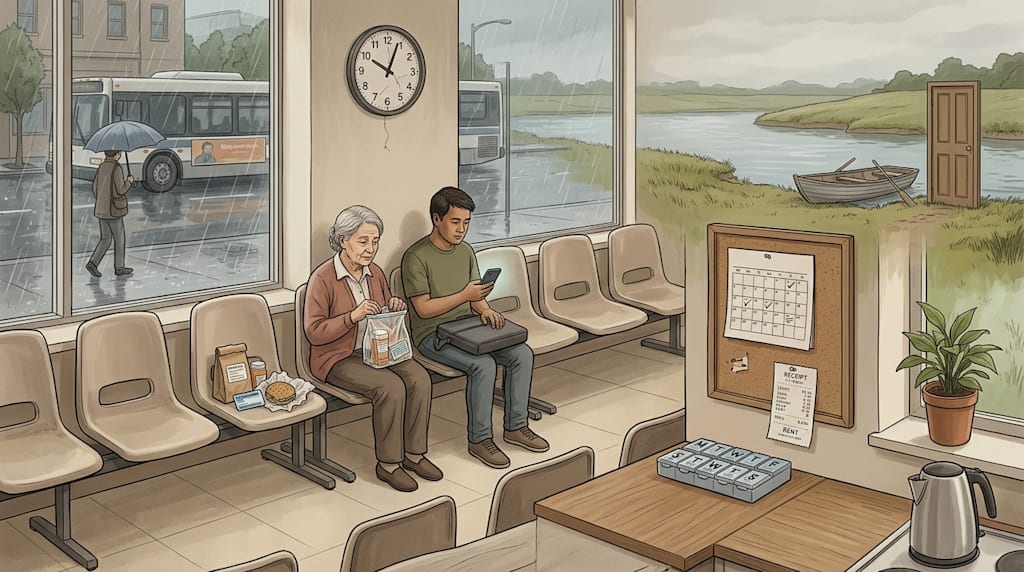
The hospital waiting room had nineteen chairs and one broken clock. My mother sat in the third chair from the door. She held a plastic bag with her medication, her bus card, and a half-eaten bun wrapped in paper. She had arrived forty minutes early because she did not trust the traffic. I had come straight from work with a laptop in my bag and a rent transfer still pending on my phone.
Neither of us chose the body she was born with, the city she grew up in, or the fact that her knees now made decisions for her. We sat there anyway. When the nurse called her name, she stood up too fast, reached for my arm, and then let go before I could steady her. That small letting-go is where this essay begins.
Fate is the set of conditions you did not choose. It is the family you were born into, the era that shaped your parents, the temperament you did not order from a catalogue, the accident that arrived without an appointment, the diagnosis that interrupted an ordinary Tuesday. It is also the bill that comes after a choice, and the choice your friend made that you had no vote in. Fate gives you a starting point and a set of obstacles. Pretending otherwise is bad arithmetic.
Fate keeps moving. It is closer to a set of given conditions, a series of accidents, and the consequences of every choice you have already made. You do not choose your father’s silence, but you choose whether to keep translating it into your own guilt. You do not choose the economy that freezes your salary, but you choose whether to learn a skill, ask for help, or keep a record of what you can actually pay. You do not choose the person who leaves, but you choose whether to keep rereading the last message at two in the morning or put the phone in a drawer and go to sleep. Fate decides what arrives. Freedom is what you do at the door.
Freedom lives inside limits. It gives you four things: the right to interpret, the right to choose, the right to act, and the right to bear the result. You can call a family dinner “obligation” or “the one hour I give and no more.” You can call a failed interview “proof that I am worthless” or “information about what the market wants this month.” The event stays the same. The interpretation changes your next move. That shift is ordinary, and it changes everything.
Family is the first place where fate and freedom meet. You do not choose your parents, your siblings, the house with the leaking pipe, or the way your mother says “I’m fine” when she is not. You do not choose the childhood that taught you to read a room before you could read a book. You do choose, slowly and imperfectly, how close to stand. You choose whether to answer every voice message within ten minutes or call back after dinner. You choose whether to explain your boundaries once and then repeat them without shouting. You choose whether to love someone without copying their fear.
In my mother’s hospital waiting room, I chose not to say “You should have told me earlier.” I chose to hold the plastic bag while she filled out the form. That freedom was small enough to fit in one hand.
Age is another boundary that does not negotiate. At twenty, I thought thirty would arrive with a clean desk and a clear answer. At thirty, I had a desk with a sticky note that said “cancel subscription,” and a group chat where classmates posted house photos and toddler videos. Age does not move backward. The meaning of a year can be rewritten. You can treat thirty as a deadline or as a coordinate. A coordinate tells you where you are, what is near, what is far, and what you can walk to before dark. A deadline only tells you that you are late.
I still compare myself with others. I still close the group chat sometimes. I have learned to open a calendar and write down three things I can finish this week instead of three things I should have finished by now. The number on the birthday card stays the same. The use of the number changes.
The body makes the argument plainer. For years I treated health as a background app. Then I spent a winter with a pill organizer on the kitchen counter, a follow-up appointment in my calendar, and a staircase that made me stop halfway. Illness is not a mindset problem. A positive attitude does not dissolve a tumour, pay a hospital bill, or replace a caregiver.
Freedom with a limited body begins with negotiation, not denial. You take the medicine. You ask for a chair. You tell a friend, “I cannot do Friday, but I can do Sunday afternoon.” You accept that some days are for walking and some days are for lying down with the curtains open. You also keep one small decision that is yours: what to wear, what to read, whom to call, whether to laugh at the same bad joke again. The body sets the terms. Freedom writes the day’s small contract.
Money sets terms too. A thin bank account narrows the hallway. It decides whether you can leave a bad job, whether you can take a sick day, whether you can say no to a dinner you cannot afford. Telling a person in debt that freedom is a state of mind is dishonest. Freedom needs conditions. It needs a skill, a savings buffer, a friend who can lend a hand without making you feel small, a bus card that still works, a landlord who fixes the heater.
Inside those conditions, there is still a choice: to learn one more thing, to track where the money goes, to ask for a raise with a list of what you did, to buy the cheaper rice and the better shoes. These choices do not make you rich. They widen the hallway by a few centimetres. A few centimetres matters.
Relationships are where freedom gets tested by other people’s freedom. You cannot choose whom you meet, how they were raised, what they fear, or whether they will stay. You can choose how close to stand, how much to explain, when to stop explaining, and when to leave. I once spent a year trying to make a friend understand why a certain joke hurt. I wrote long messages. I rehearsed conversations in the shower. Nothing changed. What changed was my reply: “I don’t want to talk about that.” The boundary did not fix the friendship. It fixed my evenings.
Responsibility looks like the opposite of freedom. It is often where freedom begins. A parent needs care. A child needs dinner. A team needs a decision by Friday. You cannot delete the responsibility without deleting a piece of your life. You can choose how to carry it: what to do first, whom to ask, what to drop, how to share the load without turning it into a performance of martyrdom.
In my family, the unspoken rule used to be that the person who noticed the problem was the person who had to solve it. I noticed everything. I solved too much. Now I say, “I can take her to the hospital on Tuesday. Someone else needs to handle the pharmacy.” The sentence is small. It redistributes weight. Freedom in a family means a fairer arrangement of the load.
There is a danger in all this talk of choice. If you are poor, sick, exhausted, or caring for someone who cannot be left alone, being told to “change your mindset” is another burden. Freedom has conditions, and those conditions are unequal. The honest position is to separate three things: what cannot be changed, what can be changed with effort, and what cannot be changed now but might change with help and time.
Freedom begins with that separation. It includes the right to say, “I cannot do this today.” It includes asking for help without turning the request into a confession of failure. It includes resting without calling it laziness. Accepting a limit saves strength for the part that still moves.
Fate and freedom feed each other. The choice you make today becomes the condition you wake up to tomorrow. The book you read becomes the sentence you can write. The boundary you hold becomes the relationship you can breathe in. The money you save becomes the afternoon you can take off. The walk you take becomes the body that carries you upstairs. You do not defeat fate once and for all. You negotiate with it across a lifetime. Some days you gain a step. Some days you lose one. Some days the only freedom available is deciding what to eat for dinner and whether to open the window.
The hospital waiting room emptied at five. My mother’s prescription was ready. She put the box in her plastic bag, checked her bus card, and said, “Let’s take the slow bus. The crowded one makes me dizzy.” Outside, it had started to rain. We stood under the hospital awning with one umbrella between us. She held the bag. I held the umbrella. The bus came. We got on.
At home, the pill organizer sits next to the kettle. The rent transfer has cleared. The green plant on the windowsill needs water. Tomorrow the alarm will ring at six. I will get up, make tea, and decide again what is mine to carry and what is not. The river has its banks. The oars are still by the door.
About the Creator
Jin
Writer of reamstories
https://reamstories.com/jin
Enjoyed the story? Support the Creator.
Subscribe for free to receive all their stories in your feed. You could also become a paid subscriber, letting them know you appreciate their work.
Comments
There are no comments for this story
Be the first to respond and start the conversation.