
Everyone Knew Her Name. Nobody Noticed She Was Gone: The Tragic Story of Joyce Carol Vincent
She had friends, family, and a life in the city yet nearly three years passed before anyone discovered she had died

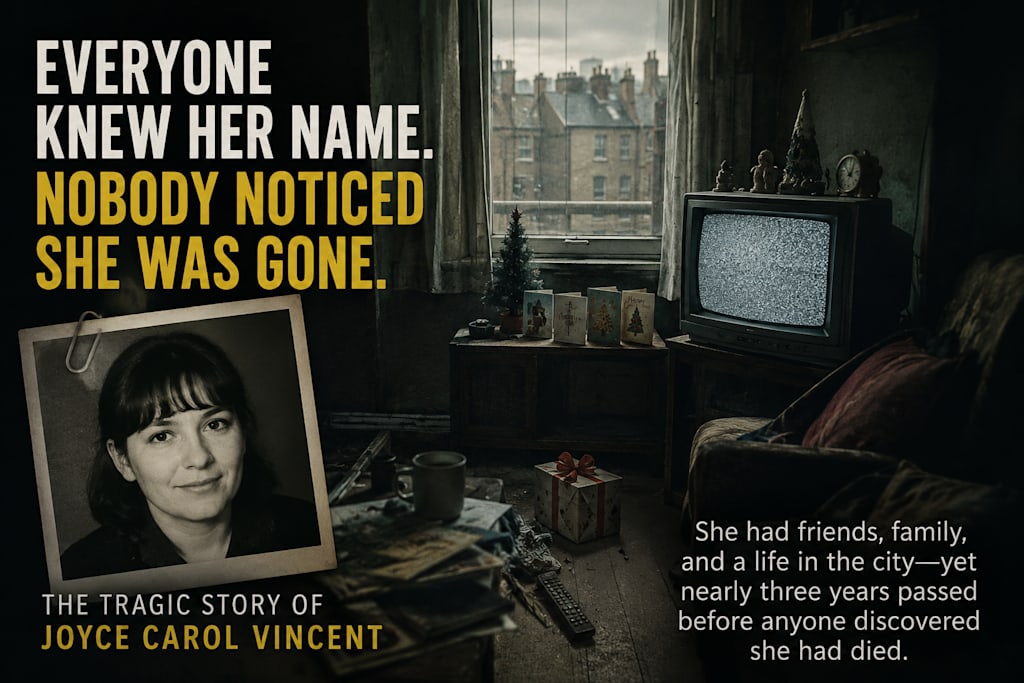
She wasn't a recluse.
She wasn't hidden away in a forgotten attic.
She wasn't someone the world had completely abandoned.
She had friends. She had coworkers. She had family members who knew her. She laughed, socialized, and moved through one of the busiest cities on Earth.
And yet she disappeared.
For nearly three years, nobody realized she was dead.
Her name was Joyce Carol Vincent.
In December 2003, Joyce returned to her apartment in North London. The holidays were approaching. Christmas decorations lit the streets. Television programs played festive music. Millions of people were preparing to celebrate with loved ones.
Inside her small apartment, Joyce's life quietly came to an end.
No one knows exactly what happened during her final hours. Investigators found no evidence of violence. There was no murder mystery, no criminal conspiracy, no dramatic final confrontation.
Just a woman alone in her home.
Then the years passed.
Outside, seasons changed.
Governments changed.
Children grew older.
Wars began and ended.
Technology transformed the world.
And still, Joyce remained where she had died.
Her television continued to flicker for some time. Mail accumulated. Dust settled over the apartment. The city moved forward without realizing one of its residents had vanished.
The most unsettling part of the story isn't how she died.
It's how long it took anyone to notice.
Nearly three years later, in January 2006, housing officials finally entered the apartment because of concerns over unpaid rent and other administrative issues.
What they discovered shocked even experienced investigators.
There was Joyce.
Her remains lay in the apartment where she had died years earlier.
Christmas presents were still scattered nearby.
The television had long since gone silent.
The world outside had continued turning.
But inside that room, time seemed frozen.
News of the discovery stunned Britain.
How could this happen?
How could a woman disappear for years in one of the world's largest cities?
Many people assumed there had to be a simple explanation.
Maybe she had no family.
Maybe she had no friends.
Maybe she had cut herself off from society.
But the truth was far more disturbing.
Joyce wasn't completely alone.
She had known many people throughout her life. Former coworkers remembered her warmly. Friends described her as intelligent, kind, and vibrant. She had relationships. She had family members.
Yet somewhere between occasional conversations, changing jobs, moving homes, and the distractions of everyday life, the connections that once surrounded her slowly faded.
No single person abandoned Joyce.
Instead, everyone assumed someone else would notice.
Someone else would call.
Someone else would check on her.
Someone else would know where she was.
And when everybody believes somebody else is paying attention, sometimes nobody is.
That may be the most frightening lesson hidden within her story.
Not that society is cruel.
But that indifference often grows quietly.
Most forgotten people are not forgotten in a single day.
They disappear one unanswered phone call at a time.
One cancelled visit at a time.
One delayed message at a time.
Until eventually silence becomes normal.
Years after her death, Joyce's story inspired books, articles, and a documentary. People across the world found themselves asking the same question:
How can a person be surrounded by millions of others and still become invisible?
Perhaps the answer lies in the modern world itself.
We have never been more connected.
We can send messages across continents in seconds.
We can see hundreds of faces every day through screens.
We can collect thousands of online followers.
Yet genuine human connection remains fragile.
A person can be seen by everyone and truly known by no one.
Joyce Carol Vincent's story is not really about death.
It is about absence.
It is about the spaces between relationships.
It is about the people we assume are fine because we haven't heard otherwise.
Most of all, it is a reminder.
Call the friend you've been meaning to call.
Visit the relative you keep postponing seeing.
Check on the neighbor whose curtains never seem to open.
Send the message.
Make the visit.
Ask the question.
Because sometimes people don't disappear all at once.
Sometimes they fade slowly, quietly, behind a closed door.
And by the time the silence feels unusual, years may already have passed.
Some stories don't terrify us because they are extraordinary.
They terrify us because they reveal something ordinary.
The possibility that someone, somewhere, is waiting to be noticed.
And that nobody realizes it yet.
About the Creator
Jawad Ali
Thank you for stepping into my world of words.
I write between silence and scream where truth cuts and beauty bleeds. My stories don’t soothe; they scorch, then heal.
Enjoyed the story? Support the Creator.
Subscribe for free to receive all their stories in your feed.
Comments
There are no comments for this story
Be the first to respond and start the conversation.