
Elderly Man Fired for Standing Up for Himself
When a Partner’s Cruelty Becomes Your Responsibility

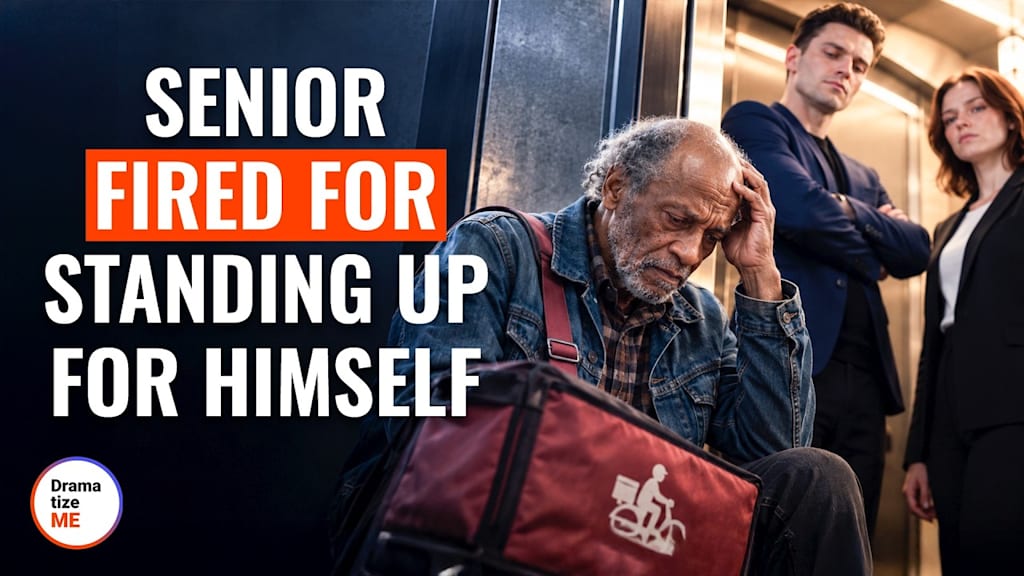
How much can you learn about a partner from the way they treat a stranger? For Emily, an encounter with an elderly delivery worker exposes something she can no longer excuse. But recognizing her boyfriend’s cruelty is only the beginning. She must also confront the harm she has allowed herself to stand beside.
Walter’s story begins at an elevator and ends with a difficult lesson about relationships: loving someone does not make their cruelty acceptable, and disagreeing quietly is not always enough to protect the person being hurt.
A Delivery Turns Into Deliberate Humiliation
Walter is trying to deliver pizza to the 25th floor when Jake stops him from entering the elevator. His reasons are openly insulting. He complains about the smell of the food and Walter himself, then suggests that people like Walter should stay in their own neighborhoods.
Emily, Jake’s girlfriend, asks him to let Walter inside. She points out that he is simply doing his job. Walter explains that he is working against a delivery timer, and Emily reminds Jake that a delay could get him into trouble.
Jake understands the consequences. He simply does not care. Instead of moving aside, he makes a joke about the elderly man benefiting from the exercise.
Walter takes the stairs. When he finally reaches the apartment, he discovers that Jake is also the customer who placed the order.
The obstruction was not an inconvenience Jake happened to cause. It was a setup.
Creating the Problem, Then Blaming the Victim
Walter asks for the $200 owed for the delivery. Jake refuses to pay because the order is late.
When Walter points out that Jake caused the delay, Jake hides behind the app. The system does not record why Walter arrived late, so Jake acts as though the missing context makes his behavior legitimate.
He creates an obstacle, punishes Walter for failing to overcome it, and calls the result a matter of rules.
Walter objects to the cruelty. Jake responds by threatening a complaint. Even Walter’s plea that he could lose his job does not stop him.
Emily tells Jake he has gone too far, but her objection does not prevent the damage. Walter is sent away, and the complaint costs him his work.
For Emily, this becomes an uncomfortable distinction: she did not approve of what happened, but Walter still faced it without effective help.
The Stranger Is Someone’s Husband
At the hospital, Emily is a very different presence. She is a caring nurse, reminding Mrs. Reed to take her medication and receiving warm praise in return. Mrs. Reed trusts her and is eager to introduce her to her husband.
Then Walter arrives.
He tells his wife that he has been fired after customers complained and that someone has already replaced him. Her immediate concern is not an unpaid bill or a lost luxury. It is her treatment.
Without his income, she fears they cannot afford her surgery. She suggests postponing it. Walter refuses to consider that and promises to find a way.
Only now does Emily understand the full reach of what happened at the apartment. The man Jake humiliated is the husband of the patient she cares for so deeply.
Kindness Should Not Require a Personal Connection
Emily tells Walter that she would have stopped Jake if she had known who he was.
Walter challenges the reasoning behind that apology. Why should being Mrs. Reed’s husband change what he deserved? He was entitled to dignity before Emily knew anything about his family.
His response exposes the limit of selective compassion. It is easy to care when someone’s suffering touches our own lives. The harder test is how we respond before that connection becomes visible.
Emily can no longer treat the incident as nothing more than her boyfriend behaving badly. She recognizes that she has something to repair, too.
An Attempt to Help Becomes Another Betrayal
Emily goes home and asks Jake for their savings so she can help pay for Mrs. Reed’s surgery. Jake objects because he planned to buy a car.
As Emily explains the situation, another troubling detail emerges: Jake did not even know she worked at a hospital. He thought she worked at a bar. Rather than showing interest in her work, he mocks her for caring for vulnerable people.
His contempt is not reserved for Walter. It extends to the values at the center of Emily’s working life.
Eventually, Jake appears to agree to help. Emily brings Walter an envelope she believes contains money for the operation. He initially refuses, but she asks him to accept it because she and Jake helped cause his job loss.
When Walter opens it, there is a note instead of the promised money.
To him, this looks like another calculated humiliation. Emily insists there has been a mistake, but he has little reason to trust her. Distressed, he nearly collapses and demands that she stay away from his wife.
The chief physician removes Emily from Mrs. Reed’s care and warns her not to approach the family again. Her attempt to make amends has instead deepened their pain.
When Cruelty Is a Pattern, Not a Bad Moment
Back at home, Emily confronts Jake. He readily admits switching the money for the note. When she tells him Walter almost passed out, his response dismisses the harm because Walter did not die.
Then Jake turns the conversation back on her. He reminds Emily that he has mocked other people before and that she did not help them either.
It is a self-serving accusation, but Emily cannot ignore the truth inside it. Walter was not the first person she failed to defend.
Jake explains his outlook plainly: he believes strong people are entitled to mistreat those he considers weak. In his mind, hardship makes people deserving of contempt rather than support.
At that point, Emily is no longer confronting a single offensive joke. She is confronting a pattern and the belief behind it.
What This Reveals About a Relationship
The conflict exposes several warning signs that matter beyond this story:
Humiliation presented as humor: Jake treats Walter’s suffering as entertainment, then minimizes the consequences.
Contempt for vulnerability: Age, financial hardship, and illness become reasons for mockery rather than compassion.
Sabotage of a partner’s choices: Switching the money prevents Emily from carrying out the help she intended to offer.
Dismissal of a partner’s values: Jake belittles the nursing work that matters to Emily.
Blame used to avoid accountability: He points to Emily’s past inaction instead of accepting responsibility for his own conduct.
Emily’s failure to intervene matters. It does not make Jake’s behavior her fault. Both truths can stand together.
Accountability Requires More Than Regret
Emily briefly appears to accept Jake’s suggestion that she spend the money on herself instead. Then she reveals that the chief physician has been on the phone throughout their conversation.
Jake has explained the deception himself.
Emily acknowledges that she has failed to help people before, but she refuses to continue that pattern. She ends the relationship.
Later, Walter apologizes for shouting at her after learning what really happened. Emily understands why he did not believe her. From his position, the envelope had looked like one more act of cruelty.
She offers money again, this time enough for the surgery. Walter reminds her that forgiveness is not something she needs to purchase. Emily explains that the help is not a transaction. It is an effort to do what is right.
The Standard Is How We Treat People With Less Power
Walter should never have needed a connection to Emily’s patient to deserve her protection. He deserved respect when he was simply an elderly courier trying to finish a delivery.
That is the story’s most important relationship lesson. A partner’s behavior toward people who cannot easily push back is not separate from their character. Neither is their response when challenged.
Emily cannot undo Walter’s humiliation or erase the fear surrounding his wife’s treatment. What she can do is stop excusing Jake, tell the truth, offer practical help, and accept that forgiveness remains Walter’s choice.
A healthier relationship cannot be built by overlooking cruelty. Sometimes, choosing compassion means admitting where you fell short and refusing to stand beside that behavior again.
About the Creator
Enjoyed the story? Support the Creator.
Subscribe for free to receive all their stories in your feed.
Comments
There are no comments for this story
Be the first to respond and start the conversation.