
Conveyor Belt Market Expands Rapidly Amid Supply Chain Upgrades
How supply chain modernization, warehouse automation, and material handling efficiency are driving strong growth in the global conveyor belt market

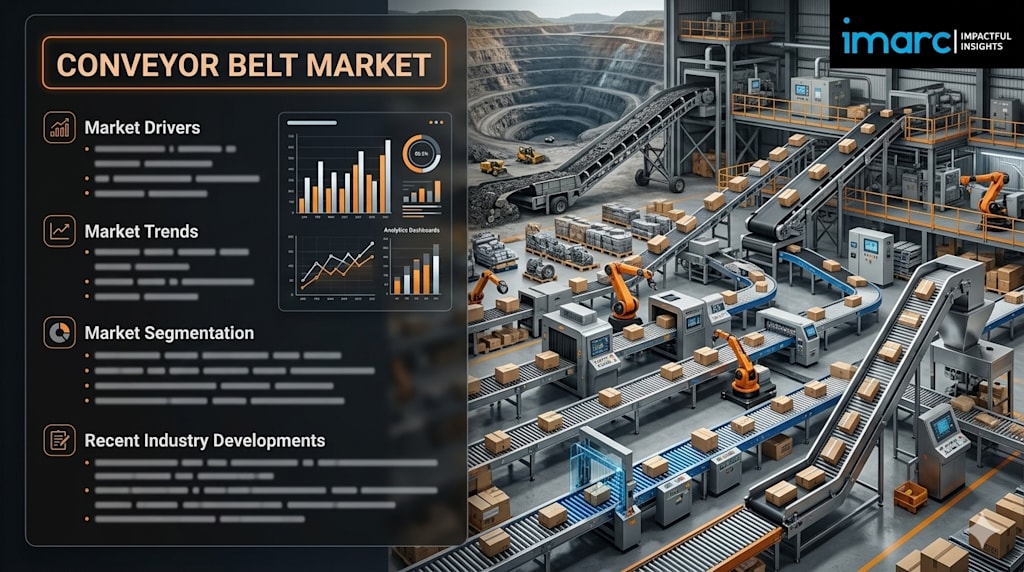
The global conveyor belt industry is rapidly gaining momentum as manufacturers, logistics operators, and infrastructure developers increasingly prioritize efficient, automated, and high-capacity material handling solutions. Rising operational costs, labor shortages, and the accelerating pace of industrial automation are transforming conveyor belt systems from basic equipment into strategically essential components of modern production and supply chain infrastructure. According to IMARC Group, the global conveyor belt market was valued at USD 7.1 Billion in 2025 and is projected to reach USD 8.9 Billion by 2034, expanding at a CAGR of 2.51% during 2026-2034. Asia-Pacific currently dominates the market, holding a significant market share of over 37.1% in 2025.
The growing emphasis on operational efficiency and cost reduction is reshaping procurement behavior across global industries. Businesses are becoming increasingly aware that manual material handling is slow, expensive, and incompatible with the throughput demands of modern industrial and logistics environments. As companies seek systems that support continuous production flows, reduce workplace injuries, and minimize downtime, demand for advanced conveyor belt technologies has become an increasingly critical part of contemporary industrial planning.
One of the major factors supporting market growth is the accelerating adoption of automation and Industry 4.0 technologies. The rapid expansion of e-commerce fulfillment centers, the modernization of mining operations, and the growth of pharmaceutical and semiconductor manufacturing have heightened industry interest in conveyor systems that deliver precision, durability, and smart monitoring capabilities. During periods of heightened industrial investment, conveyor belts have emerged as foundational infrastructure for operational scale-up, especially across mining, logistics, aviation, and food processing sectors seeking to reduce labor dependency and improve throughput consistency.
Request a Strategic Market Intelligence Report for Investment Planning
The Key Forces Behind the Industry's Rapid Growth
Infrastructure development remains one of the strongest growth drivers for the global conveyor belt market. Global infrastructure investments are projected to reach USD 94 Trillion by 2040, fueling demand for conveyor belts as industries prioritize efficient movement of construction materials including cement, aggregates, and steel across large-scale project sites. The rising pace of urbanization across emerging economies is accelerating the construction of transportation networks, residential complexes, and public utilities, all of which depend on conveyor systems to manage high-volume material flows.
Manufacturing sector expansion is also playing a significant role in market growth. India's manufacturing sector recorded annual growth of 11.6%, alongside a 9.5% rise in construction sector activity, directly accelerating conveyor belt adoption to support efficient operations across expanding production facilities. Conveyor systems play a key role in enabling just-in-time manufacturing, automating assembly line logistics, and maintaining consistent output quality in automotive, electronics, and food processing plants.
The growth of warehousing and logistics infrastructure is transforming the industry as well. The United States alone hosts 27,528 general warehousing and storage businesses, reflecting an 8.5% increase from the prior year. As fulfillment centers scale to meet surging e-commerce demand, conveyor belts have become indispensable for automating order picking, package sorting, and distribution, enabling faster delivery times and higher operational accuracy across increasingly complex supply chains.
Emerging Trends Transforming the Conveyor Belt Market
Smart Conveyor Systems and IoT Integration
Industrial operators are rapidly integrating IoT-enabled sensors, predictive maintenance platforms, and digital management systems into conveyor belt operations to reduce downtime and lower total cost of ownership. In January 2025, Wuxi Boton of China and iron ore producer Roy Hill finalized a Conveyor Belt and Services Partnership Agreement, introducing smart monitoring devices and digital management tools alongside a Total Cost of Ownership innovation model. This partnership reflects a broader industry shift toward data-driven conveyor operations management that prioritizes uptime, efficiency, and long-term asset performance.
Cleanroom-Grade and Specialized Industrial Belts
The expanding scope of pharmaceutical, semiconductor, and precision manufacturing is driving demand for conveyor systems certified for controlled environments. In May 2024, Montech launched a new belt conveyor line designed for cleanrooms certified for ISO air purity classes 4, 5, and 6, specifically tailored for pharmaceutical and semiconductor industries to ensure contamination prevention during sensitive production processes. This development highlights how the conveyor belt industry is diversifying well beyond traditional heavy industry into high-margin, high-specification industrial applications.
High-Capacity Mining and Energy Infrastructure Belts
The mining sector continues to drive substantial demand for heavy-duty, long-distance conveyor systems. Latin America contributes approximately 40% of global copper production, with Chile, Peru, and Mexico relying on durable high-capacity conveyor systems for uninterrupted ore transport from extraction sites to processing facilities. In April 2025, NTPC's Pakri Barwadih coal mining project launched a 21-kilometre conveyor belt system to carry coal directly to Hazaribag railway station, featuring high-capacity steel cord belts with widths between 1,800mm and 2,200mm, engineered for exceptional tensile strength and operational reliability in demanding conditions.
Opportunities and Future Outlook
The conveyor belt market is expected to witness strong growth opportunities driven by large-scale infrastructure investments, the deepening penetration of automation technologies, and the expansion of specialized applications across pharmaceuticals, aviation, and food processing. Saudi Arabia's construction sector, with over 5,200 active projects worth USD 819 Billion, is creating sustained demand for conveyor systems in cement, steel, and aggregate handling across both greenfield developments and infrastructure modernization programs.
The integration of smart technologies, including real-time monitoring, automated sorting, and predictive maintenance, is further enabling conveyor belt manufacturers to offer higher-value solutions that reduce operational costs and extend system lifespans. Overall, the market outlook remains highly positive, supported by continuous product innovation, growing industrial automation investment, and deepening adoption of conveyor systems across new end-use categories including cleanroom manufacturing, airport baggage handling, and renewable energy infrastructure.
Recent News and Developments in the Conveyor Belt Market
September 2025: Shanghai Puteken Transmission System Co., Ltd. unveiled its high-performance silicone conveyor belt, designed to address evolving global industrial demands with superior durability and versatile application capability across multiple industry sectors.
July 2025: Pune Airport introduced a new meet-and-greet and porter service for travelers, with conveyor belt operations integrated into a passenger assistance model designed to support elderly individuals, persons with disabilities, and those with heavy luggage from arrival conveyor areas to taxi stands.
April 2025: NTPC's Pakri Barwadih coal mining initiative launched a 21-kilometre conveyor belt system connecting the mine to Hazaribag railway station, using high-capacity steel cord belts with widths between 1,800mm and 2,200mm engineered for exceptional tensile strength and dependability.
January 2025: Wuxi Boton of China and iron ore producer Roy Hill finalized a new Conveyor Belt and Services Partnership Agreement in Wuxi, introducing smart monitoring devices, digital management systems, and a Total Cost of Ownership innovative partnership model.
About the Creator
Suhaira Yusuf
I specialize in Consumer Insights, focusing on transforming detailed market data into strategic business solutions that accelerate growth and improve customer engagement.
Enjoyed the story? Support the Creator.
Subscribe for free to receive all their stories in your feed.
Comments
There are no comments for this story
Be the first to respond and start the conversation.