
Augmented Reality Market Set to Explode Beyond $514 Billion by 2034 as Digital and Physical Worlds Converge
From smart glasses and AI-powered experiences to industrial training and immersive shopping, augmented reality is becoming the next major computing platform.

Not long ago, augmented reality (AR) felt like a futuristic concept reserved for science fiction movies and experimental tech demonstrations. Today, it is rapidly becoming one of the most transformative technologies shaping how people work, shop, learn, communicate, and interact with the world around them.
By seamlessly blending digital content with physical environments, augmented reality is redefining human-computer interaction. Whether it's trying on clothes virtually, receiving real-time maintenance instructions in a factory, exploring immersive educational experiences, or navigating a city through digital overlays, AR is moving from novelty to necessity.
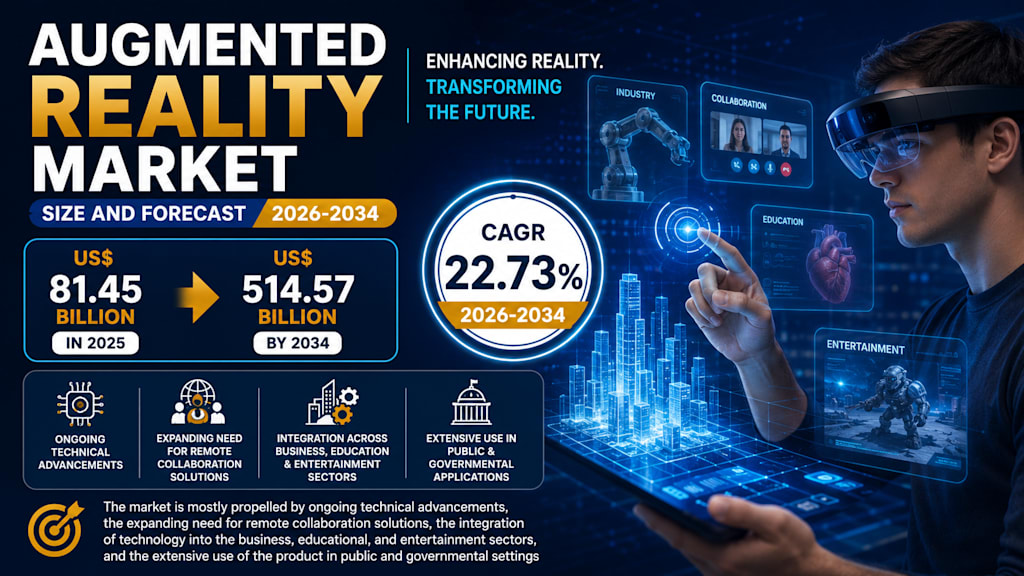
According to Renub Research, the global Augmented Reality Market is expected to grow from US$81.45 billion in 2025 to an astonishing US$514.57 billion by 2034, expanding at a remarkable compound annual growth rate (CAGR) of 22.73% between 2026 and 2034. This extraordinary growth reflects increasing adoption across industries, rapid technological advancements, expanding enterprise use cases, and growing consumer demand for immersive digital experiences.
As technology giants, startups, governments, and enterprises continue investing heavily in AR innovation, the technology is poised to become one of the defining digital platforms of the next decade.
What Makes Augmented Reality Different?
Unlike Virtual Reality (VR), which completely immerses users inside a digital environment, augmented reality enhances the real world by overlaying digital information onto physical surroundings.
Through smartphones, tablets, smart glasses, and head-mounted displays, AR enables users to view virtual objects, text, animations, and data while remaining connected to their real-world environment.
This unique capability allows AR to bridge the gap between digital information and physical experiences in ways traditional screens cannot.
The technology combines multiple advanced systems, including computer vision, artificial intelligence, cloud computing, sensors, and real-time graphics rendering. Together, these technologies create interactive experiences that respond dynamically to the user's surroundings.
As devices become more powerful and accessible, AR is increasingly moving beyond entertainment into practical, everyday applications.
Why Augmented Reality Is Growing So Fast
The rapid growth of the AR market is not happening by chance.
Several powerful trends are converging to accelerate adoption across both consumer and enterprise environments.
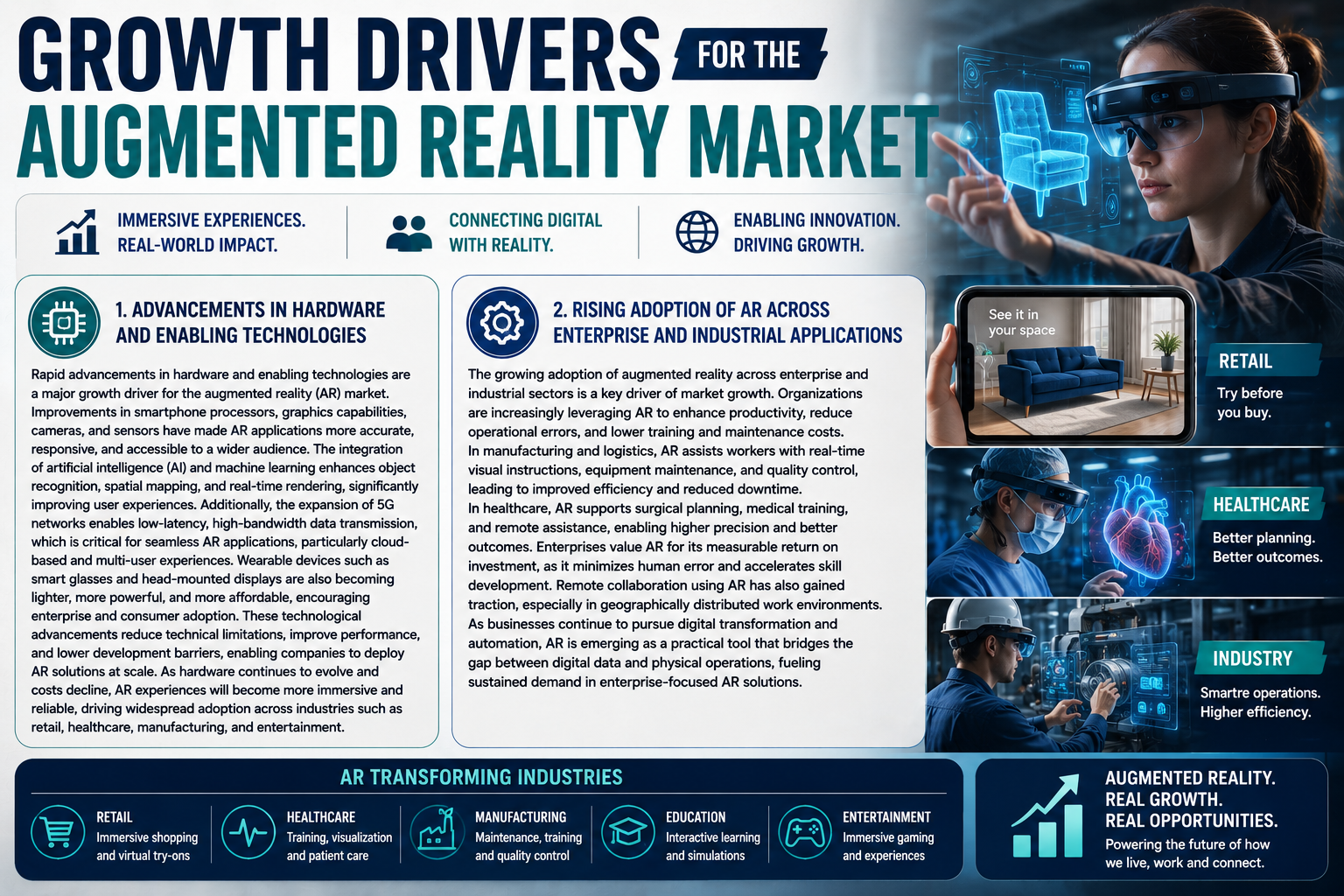
One major factor is the widespread availability of smartphones equipped with advanced cameras, sensors, and processors. Millions of consumers already possess AR-capable devices, significantly reducing barriers to adoption.
At the same time, breakthroughs in artificial intelligence, machine learning, computer vision, and cloud computing are making AR experiences more realistic, responsive, and useful than ever before.
The expansion of 5G networks is adding another layer of momentum by enabling ultra-fast data transmission and low-latency interactions. This connectivity is crucial for delivering seamless AR experiences, particularly those involving real-time collaboration and cloud-based processing.
Together, these technologies are creating an environment where augmented reality can scale rapidly across industries and consumer markets.
Enterprise Adoption Is Leading the Charge
While consumers often associate AR with gaming and social media filters, businesses are currently among the largest adopters of the technology.
Organizations are increasingly leveraging AR to improve efficiency, reduce costs, and enhance employee performance.
In manufacturing environments, workers use AR-enabled devices to receive real-time visual instructions during assembly and maintenance processes. These systems help reduce errors, improve productivity, and minimize downtime.
Logistics companies are adopting AR to optimize warehouse operations and inventory management. Healthcare providers use AR for surgical planning, medical training, and remote consultations. Engineers and technicians rely on AR for equipment maintenance and troubleshooting.
One of the biggest advantages of AR in enterprise settings is its measurable return on investment. Companies can improve training outcomes, reduce operational mistakes, and accelerate knowledge transfer among employees.
As businesses continue their digital transformation journeys, AR is emerging as a powerful tool for connecting digital intelligence with physical workflows.
Retail and E-Commerce Are Being Reinvented
The retail industry has become one of the most exciting examples of AR's practical impact.
Traditional online shopping often leaves customers uncertain about product appearance, fit, or compatibility. Augmented reality solves this problem by allowing consumers to visualize products before making purchases.
Virtual try-on experiences for clothing, eyewear, cosmetics, and accessories are becoming increasingly common. Furniture retailers enable shoppers to place digital versions of products inside their homes using smartphone cameras, helping them make more confident purchasing decisions.
These experiences not only improve customer satisfaction but also reduce return rates—a major challenge in e-commerce.
Brands are embracing AR as a way to create memorable, interactive shopping journeys that strengthen engagement and build customer loyalty.
As online commerce continues to evolve, AR is expected to become a standard feature rather than a competitive advantage.
Education Is Becoming More Interactive
Education represents another sector experiencing significant transformation through AR technology.
Traditional learning methods often struggle to maintain student engagement, particularly when dealing with complex or abstract concepts. AR addresses this challenge by creating immersive learning environments that make information more tangible and interactive.
Students can explore historical landmarks, visualize scientific phenomena, interact with three-dimensional models, and participate in simulations that enhance understanding and retention.
Educational institutions increasingly recognize AR's potential to improve learning outcomes while making lessons more engaging and memorable.
The technology also supports remote and hybrid learning environments, allowing students to access interactive educational experiences regardless of location.
As schools and universities continue embracing digital innovation, AR is likely to play an increasingly important role in the future of education.
Healthcare Is Discovering New Possibilities
Healthcare professionals are finding numerous applications for augmented reality across clinical and training environments.
AR enables surgeons to visualize critical anatomical information during procedures, improving precision and reducing risks. Medical students can practice complex procedures using immersive simulations before working with real patients.
Patient education also benefits from AR technology. Interactive visualizations help individuals better understand diagnoses, treatment plans, and medical conditions.
Remote collaboration is another emerging area where AR is creating value. Specialists can provide guidance and support to healthcare providers located elsewhere, improving access to expertise and enhancing patient outcomes.
As healthcare systems increasingly prioritize efficiency and accuracy, AR technologies are becoming valuable tools for improving both education and patient care.
Smart Glasses Could Change Everything
Although smartphone-based AR currently dominates the market, many experts believe the technology's biggest breakthrough will come through wearable devices.
Smart glasses and head-mounted displays represent the next frontier of augmented reality.
Unlike smartphones, wearable AR devices offer hands-free experiences that integrate seamlessly into daily activities. Users can access information, receive notifications, navigate environments, and interact with digital content without constantly looking down at a screen.
Advancements in hardware design are making these devices lighter, more comfortable, and more affordable than previous generations.
Technology companies around the world are investing heavily in wearable AR ecosystems, viewing them as potential successors to traditional smartphones.
If adoption accelerates as expected, smart glasses could fundamentally change how people interact with digital information.
Challenges Still Stand in the Way
Despite its enormous potential, augmented reality faces several obstacles that could slow adoption.
One major challenge is cost.
Developing sophisticated AR applications requires expertise in artificial intelligence, computer vision, 3D design, software engineering, and user experience development. These specialized skills contribute to high development expenses. Additionally, advanced AR hardware can remain costly for businesses and consumers alike.
Hardware limitations also continue to present challenges. Battery life, processing power, comfort, and device size can affect user experiences, particularly for wearable technologies.
Privacy and security concerns represent another significant issue. AR systems often rely on continuous data collection through cameras, sensors, microphones, and location tracking, raising questions about surveillance and personal data protection.
Addressing these concerns will be critical to building public trust and encouraging widespread adoption.
Regional Markets Are Accelerating Worldwide
The United States currently leads the global AR market thanks to strong technology infrastructure, significant investment, and early enterprise adoption. Industries ranging from healthcare and manufacturing to gaming and retail continue driving innovation.
The United Kingdom is experiencing strong growth as businesses increasingly integrate AR into retail, logistics, healthcare, and workforce training initiatives.
India represents one of the fastest-growing opportunities due to widespread smartphone penetration, increasing digital transformation efforts, and expanding interest in immersive technologies across education, healthcare, retail, and entertainment.
Meanwhile, the United Arab Emirates is leveraging AR to support smart city initiatives, tourism, retail innovation, and real estate experiences, further strengthening its reputation as a technology-forward economy.
These regional developments demonstrate the truly global nature of AR's expansion.
Industry Innovation Is Accelerating
Recent developments highlight the pace of innovation occurring across the AR ecosystem.
In September 2025, Meta introduced the Quest 3S, an entry-level headset designed to encourage broader adoption within educational environments. Google and Samsung also announced a collaborative Android XR operating system, while Microsoft enhanced Azure Mixed Reality with AI-powered spatial anchoring capabilities for industrial applications. SAP integrated Apple's visionOS technology into enterprise workflows, supporting advanced remote collaboration.
These initiatives demonstrate how major technology companies are competing to shape the future of immersive computing.
Final Thoughts
The augmented reality industry is entering a transformative phase that could redefine how people interact with technology over the coming decade.
With the market projected to exceed US$514 billion by 2034, AR is rapidly evolving from a specialized innovation into a mainstream digital platform. Advances in artificial intelligence, 5G connectivity, cloud computing, and wearable devices are making augmented reality more practical, accessible, and valuable than ever before.
From healthcare and education to retail, manufacturing, and entertainment, AR is helping organizations bridge the gap between digital information and real-world experiences.
While challenges related to cost, privacy, and hardware limitations remain, the momentum behind augmented reality is undeniable. As technology continues to mature and ecosystems expand, AR is poised to become one of the most influential innovations of the digital age.
The future won't simply be digital or physical—it will be a seamless blend of both, powered by augmented reality.
About the Creator
Enjoyed the story? Support the Creator.
Subscribe for free to receive all their stories in your feed.
Comments
There are no comments for this story
Be the first to respond and start the conversation.