
World's Most Dangerous Tunnel — Engineers Almost Gave Up
World's Most Dangerous Tunnel

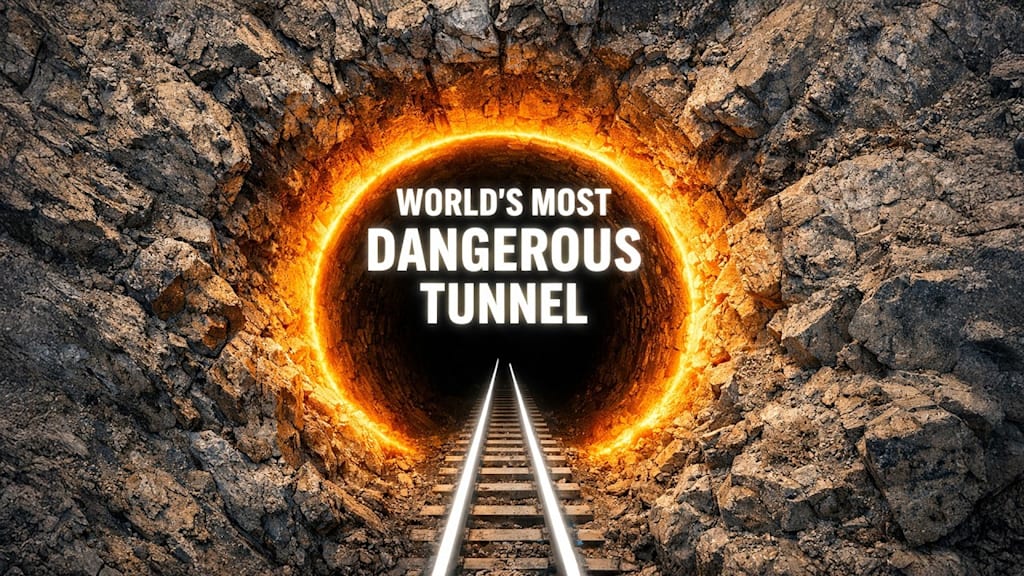
When the engineering team began digging the tunnel, at one point, water hidden inside the mountain burst into the tunnel with jet-like pressure, creating a flood-like situation.
In Switzerland, the Gotthard Base Tunnel is truly called the “Mount Everest of engineering.” With a length of 57 km, it is not only the longest tunnel in the world but also the deepest, built 2.5 km beneath the surface. Why did this tunnel become so essential for all of Europe? How did engineers deal with falling rocks, fast-flowing water, and the powerful air pressure that could shatter train windows?
Welcome once again my story.
If you look closely at the map of Europe, you’ll notice a massive wall of mountains in the center known as the Alps. For centuries, these mountains created obstacles for trade and travel. People had to travel through long zigzag routes, often blocked by snow or avalanches. Bridges and railway tracks were built, but trains struggled to climb steep slopes, making travel slow and difficult.
Over time, another major problem emerged. To boost Europe’s economy, more goods needed to be transported between countries. Northern Europe’s factories and southern Europe’s seaports depended on each other. Engineers had two options: either build wider and more difficult roads over the mountains or attempt something considered impossible for centuries—dig a tunnel straight through the mountain.
They decided to build the world’s longest and deepest tunnel through the heart of the mountain. But this mission was far more dangerous than it sounded. Deep underground, the immense weight of the mountain could crush steel like paper. Engineers knew they were not just fighting rocks and soil but powerful natural forces.
The biggest challenge was extreme pressure. The tunnel was to be dug under a mountain 2,500 meters high, meaning enormous weight would constantly press on the tunnel walls. Initial small tunnels even began closing due to this pressure.
Then came extreme heat. At such depths, temperatures can reach up to 50°C. In such conditions, humans can only work for 15–20 minutes. Without cooling systems, the tunnel could become a living grave for workers.
Another major threat was water pressure. This wasn’t ordinary groundwater—it was ancient, highly pressurized water that could break through concrete like a cannonball. Many engineers around the world initially declared that such a tunnel was impossible.
They argued that machines would fail in such extreme conditions, and workers wouldn’t survive. Also, the tunnel had to be dug from both sides over 57 km. Even a 1 mm misalignment could mean the tunnels would never meet.
However, for Switzerland, this was a matter of survival. Thousands of trucks crossed the Alps every year, increasing pollution and exceeding road capacity. Without this tunnel, Europe’s trade system could collapse.
So Switzerland decided to go ahead, no matter the cost.
On September 27, 1992, the project was officially approved. This was no ordinary tunnel—the scale was beyond imagination. Engineers used laser navigation and GPS technology to ensure precise alignment from both ends.
Massive tunnel boring machines (TBMs) were built, with cutter heads taller than a two-story house and lengths up to 450 meters. Despite their size, they could only dig a few meters per day. The project became a test of patience that lasted 17 years.
During excavation, about 30 million tons of rock were removed—enough to form an entire mountain. Thousands of workers labored underground with no sense of day or night, no phone signals, and no fresh air.
As digging progressed deeper, temperatures rose to 50°C, turning the tunnel into an oven. Workers could only operate in short shifts to avoid heatstroke. Cooling pipes were installed to circulate cold water, creating a livable environment before continuing construction.
Rock pressure caused frequent collapses. Engineers sprayed concrete, installed precast slabs, and used steel rings to reinforce weak areas.
Then came the water problem. Pressurized water trapped in rock cracks could reach pressures of 2900 PSI. To handle this, engineers froze the water by drilling pipes and circulating freezing liquid. Once frozen, the water became solid and could be drilled like rock. Afterward, concrete lining was installed, and drainage systems allowed water to flow safely.
Finally, on October 15, 2010, both sides of the tunnel met deep inside the mountain. After 17 years of work, the alignment error was only half an inch—an incredible achievement.
However, another challenge remained: air pressure. High-speed trains entering the tunnel could create shockwaves capable of shattering windows. To solve this, engineers built two parallel tunnels with connecting passages and ventilation shafts to manage airflow.
The idea for the Gotthard Base Tunnel was first proposed in 1940, but construction began in 1993 due to technical challenges. It took 17 years, 2,600 workers, and $12.5 billion to complete.
The mountain above the tunnel is as tall as three Burj Khalifas stacked together. Advanced technologies like GPS, gyroscopes, and laser navigation ensured perfect alignment. The tunnel was even designed considering the Earth’s curvature.
The excavated material was used to create artificial islands in Lake Lucerne. The TBMs consumed as much electricity as 20,000 homes.
Finally, tribute is paid to the nine workers who lost their lives during construction. A memorial stands at the tunnel entrance to remind the world of the true cost of this engineering marvel.
About the Creator
Imran Ali Shah
🌍 Vical Midea | Imran
🎥 Turning ideas into viral content
✨ Watch • Share • Enjoy
Enjoyed the story? Support the Creator.
Subscribe for free to receive all their stories in your feed.
Comments
There are no comments for this story
Be the first to respond and start the conversation.