
Why Ships Raise the Yellow Flag
Why the yellow flag at sea came to mean quarantine, then changed into a formal request for permission to enter port.

The yellow flag on a mast is one of those maritime signs that seems not to require any explanation. But once you look into its history, things become far less obvious. What many people take for a simple signal turns out to be something much more interesting.
Before radio, people spoke with flags
Imagine a port in the eighteenth century. There is no radio, no telephone, no mobile communication. A ship appears on the horizon, and the port authorities must quickly understand who it is, where it has come from, what cargo it carries, and — most importantly — whether it might infect the city. For that purpose, signal flags were invented. They could be seen from several kilometers away. Raise the right flag on the mast, and you could be “read” like an open book. There were many flags: white, red, blue, striped, with circles and crosses. Each combination carried its own message. But the color yellow very quickly acquired a special and troubling reputation.
Why yellow in particular?
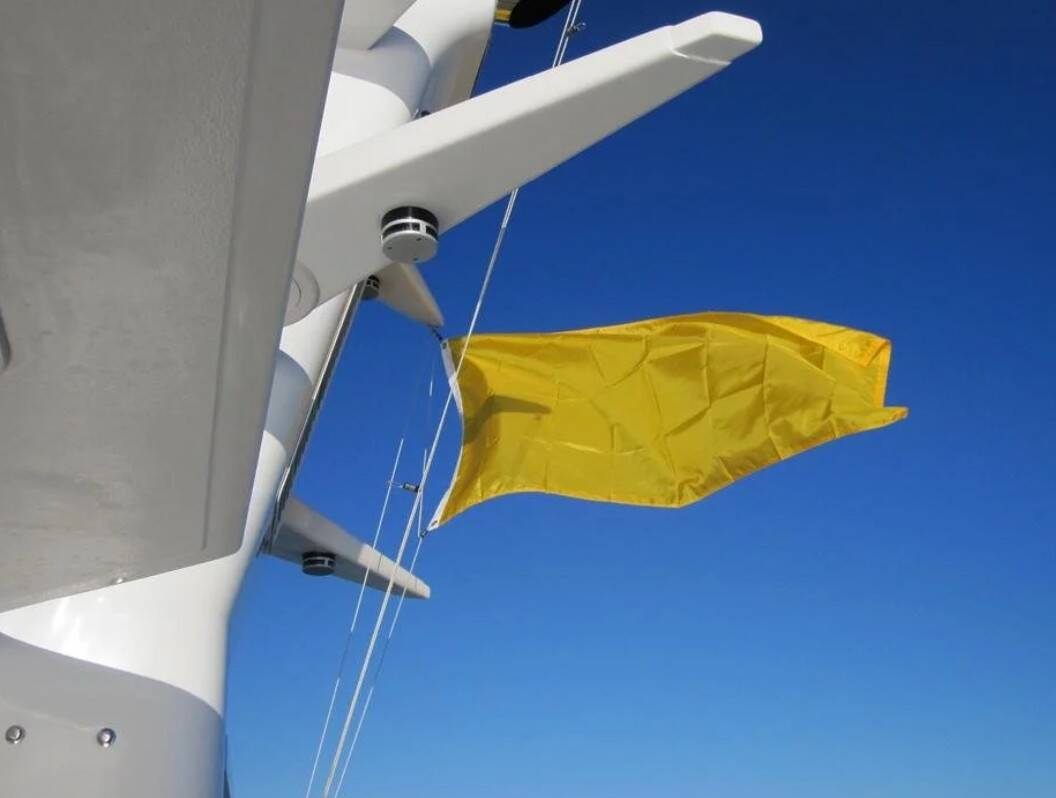
No one knows for certain why yellow was chosen. But two explanations are usually given. The first is the color itself. In Europe, yellow had long been associated with illness and misfortune. Houses where sick people lived could be marked with it, and quarantine notices were sometimes written on yellow paper. The second reason was maritime practice. A yellow flag is easy to see from a distance. It is hard to confuse with military or commercial flags, so it worked well as a signal for quarantine or disease on board. Over time, English even developed a special name for it — yellow jack, meaning “yellow flag.” To sailors, the phrase sounded fairly grim.
What it meant in the old days, from the seventeenth to the nineteenth century

In the age of sail, the yellow flag was a quarantine flag. It was raised in two cases. The first case: there really were sick people on board. Plague, cholera, yellow fever, typhus. The ship became “unclean.” The port had to keep it at a distance. The second case: the vessel had arrived from a port where an epidemic was raging. Even if the crew was healthy, the ship was automatically considered suspicious. The yellow flag meant: “We have not yet passed inspection. Do not approach until the authorities allow it.” For the port, this was a signal to act. The ship was sent to a quarantine anchorage, away from the piers, sometimes beyond a special boom, a floating barrier. Doctors boarded in protective clothing. The crew could be kept on the vessel for weeks.
A clear historical example comes from Venice.
In 1377, the Venetian Republic introduced the first quarantine rule in world history. Ships arriving from plague ports had to remain for 40 days, quaranta giorni — the origin of the word “quarantine” — on the island of Santa Maria di Nazareth. Later, when a system of flags appeared, yellow was used for such vessels.
Another example comes from nineteenth-century New York.
In the summer of 1856, a yellow fever epidemic broke out in New York. Steamships arriving from the American South had to raise the yellow flag and wait for inspection in the quarantine harbor on Staten Island. Those who tried to conceal disease paid enormous fines. One captain, a certain John Harrison, was even sent to prison in 1858 for lowering the yellow flag too early.
What the crew felt under the yellow flag
Raising the yellow flag was not a mere formality. It meant real isolation. As long as the flag remained up, no one from the ship could go ashore. Not the sailors, not the captain, not the passengers. No pilot would come aboard. No merchant would approach the vessel. Food and water might be left on a special raft, which was then pushed away with poles. For the crew, it was imprisonment within sight of the city. For a merchant, it was a disaster: cargo spoiled, contracts collapsed, and money drained away. But the port was right. A single sick sailor stepping ashore could kill hundreds of people in the city.
The turning point: the 1880s and 1890s, and the International Code of Signals
By the late nineteenth century, countries decided to bring order to the maritime signal system. Too often there was confusion: one flag meant one thing in England and something else in France. In 1855, the British Board of Trade issued the first “Universal Signal Code.” It was revised during the 1880s and finally adopted in 1897. That was when each flag received one clear meaning. The solid yellow flag in this code was assigned the letter Q, Quebec. Its official meaning was: “My vessel is healthy and I request free pratique.” That is exactly the opposite of the old meaning. The ship was saying: “There is no infection on board. Give us permission to enter.”
Why did the meaning change?
Later, the yellow flag came to be understood not as a warning of danger, but as an appeal to the port authorities. The vessel was informing them that it had arrived and was waiting for permission to enter the port. Until that permission was granted, the ship remained under quarantine control. In other words, the yellow flag ceased to mean “stay away” and became a signal that “we are waiting for inspection.”
So what does the yellow flag mean today?
Under international rules that have been in force since the mid-twentieth century, with the last major revision in 1969, a single yellow flag, Q, means precisely a request for free pratique. This is how it works in practice. When a merchant vessel or pleasure craft arrives in a foreign port, it must raise the yellow Q flag on the foremast. This signals to the port authorities: “I have arrived, there are no infectious diseases on board, and I am waiting for permission to enter.” Port doctors and customs officers check the documents and may board the vessel. After that, they grant free pratique — permission to communicate with the shore. Only then is the yellow flag lowered. Sometimes it is replaced with the H flag, Hotel, meaning “I have a pilot on board.”
What if there is a real illness on board today?
There is a signal for that as well. But it is not just the plain yellow flag. Under the International Code of Signals, the combination of the Q and L flags, Quebec and Lima, means: “I have a dangerous infectious disease on board. Contact the authorities immediately.” Sometimes two yellow flags are raised, but that is a local tradition, not a global rule. So today, a single yellow flag is not an admission of illness. It is a declaration of health and a request to be admitted.

Why do people still think the yellow flag means disease?
For centuries, the yellow flag was a symbol of quarantine. It entered literature, maritime legends, pirate novels, and film. For example, Stevenson’s Treasure Island mentions a yellow flag on a pirate ship, though there it meant death — a different story altogether. When the meaning changed in 1897, sailors and port officials, of course, knew the new rules. But in the broader public imagination, the old fear remained: yellow meant plague. A vivid historical example of that confusion came in 1892, in New York. Five years before the new code was introduced, the steamship Moravia arrived from Hamburg, where cholera was raging. There were sick people on board. The captain raised the yellow flag in its old sense, as a warning. The authorities sent the vessel into quarantine on Swinburne Island. Newspapers wrote about the “yellow flag of death.” The passengers were held in isolation for a month. Two died.
An important detail for yacht owners and travelers
If you approach a foreign country on your own yacht, you will be told to raise the yellow Q flag as you arrive. And you should not lower it until you receive permission from the authorities. That does not mean you are sick. It means you are following the rules and will not go ashore without authorization. Break those rules, and you may be fined. In some countries, such as Australia, you can even be deported.
About the Creator
Enjoyed the story? Support the Creator.
Subscribe for free to receive all their stories in your feed.
Comments
There are no comments for this story
Be the first to respond and start the conversation.