
Why History Tells Us Every Invention Should Come with a Warning.
A new adage called Hephaestus’ Law explains why we are the “lawful prey” of our own advancements.
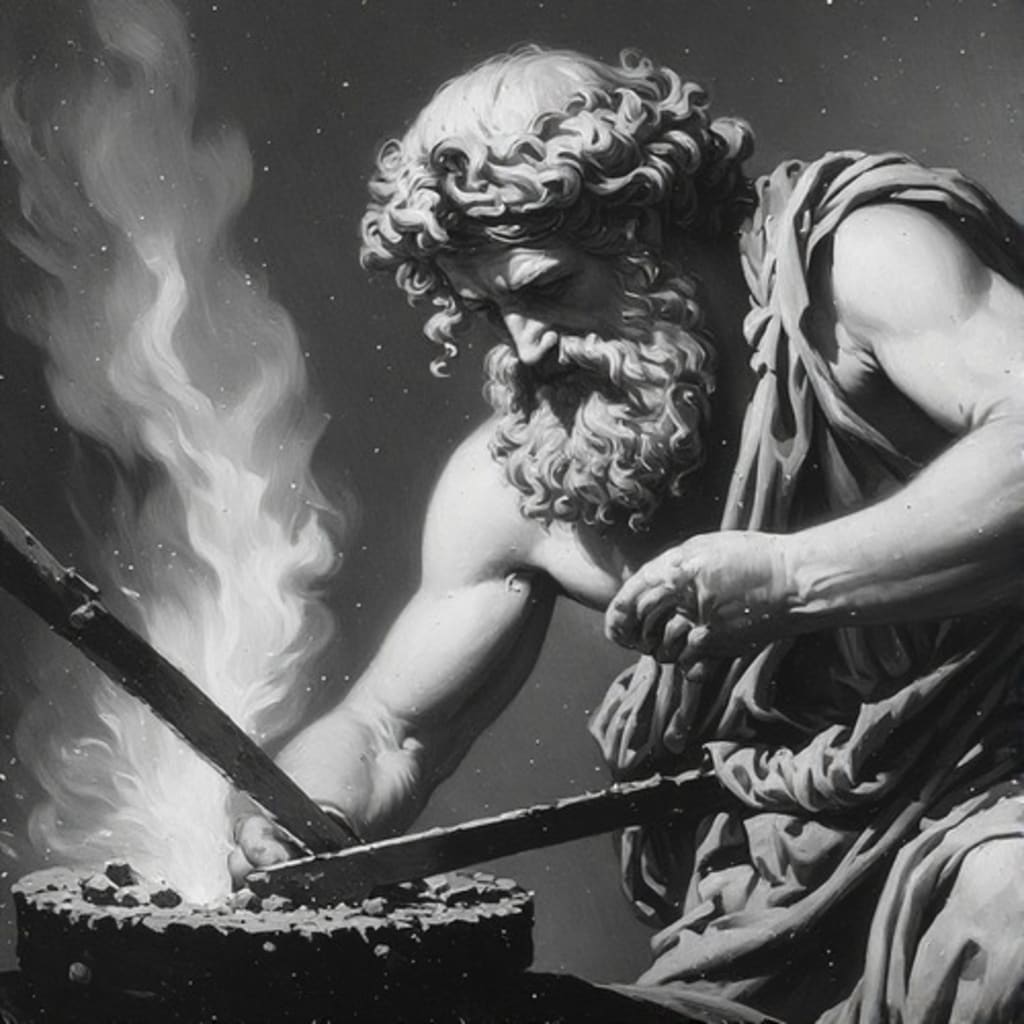
We like to believe technology moves us forward, but history shows it eventually succumbs to the flaw in our human nature.
If you have ever visited Aberdeen, in the North East of Scotland, you may have tried the local cuisine in the form of a ‘fish supper’ from The Ashvale, the city’s iconic and longest-running fish and chip restaurant on Great Western Road, or from one of its outlying takeaway shops.
On the wall inside hangs a plaque setting out their core business philosophy:
“It is always within the ingenuity of man to produce something a little bit smaller or a little bit poorer or a little of both and sell it a little cheaper. People who buy by price alone are the legitimate prey of such a policy.
At the Ashvale we ask you to judge by quality, quantity and price, then decide whether the product is value for money.”
This plaque always intrigued me and I would often contemplate these words.
Eventually I did some research and found that the text is a variation on a famous nineteenth-century saying, often known as Ruskin’s Common Law of Business Balance and commonly attributed to the art critic John Ruskin (1819–1900):
“There is hardly anything in the world that some man cannot make a little worse and sell a little cheaper, and the people who consider price only are this man’s lawful prey.”
Both versions describe the modern consumer world rather well. When a good-quality product succeeds, a cheaper and inferior imitation is rarely far behind.
But it was the phrase “lawful prey” that troubled me. If the buyers are considered prey, should the actors taking advantage of them not be considered predators? That led me to a more general observation: not every idea, discovery or invention is used for the purpose it was originally designed or intended. There is always the opportunist and predator who will find a way to use or adapt it for their own ends.
Fire
Our ancestors discovered fire as a source of warmth and light, and a means of cooking food. Before long, it was also being used as a weapon, to cause harm and destruction.
The Internet
The internet began as a way to link university and government research centres so their computers could share information and resources. It grew among people who largely trusted one another, with little thought for security or for verifying who was who.
That openness has since been exploited by phishers and identity thieves, by dark-web marketplaces and state-sponsored disinformation, and by attackers whose ransomware can lock down critical public infrastructure in minutes.
E-bikes
Electrically assisted bicycles were developed to help riders tackle hills and long distances without exhaustion. They have evolved into E-bikes, which have transformed urban transport. However illegally modified E-bikes now bypass legal speed limits or are used by criminals to snatch mobile phones and bags from their victims.
Looking for a law
I began looking for a law that described this aspect of human nature. Sod’s Law and Murphy’s Law capture how things go wrong by themselves, but neither says anything about people using or modifying good things for bad ends.
What I wanted was something closer to one of my favourite phrases, often attributed to the eighteenth-century Irish philosopher Edmund Burke (1729–1797):
“The only thing necessary for the triumph of evil is for good men to do nothing.”
It is actually a misattribution, as there is no evidence that Burke ever wrote or said these exact words. The closest and earliest similar sentiment belongs to the philosopher John Stuart Mill (1806–1873) who said in his 1867 inaugural address at the University of St Andrews :
“Bad men need nothing more to compass their ends, than that good men should look on and do nothing.”
I wanted a law with that same quality: short, quotable and uncomfortably true.
Naming the law
As well as being a member of Vocal, I also spend a lot of time on Discord under a username with a humorous nod to Greek mythology.
I am too unassuming to name a law after myself, so I went back to Greek mythology for inspiration and found it in Hephaestus, the god of craftsmen and inventors.
In Homer’s Iliad (BkXVIII:368–467) Hephaestus builds tripods that move by themselves to serve the gods, and golden handmaidens with minds of their own: in effect, some of the first robots in literature.
However, not all of Hephaestus’ creations remained harmless. In Apollonius of Rhodes’ Argonautica (Bk III: [210],[396]) Hephaestus forged a pair of fire-breathing bronze bulls as a thank-offering to the sun god Helios, who had rescued him during the war between the Olympians and the Giants.
Hephaestus gave the bulls to Helios’ son, King Aeetes of Colchis, and Aeetes turned them into a deadly test for outsiders: anyone who wanted the Golden Fleece first had to yoke the bulls, and their scorching breath made it a trial few could hope to survive.
The god of craftsmen and inventors — who repeatedly witnessed his own benign creations turned into tools of harm — served as the perfect namesake for this reality. Hephaestus’ Law seems the right name, given how relevant it is to the development of robotics and artificial intelligence today, though it applies equally well to any discovery, invention or innovation.
Hephaestus’ Law
Hephaestus’ Law is an adage, or epigram:
“Whatever one person discovers or invents for good, another will have the opportunity and motive to exploit for evil.”
and it comes with a Corollary:
“Any object can be used or adapted for a purpose contrary to the one for which it was designed, and sooner or later someone will think of it.”
What is the best example of Hephaestus’ Law that you can think of?
Conclusion
Hephaestus, the divine blacksmith, learned millennia ago what we are rediscovering today in the digital age: we cannot separate design from human nature.
Hephaestus’ Law dictates our reality and suggests that the morality of an invention is ultimately defined not by its creator, but by its consumer.
When good men discover or invent something for good, it is inevitable that sooner or later bad actors will have the opportunity or motive to use or adapt it for something else. If we wish to escape becoming the ‘lawful prey’ of our own advancements, we must look at our technology not just with wonder, but with vigilance.
Postscript
This article was originally published by the author on Medium. Given what happened to Burke, I’d like to avoid becoming the next misattributed author! If you share Hephaestus’ Law, please link back to my original article on Medium, or to this one. Thank you.
About the Creator
Enjoyed the story? Support the Creator.
Subscribe for free to receive all their stories in your feed.
Comments
There are no comments for this story
Be the first to respond and start the conversation.