
Why Europe Hunted Insects for Centuries
How tiny insects living on cacti produced one of Europe’s most expensive reds and became a major colonial commodity for Spain.
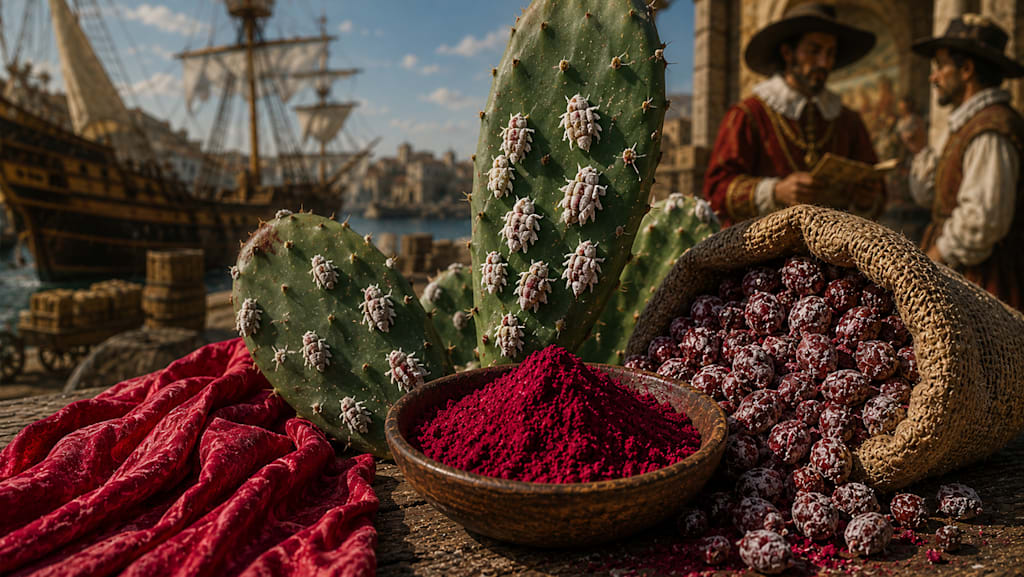
Bright red once cost enormous sums of money and was a symbol of power. But its main secret was hidden not in minerals and not in plants, but in tiny insects living on cacti. This is the story of how cochineal became one of Europe’s most expensive dyes, and why Spain turned it into a profitable colonial commodity.
What cochineal is and why it was so expensive


Cochineal is a dye made from the females of the insect Dactylopius coccus. They live on prickly pear cacti. From the outside, they do not look like red bugs, but like whitish waxy lumps on the green surface of the cactus.
The red color is hidden inside. The females contain carminic acid, a substance that protects them from predators and produces that rich pigment.
The process was slow and labor-intensive: the insects were raised by hand on cacti; they were gathered with a brush; dried in the sun; and ground into powder.
Tens of thousands of insects were needed for one pound of dried raw material. If the powder was treated with aluminum or calcium salts, it produced carmine — an even more stable pigment for textiles, painting, and cosmetics.
That was the source of its value: a tiny insect produced a red color for which people in Europe paid almost as if it were gold.


How red was made before the Spanish

Cochineal was not a Spanish invention. Long before the conquest of the Americas, it was already being cultivated in the regions of Oaxaca, Puebla, and Tlaxcala. For the Maya and the Aztecs, red was associated with blood, the sun, and power. It was used to color fabrics, feathers, manuscripts, and ritual objects. It was not simply a beautiful shade, but a color with clear symbolic weight.
The tradition was especially strong in Oaxaca. Local specialists knew: which cacti worked best; how to transfer the insects to new plants; when to harvest them; and how to dry them for the desired shade.
Cochineal was not only a dye, but also a commodity. In Aztec tribute records, sacks of dye appear among the items collected. That means cochineal was already part of a large economy before the Spanish arrived.
What Spain did with it
In 1521, Hernán Cortés captured Tenochtitlan. Spain gained control over silver, gold, and the lands of the former Aztec Empire. Among the valuable goods, cochineal quickly stood out. Europe had long been searching for a good red. It already knew dyes from madder and kermes, but American cochineal produced a brighter and stronger color. It was especially striking on wool and silk — exactly the fabrics that mattered for expensive clothing, church vestments, and military uniforms.
By 1523, the Spanish had begun treating this product seriously. Shipments from New Spain became part of imperial trade. The main center remained Oaxaca, where the local knowledge of cultivation already existed.
For Spain, this was almost an ideal colonial commodity: light in weight, because dried insects weighed little; expensive; able to survive an ocean crossing well; and in enormous demand in Europe.
A ship could carry relatively small sacks, and in Europe those sacks turned into money, color, and power.
Why red was worth such extraordinary sums
The price of cochineal did not depend on fashion alone. There were specific reasons for it.
First, it was labor-intensive. The insects had to be collected by hand. A mistake in cultivation or drying could ruin the entire batch.
Second, the color quality was exceptional. Cochineal produced a strong, rich shade that did not fade quickly. For expensive fabric, that mattered greatly.
Third, there was status. Red was worn by cardinals, officers, and nobles. It was not simply a matter of taste, but a display of rank.
Fourth, there was monopoly. As long as production remained concentrated in Spanish possessions, the price stayed high.
How people tried to steal the secret
Any expensive monopolized commodity is eventually targeted by others who want to take production out of the monopolist’s hands. The same happened with cochineal. Other countries wanted not sacks of finished dye, but the production process itself.
That was not easy. Cochineal could not simply be put in a box and transported away. The insects needed living cacti, the right climate, and careful handling.
In 1777, the French botanist Nicolas-Joseph Thiéry de Menonville secretly smuggled cochineal insects and prickly pears to Saint-Domingue, the French colony on Hispaniola. The plan was clear: create an independent source of production and weaken the Spanish monopoly. But the attempt failed. The insects did not establish themselves on the necessary scale. Production later did appear in Guatemala, the Canary Islands, and North Africa. But by then the market had already changed.
What killed cochineal and then brought it back
In 1856, the Englishman William Henry Perkin accidentally created mauveine, the first synthetic aniline dye. In 1868, synthetic alizarin appeared and replaced the red dye that had previously been made from madder.
Factories wanted dyes that were cheap and predictable. Hand cultivation of insects could not compete with chemical plants. Cochineal remained beautiful, but industry chose price.
This was especially painful for the Canary Islands, where cochineal had become a major crop and then sharply lost its importance.
But cochineal did not disappear. In Oaxaca there are still artisans who work in the old way: raising insects on nopal cactus, drying them, grinding them, and producing shades of red, pink, and burgundy.
In the twenty-first century, cochineal found a new role. Today it appears in the food industry, cosmetics, and pharmaceuticals. On labels it may be listed as: carmine; cochineal extract; E120.
It does have limitations. It is animal-derived, so it is not suitable for vegans. A small number of people may also have allergic reactions. That is why, in some countries, manufacturers are required to name it clearly on the label.
The story made a strange circle. Once, cochineal displaced older dyes because it was brighter. Then chemistry displaced it because chemistry was cheaper. And later, growing interest in natural products brought it back to the market.
About the Creator
Enjoyed the story? Support the Creator.
Subscribe for free to receive all their stories in your feed.
Comments
There are no comments for this story
Be the first to respond and start the conversation.