
Why Ancient Chinese Architecture Feels Oppressive
Dark red columns get blamed. Scale, shadow, and built-in power do more of the work.
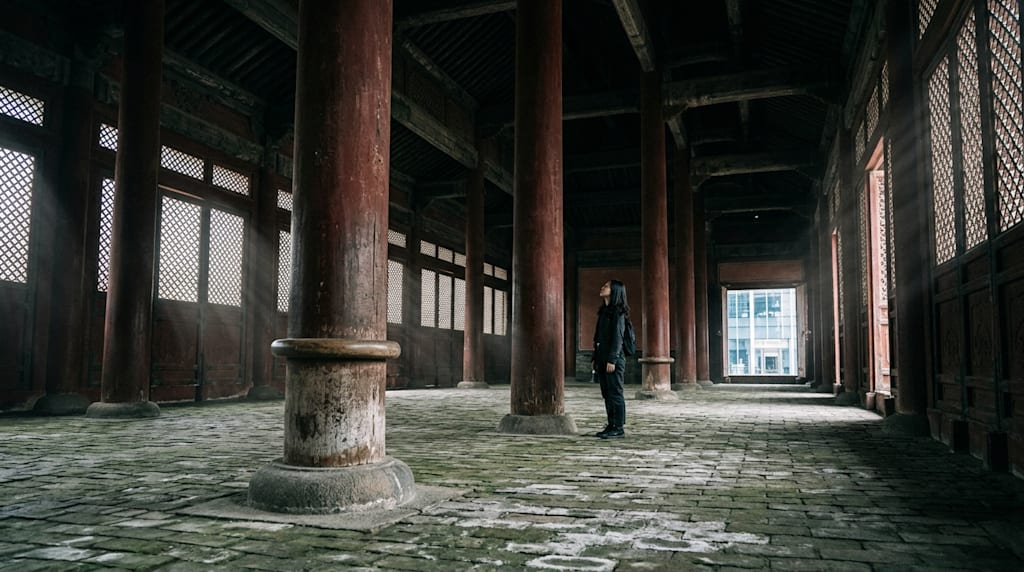
Walk into a preserved courtyard after rain and the body reacts before the guidebook does. The air smells of damp wood and wet stone. The red columns look less red than oxidized, a dark brown red like dried blood under varnish. Gold leaf has flaked from a bracket set and left gray wood. Brick paving is mottled with moss and a thin white bloom of salt. Your shoulders rise. Your voice drops. You have not read a plaque yet, and the space has already told you something about your size.
This reaction is easy to dismiss. One explanation says you are comparing old Chinese buildings with modern architecture or with Western monuments scrubbed bright by restoration. Another says you lack the taste for canggu and baojian, the aesthetic of age, patina, and wear. Both explanations contain something. Both become lazy when they turn a concrete experience into a verdict on the viewer.
Ancient Chinese architecture produces oppression through several sources. Material decay is one. Power scale is another. Light is a third. Maintenance, display, and the viewer’s visual training also matter. None of these sources cancels the others. The useful question is not whether your discomfort is legitimate. Ask what exactly is pressing on you.
Oxidation explains part of the darkness, not all of the effect
Most surviving Chinese ancient buildings are timber structures. Mineral pigments oxidize. Cinnabar red darkens. Gold leaf peels. Lacquer cracks. Brick and tile collect moss, lichen, and alkaline bloom. A visitor today often sees centuries of chemical change, not the original palette.
That fact matters. The architect of a Ming hall did not intend columns to look like dried liver. Bright vermilion and gold were part of the original visual program. Time added a second program: shadow, wear, stain, and loss.
Physical cause does not cancel psychological effect. A dark red column still reads as heavy. Bare gray wood still pulls the eye toward absence. Moss and salt bloom still make a wall look damp, cold, and older than the person standing before it. Knowing that oxidation is natural does not brighten the room. It explains why the room is dark.
There is also a tendency to treat canggu as the single philosophical base of Chinese architecture. It is one important strand, especially in literati taste: dry brushwork, old trees, cracked stone, the beauty of what has survived. It is not the whole tradition. The Forbidden City was not built as a meditation on decay. It was built as a statement of order, and its original colors served that statement. The patina we admire now is a later layer, produced by time and by changing taste.
Color is not the original sin. Color is part of the experience. Dark red, gray wood, green moss, and white alkali are not neutral facts. They press on the eye.
The scale was designed to press on the individual
The stronger source of oppression is scale.
Palaces, altars, tombs, and government compounds were not designed for individual comfort. They staged hierarchy. A high platform lifts the building above the visitor. A double eave makes the roof heavy. A long axial sequence of gates and courtyards turns movement into submission. Steep stairs force the body to lean forward. Massive columns make the human figure look temporary.
Stand under one of the great columns at the Taihe Hall and the effect is immediate. The column is too thick to circle with your arms. The roof above it disappears into shadow. The stone platform stretches in both directions. You step back without deciding to. Your shoulder tightens. The building wins the first exchange.
This is spatial language doing its work. Some ancient Chinese buildings really do bully the individual. They were built to make the emperor, the state, or the deity look distant and unquestionable. A visitor who feels small is not imagining the message. The message was carved into the proportions.
A guidebook may call this grandeur. A body may call it pressure. The same scale that produces awe in one visitor can produce claustrophobia in another, especially when the space is crowded, poorly lit, or lacks a clear route out. The building does not care which word you use. It keeps pressing.
The light is often absent on purpose
Light is the third source, and it is easy to underestimate.
Chinese timber architecture often uses deep eaves, lattice windows, and internal partitions. Light enters in strips and slivers. Inside a hall, beams may be visible only as silhouettes. The floor disappears into shadow. The ceiling becomes a dark grid. Your eyes adjust slowly, and the adjustment feels like a small loss of control.
This is a spatial strategy. The architecture values enclosure, depth, and concealment. It draws the eye inward and downward. It does not flood the interior with even light.
The usual comparison is with Gothic cathedrals. The comparison is useful but often simplified. A Gothic church does not produce modern gallery brightness. Colored glass turns sunlight into a dark, saturated, mysterious light. The nave may be tall and bright at the windows, while the lower spaces remain shadowed. The difference is not West bright and China dark. Different traditions use light to produce different psychological states. One lifts the eye upward through height and colored light. The other compresses the body through depth, lattice, and shadow.
You can dislike the compression. You can also recognize that it was designed. Darkness is part of the room’s grammar.
Plastic aesthetics is a useful observation until it becomes a taste test
Modern cities do train the eye. Glass curtain walls, polished tile, LED lighting, and smooth surfaces teach us to expect even brightness and low visual friction. A person who has spent the day in an office lobby with white floors and recessed lights may walk into a dark timber hall and feel the change as pressure. The eye has to work. The body has to adjust. The space refuses to be clean.
This observation has value. It explains why some visitors experience old buildings as gloomy rather than solemn. It explains why the same courtyard can feel majestic in a photograph and suffocating in person.
The observation turns sour when it becomes a hierarchy. “You’re spoiled by plastic aesthetics” is not an explanation. It tells someone that their discomfort disqualifies them from the conversation. A visitor may frown under a dark red column because the space is dark, the route is confusing, the crowd is dense, the labels are inadequate, the floor is uneven, or they have claustrophobia. None of these reasons requires a cultural deficiency.
Mature criticism can do two things at once. It can explain why a space produces oppression. It can also allow a visitor to dislike that oppression. Reading canggu as historical presence is a skill. It is not a moral requirement. Saying “this room makes me feel small and I do not enjoy it” is also a valid response.
A better account has more than one cause
The oppressive feeling of ancient Chinese architecture comes from several sources at once.
Material oxidation darkens the palette and roughens the surface. Power scale turns proportion into pressure. Light strategy compresses the interior and slows the body. Modern visual habits make the contrast sharper. Maintenance and display can soften or amplify the effect. The viewer’s history, mood, and physical state do the rest.
You can read the same hall as authority or as patina. You can stand under the eaves and think of imperial order, or you can think of the workers who repaired the roof. You can admire the cracked lacquer, or you can wish the space had better lighting and a clear exit. The building supports several readings. It does not require you to choose the flattering one.
At the Taihe Hall, after the first pressure has passed, look down at the base of a column. The stone is dark and uneven, but around the height of a hand there is a ring worn smooth. Thousands of palms have rested there. The ring is darker than the stone around it, polished by use. The column still presses on your shoulders. The ring says that other people were pressed too, and that they reached out anyway.
You leave with your shoulders still slightly raised.
About the Creator
Jin
Writer of reamstories
https://reamstories.com/jin
Enjoyed the story? Support the Creator.
Subscribe for free to receive all their stories in your feed. You could also become a paid subscriber, letting them know you appreciate their work.
Comments
There are no comments for this story
Be the first to respond and start the conversation.