
Why America Never Leaves Israel: The Historical Roots of an Unbreakable Alliance
From the Roman Empire and the Jewish Diaspora to Zionism, the Holocaust, and Modern Geopolitics—A Journey Through the Events That Shaped the U.S.–Israel Relationship

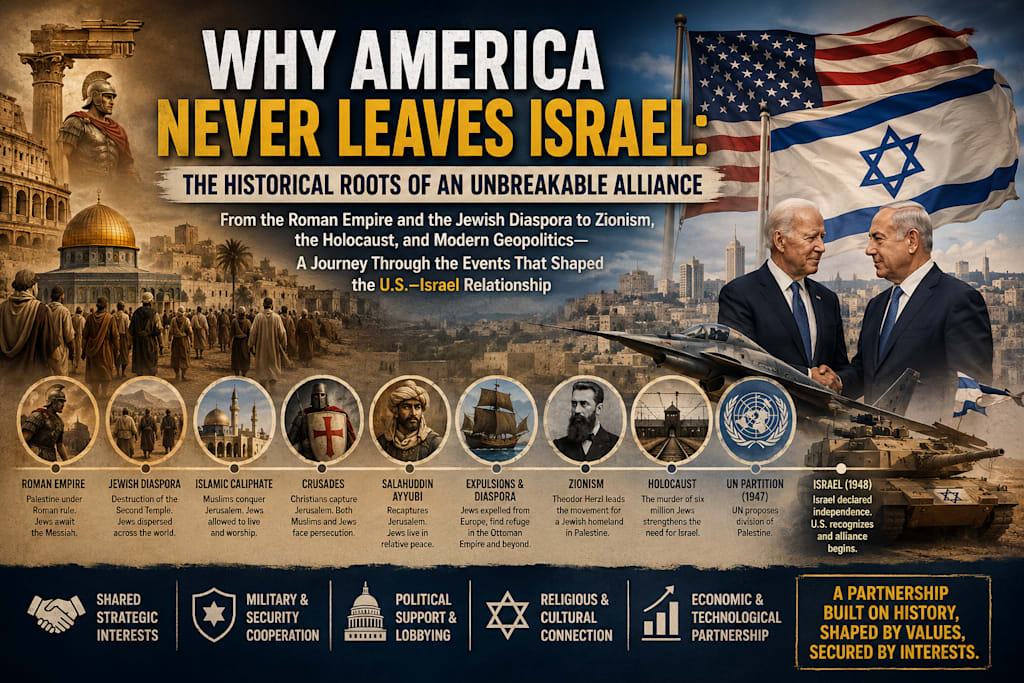
Why America Never Leaves Israel: A Brief History
Many people wonder why the United States consistently supports Israel despite international criticism. To understand this relationship, we need to look at centuries of history involving Jews, Christians, Muslims, and the land of Palestine.
Around 2,000 years ago, Palestine was under the control of the Roman Empire. The Jewish population lived under Roman rule and hoped for the arrival of a Messiah who would save them. According to the narrative, Jesus challenged certain religious authorities, creating tensions between his followers and some Jewish scholars. After major conflicts between the Jews and the Romans, Jerusalem's Second Temple was destroyed, and many Jews were dispersed throughout the world, beginning the Jewish diaspora.
Several centuries later, the Islamic Caliphate emerged and expanded rapidly. During the reign of Caliph Umar ibn al-Khattab, Muslims gained control of Jerusalem. Jewish communities were allowed to return and settle there. For many centuries, Jews lived under various Muslim governments across the Middle East, North Africa, and Spain.
In the 11th century, the Crusades began. European Christian armies captured Jerusalem and fought against Muslim rulers. During these conflicts, both Muslims and Jews suffered persecution. Nearly a century later, the Muslim leader Salahuddin Ayyubi (Saladin) recaptured Jerusalem and restored Muslim control. Jewish communities generally viewed his rule more favorably than that of the Crusaders.
Another important chapter took place in Muslim Spain, known as Al-Andalus. For centuries, Muslims, Jews, and Christians lived together with varying levels of cooperation. However, after Christian kingdoms reconquered Spain, both Muslims and Jews faced pressure to convert or leave. Many Jewish families migrated to the Ottoman Empire, where they were welcomed.
As Europe developed economically, Jewish communities increasingly became involved in trade, finance, and commerce. In many European countries, Jews faced restrictions on land ownership and political participation, pushing them toward business and banking. Over time, some Jewish families became influential in European finance. Among the most famous was the Rothschild family, which built an international banking network across Europe.
During the 19th century, a new political movement called Zionism emerged. Its supporters argued that Jews needed a homeland of their own, particularly because they had faced centuries of discrimination and persecution in different countries. The movement's most prominent early leader was Theodor Herzl, who advocated for the establishment of a Jewish state in Palestine.
At the same time, some Christian groups, especially in the United States, believed that the return of Jews to the Holy Land was connected to biblical prophecy. These religious beliefs helped create sympathy for the Zionist cause among many American Christians.
Palestine at that time was part of the Ottoman Empire. Zionist organizations encouraged Jewish immigration and purchased land in the region. Jewish settlements gradually increased, though the area was already populated by Arab communities.
World War I dramatically changed the situation. The Ottoman Empire collapsed, and Britain gained control of Palestine. In 1917, Britain issued the Balfour Declaration, expressing support for the establishment of a Jewish national home in Palestine. This decision became one of the most significant moments in the history of the conflict.
Jewish immigration increased further during the British Mandate period. At the same time, tensions grew between Jewish and Arab communities. The situation became even more complicated after the rise of Adolf Hitler in Germany. The Holocaust resulted in the murder of millions of Jews and convinced many people that a Jewish homeland was urgently needed.
After World War II, Britain referred the Palestine issue to the United Nations. In 1947, the UN proposed dividing Palestine into separate Jewish and Arab states while placing Jerusalem under international administration. Jewish leaders accepted the plan, while Arab leaders rejected it, arguing that it was unfair.
In 1948, Israel declared independence. The United States recognized the new state shortly afterward, followed by several other countries. Neighboring Arab states launched military action against Israel, beginning the first Arab-Israeli war. Israel survived the conflict and expanded beyond the territory originally allocated by the UN plan.
The war also led to a major Palestinian refugee crisis, with hundreds of thousands of Palestinians leaving or being displaced from their homes. This event remains one of the central issues in the Israeli-Palestinian conflict today.
Since then, the relationship between the United States and Israel has continued to grow. Several factors explain this alliance: shared strategic interests in the Middle East, political cooperation, economic partnerships, military collaboration, and support from influential American political and religious groups.
Today, the connection between America and Israel is shaped by decades of diplomacy, security cooperation, historical events, and domestic politics. Understanding this history helps explain why the relationship remains one of the strongest alliances in modern international affairs.
About the Creator
Mohib Ullah
I write about crime, justice, and political affairs, focusing on real cases and current events. My goal is to deliver clear, research-based content that informs readers about law, society, and government systems.
Enjoyed the story? Support the Creator.
Subscribe for free to receive all their stories in your feed.
Comments
There are no comments for this story
Be the first to respond and start the conversation.